

Views: 53
Confused about what a vakalatnama is? Learn its meaning, mandatory format, stamp duty rules, and the step-by-step process to execute one correctly in 2026
Table of Contents
- 1 Introduction
- 2 What Is a Vakalatnama?
- 3 The Legal Basis for a Vakalatnama
- 4 Vakalatnama vs. Power of Attorney: What’s the Difference?
- 5 When Is a Vakalatnama Required?
- 6 Essential Elements of a Valid Vakalatnama
- 7 Understanding Stamp Duty and the Advocate Welfare Stamp
- 8 Step-by-Step Process to Execute a Vakalatnama
- 9 Vakalatnama in the Era of e-Filing and Digital Courts
- 10 How Long Does a Vakalatnama Remain Valid?
- 11 Can a Vakalatnama Be Revoked?
- 12 Can Multiple Advocates Be Named in One Vakalatnama?
- 13 Common Mistakes That Get a Vakalatnama Rejected
- 14 What Happens If a Vakalatnama Is Improperly Executed?
- 15 How QuickDivorce.in Can Help
- 16 Frequently Asked Questions (FAQs)
- 17 Conclusion
- 18 Talk With Experts about Vakalatnama
Introduction
If you’ve ever walked into a courtroom in India, or even just consulted a lawyer to file a case, there’s a good chance you’ve signed a document without fully understanding what it actually does. That document is the vakalatnama — and it is, quite literally, the piece of paper that gives your lawyer the legal right to speak on your behalf in court.
Despite being one of the most routinely signed documents in Indian litigation, the vakalatnama remains poorly understood by most litigants. People sign it, hand it back to their advocate, and move on — without realising that this short document defines the exact scope of authority their lawyer has, and that getting it wrong can derail an otherwise solid case. This guide breaks down everything you need to know about the vakalatnama in 2026 — what it means, what it must contain, how stamp duty and welfare stamps work, and how to execute it correctly, whether you’re filing in a district court or the Supreme Court.
What Is a Vakalatnama?
A vakalatnama is a written legal document through which a client formally authorises an advocate to represent them in a court of law or before a quasi-judicial forum. The term itself comes from Persian — “vakalat” meaning authority or representation, and “nama” meaning document — and in various parts of India, it is also referred to as Vakalat, Vakalath, or Wakalat.
In practical terms, it functions as a power of attorney specifically limited to litigation: it doesn’t grant your lawyer broad financial or personal authority the way a general power of attorney might, but it does empower them to appear, plead, sign documents, and act on your behalf for the specific case mentioned in the document. Without a properly executed vakalatnama on file, an advocate has no legal standing to represent you — the court simply will not recognise their appearance.
The Legal Basis for a Vakalatnama
In civil proceedings, the vakalatnama is governed by Order III, Rule 4 of the Code of Civil Procedure, 1908, which specifies that a party to a suit may appear in person, through a recognised agent, or through an advocate formally appointed via a vakalatnama. The document must be in writing, signed by the client, and submitted to the court before the advocate can be recognised as the authorised representative.
For criminal matters, representation traditionally followed similar principles, though under the new Bharatiya Nagarik Suraksha Sanhita (BNSS), 2023, there’s a notable procedural nuance: during the arrest or bail phase, a lawyer can represent an accused based on a “Memo of Appearance,” but for the full trial, a formally executed vakalatnama — signed by the accused, and where the accused is in custody, often attested by the Jail Superintendent — remains mandatory.
Each High Court in India also tends to layer its own specific rules on top of this general framework. For instance, the Delhi High Court (Original Side) Rules, 2018 require that the advocate be eligible to practice before that specific High Court, and that the vakalatnama be duly signed by the client or an authorised representative.
Vakalatnama vs. Power of Attorney: What’s the Difference?
This is a common point of confusion. While both documents authorise someone to act on your behalf, they serve very different purposes:
- A vakalatnama authorises a lawyer specifically to represent you in court proceedings — filing pleadings, making submissions, and arguing your case.
- A power of attorney grants much broader authority, covering legal, financial, and personal matters that extend well beyond court representation — such as managing property, signing contracts, or operating bank accounts on someone’s behalf.
In short, every vakalatnama is a narrow, litigation-specific form of agency, while a power of attorney can be far more expansive in scope.
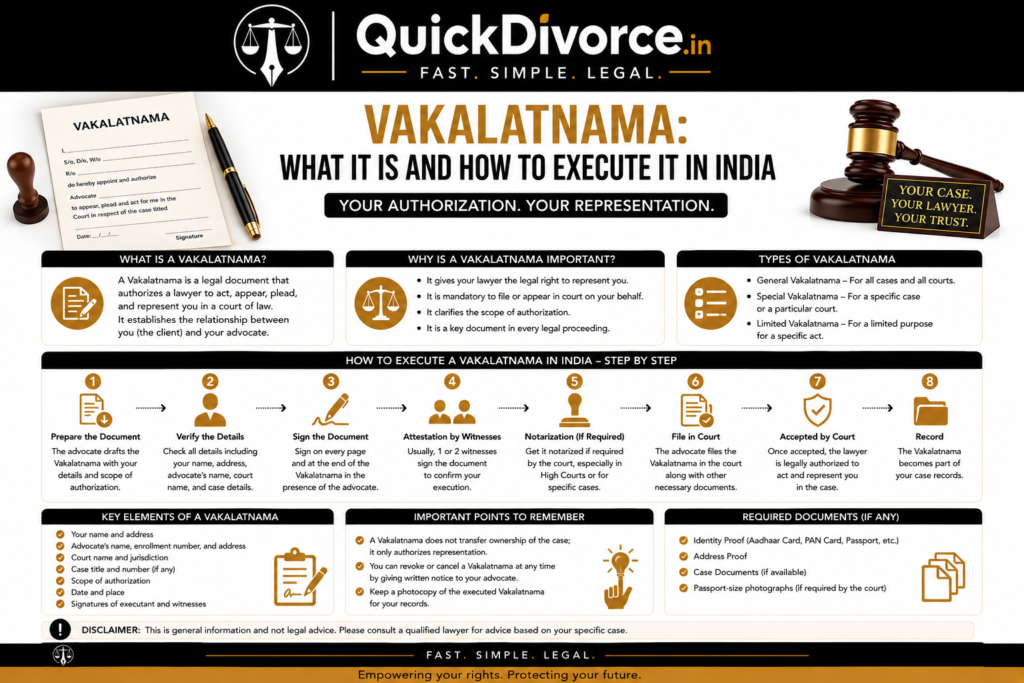
When Is a Vakalatnama Required?
A vakalatnama is required any time an advocate is engaged to formally represent a client before a judicial or quasi-judicial forum. This includes:
- Civil court appearances — suits, petitions, applications, and appeals before any civil court, from the trial court right up to the Supreme Court
- Criminal matters — when an advocate appears for an accused or a complainant before a Magistrate, Sessions Court, or High Court
- High Court proceedings — generally requiring execution on stamp paper of the value prescribed by the relevant state
- Consumer forum proceedings — required when an advocate represents a party before District Commissions, State Commissions, or the NCDRC
- Arbitration proceedings — required when a lawyer represents a party in domestic or international arbitration under the Arbitration and Conciliation Act, 1996
Essential Elements of a Valid Vakalatnama
While there is no single, legally mandated format for a vakalatnama across all Indian courts, certain elements are considered essential for it to be accepted without objection at the court registry:
- Court name and case details — the exact name of the court, case type, case number (or “to be allotted” if filed alongside a fresh petition), and year
- Names of the parties — full names, with parentage (S/o, D/o, W/o) and complete address, for both the petitioner/plaintiff and the respondent/defendant
- Advocate’s details — full name, enrollment number, chamber address, and contact information
- Scope of authority granted — a clause specifying what powers the advocate is being given, which commonly includes filing pleadings and appeals, compromising or withdrawing the matter, engaging senior or junior counsel, and receiving or depositing money through the court registry
- Client’s signature or thumb impression — without this, the document is invalid; for minors, a parent or guardian signs on their behalf, and for companies, an authorised signatory (such as a Director) signs with their designation noted
- Advocate’s acceptance signature — typically marked “Accepted,” along with the enrollment number
- Date of execution
- Required stamps — both court fee stamps and the Advocate Welfare Fund stamp, discussed in detail below
Understanding Stamp Duty and the Advocate Welfare Stamp
This is one of the most overlooked, yet most consequential, aspects of executing a vakalatnama correctly.
Court Fee Stamps
A vakalatnama typically requires a small, fixed court-fee stamp, generally ranging from ₹1 to ₹20, depending on the specific state’s stamp rules. This is separate from the broader, ad valorem court fees applicable to the main petition or plaint itself.
Stamp Duty (For High Courts and Certain Trial Courts)
For matters before High Courts, and some trial courts, the vakalatnama must be executed on non-judicial stamp paper of a value prescribed by the relevant State Stamp Act, governed overall by the Indian Stamp Act, 1899 as amended by individual states. There is no single, uniform national rate — states like Maharashtra, Karnataka, and Tamil Nadu each maintain their own Schedule of Stamp Duty specifying exact amounts for vakalatnamas before different levels of court.
Advocate Welfare Fund Stamp
In addition to court fee stamps, most states mandate an Advocate Welfare Fund Stamp, the proceeds of which go toward welfare schemes for the legal community. The value of this stamp varies by state — commonly ₹2, ₹5, or ₹10 — with the Delhi High Court, for instance, requiring a ₹10 stamp. Crucially, this stamp must be cancelled by crossing it with a pen once affixed, so that it cannot be reused; failing to do so, or omitting the stamp altogether, is the single most common reason a vakalatnama gets marked “Defective” by the court registry, potentially preventing the advocate from being heard on that date.
In practice, you generally don’t need to source these stamps yourself — your advocate procures the correct stamp paper and welfare stamps as a routine part of taking on your representation.
Step-by-Step Process to Execute a Vakalatnama
- Engage your advocate. Once you’ve finalised which advocate will represent you, they will prepare the vakalatnama specific to your case and court.
- Verify the details before signing. Check that the court name, case number (if already allotted), party names, and your own name and address are accurate and match your identity documents and case records.
- Review the scope of authority. Read the powers being granted carefully — particularly clauses relating to compromising, settling, or withdrawing the case — and discuss with your advocate whether any clauses need to be limited or struck out based on your specific instructions.
- Sign in the appropriate place. The client signs or affixes a thumb impression at the designated spot, typically the bottom left of the document. If you’re signing on behalf of a minor or a company, the relevant capacity (e.g., “Guardian of minor X” or “Managing Director”) should be noted above the signature.
- Advocate’s acceptance. The advocate signs at the bottom right, under “Accepted,” along with their Bar Council enrollment number.
- Stamps affixed and cancelled. The required court fee stamp and Advocate Welfare Fund stamp are affixed in the designated space and properly cancelled.
- Filing with the court. The completed vakalatnama is attached to the plaint, written statement, petition, or relevant application and submitted at the court’s filing counter, where the court clerk verifies and stamps it, formally recognising the advocate as your authorised representative for the case.
Vakalatnama in the Era of e-Filing and Digital Courts
As India’s e-Courts ecosystem has matured, the process around vakalatnamas has evolved considerably by 2026:
- Scanned and digitally signed filings: Across many High Courts, the physical vakalatnama is signed, scanned at high resolution, and converted into a searchable PDF, with the advocate affixing their Class-3 Digital Signature Certificate to the filing.
- Aadhaar e-Sign pilots: Some courts are piloting Aadhaar-based e-Sign functionality, allowing clients to digitally sign their vakalatnama remotely from a mobile device, without needing to visit the advocate’s chamber in person.
- e-Stamps replacing physical stamp paper: Several states, including Delhi and Maharashtra, have transitioned to e-Stamps for vakalatnamas, streamlining the procurement process that advocates previously had to handle manually through licensed stamp vendors.
That said, in many courts — particularly at the district level — physical signatures and physical stamping remain the norm, so it’s worth confirming with your advocate which process applies to your specific court.
How Long Does a Vakalatnama Remain Valid?
Once filed, a vakalatnama remains valid for the entire duration of the case — covering all hearings, applications, and proceedings within that matter — unless it is specifically revoked by the client or replaced with a fresh one. You do not need to execute a new vakalatnama for every hearing in the same case.
Can a Vakalatnama Be Revoked?
Yes. A client can revoke a vakalatnama at any time by filing a written notice of revocation with the court and formally notifying the advocate. Once filed, the court records the revocation, and the advocate’s authority to act in that matter ends. If you wish to engage a new advocate, a fresh vakalatnama must then be executed for the incoming counsel.
It’s worth noting a procedural safeguard here: under Bar Council of India rules, a new advocate generally cannot file a vakalatnama in a case where another advocate is already “on record,” unless a No Objection Certificate (NOC) is obtained from the outgoing advocate. If the previous advocate refuses an NOC over unpaid fees, courts typically still allow the client to switch counsel, but may direct the client to deposit the undisputed fee amount with the court, or require a formal application to discharge the previous advocate.
A vakalatnama also automatically terminates upon the advocate’s death, requiring the client to execute a fresh one for new counsel to continue the matter.
Can Multiple Advocates Be Named in One Vakalatnama?
Yes. It is standard and accepted practice to name multiple advocates — for instance, a senior counsel alongside one or two junior counsel from the same chamber or firm — on a single vakalatnama. This ensures that at least one authorised advocate is available to represent the client whenever the case is called, even if the primary counsel is unavailable on a particular date.
Common Mistakes That Get a Vakalatnama Rejected
- Missing or uncancelled welfare stamp — by far the most frequent reason for a “Defective” marking by the court registry.
- Incorrect or incomplete case details — wrong case number, misspelled party names, or a mismatch with existing case records.
- Unsigned by the advocate — a vakalatnama signed only by the client, without the advocate’s acceptance signature, is incomplete and invalid.
- Missing enrollment number — courts require the advocate’s Bar Council enrollment number to be clearly stated; omitting it is a common cause for objection.
- Mismatched client signature — a signature that doesn’t match the client’s identity documents can raise authenticity concerns and delay acceptance.
- Filing without an NOC where another advocate is already on record — attempting to step into a case without proper handover documentation can itself amount to professional misconduct under Bar Council rules.
What Happens If a Vakalatnama Is Improperly Executed?
If a vakalatnama is not properly executed — missing signatures, incorrect details, or absent stamps — the court may refuse to recognise the advocate’s authority to act for the client. This can, in serious cases, lead to dismissal of an application or proceeding for want of proper representation, making it essential to verify every detail before submission rather than treating the document as a mere formality.
How QuickDivorce.in Can Help
Whether you’re initiating a divorce petition, a maintenance application, or any other family law proceeding, a properly executed vakalatnama is the very first step that gets your case moving in court. At QuickDivorce.in, our family law team handles the drafting, stamping, and filing of your vakalatnama as a standard part of taking on your case — ensuring there are no procedural defects that could delay your matter before it even begins.
Frequently Asked Questions (FAQs)
1. What is a Vakalatnama?
A Vakalatnama is a legal document through which a client authorizes an advocate to represent them before a court, tribunal, or other legal authority. It gives the lawyer the authority to act on the client’s behalf during legal proceedings.
2. Why is a Vakalatnama required in India?
A Vakalatnama is required so that the court recognizes the advocate as the authorized representative of the client. Without a properly executed Vakalatnama, an advocate generally cannot appear or act for a party in a case.
3. How do I execute a Vakalatnama?
To execute a Vakalatnama, the client must carefully read the document, fill in the necessary details, sign it, and provide any required identification or court fee stamps, if applicable. The advocate also signs the Vakalatnama before filing it with the concerned court.
4. Can I revoke a Vakalatnama after appointing an advocate?
Yes. A Vakalatnama can generally be revoked if you wish to change your advocate. The process usually involves informing the existing advocate, complying with court procedures, and filing a fresh Vakalatnama in favor of the new advocate.
5. What information is included in a Vakalatnama?
A Vakalatnama typically contains the names of the client and advocate, case details, the court where the matter is pending, the powers granted to the advocate, and the signatures of both the client and the advocate.
6. Is a Vakalatnama valid for every legal matter?
No. A Vakalatnama is generally executed for a specific legal matter or case. If you have multiple cases in different courts or tribunals, a separate Vakalatnama may be required for each matter, depending on the applicable legal procedure.
Conclusion
The vakalatnama may look like a routine formality, but it is in fact the foundational document that gives your advocate the legal right to act, argue, and file on your behalf — and getting even small details wrong, from an uncancelled welfare stamp to a mismatched signature, can create avoidable delays in your case. Understanding what it contains, what powers you’re granting, and how to execute it correctly puts you in a far stronger position right from the moment you walk into court.
If you’re starting a legal matter and want to ensure your representation begins on solid procedural footing, don’t leave the vakalatnama as an afterthought — get it right the first time.
For assistance with drafting, stamping, and filing your vakalatnama correctly for any family law matter, reach out to the team at QuickDivorce.in.
Talk With Experts about Vakalatnama
🟡QuickDivorce offers trusted online legal services across India, including mutual divorce, contested divorce, child custody, alimony, marriage registration, and expert family law consultation.
👉 Mutual Consent Divorce
👉 Contested Divorce Filing
👉 Child Custody and Maintenance
👉 Matrimonial Property Settlement
👉 NRI Divorce Services
👉 Alimony and Maintenance
🟡 Protect Your Rights
👉 Domestic Violence Legal Support
👉 Stridhan Recovery
🟡For other Legal and Trademark related services visit
👉 Money Recovery Cases
👉 Property Disputes
👉 Business & Licence Registrations
📞 Call Now: +91 8595439395
🕐 Free Consultation: Monday to Saturday, 10 AM to 6 PM

Adv. Manish Kashyap is a Family Law & Divorce Lawyer with extensive experience in Mutual & Contested Divorce, NRI Divorce, Child Custody, Alimony, Domestic Violence, Judicial Separation, and Family Court matters, providing professional legal guidance to clients.

