

Views: 11
Table of Contents
- 1 Introduction
- 2 What Is Court Marriage in India?
- 3 Step 1: Confirm Your Eligibility
- 4 Step 2: Identify the Correct Marriage Officer
- 5 Step 3: File the Notice of Intended Marriage
- 6 Step 4: Publication of the Notice (The 30-Day Waiting Period)
- 7 Step 5: Objection Period and Resolution
- 8 Step 6: Solemnisation of the Marriage
- 9 Step 7: Receiving Your Marriage Certificate
- 10 Step 8: Post-Marriage Formalities
- 11 Total Timeline and Cost Overview
- 12 What Happens If Your Application Is Delayed or Refused?
- 13 Special Considerations for NRIs and Foreign Nationals
- 14 Common Mistakes That Delay Court Marriage in India
- 15 How QuickDivorce.in Can Help
- 16 Frequently Asked Questions (FAQs)
- 17 FAQs – Step-by-Step Process for Court Marriage in India
- 18 Conclusion
- 19 Know more about the Process for Court Marriage
Introduction
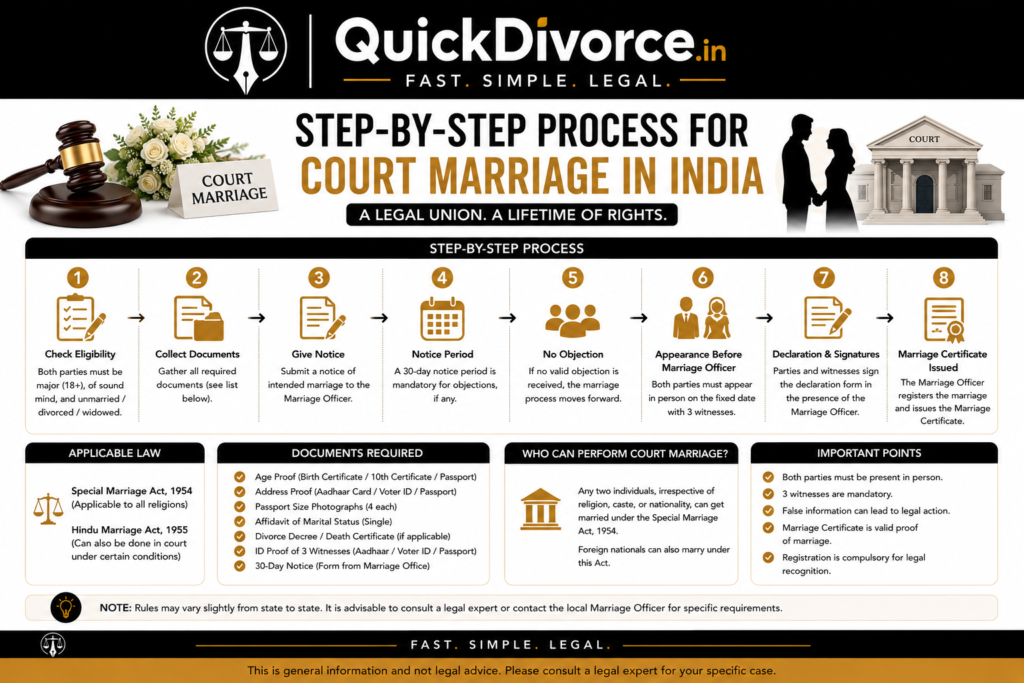
For couples who want to marry without religious rituals, across different faiths, or simply through a straightforward civil process, court marriage in India offers a clean, legally secure path under the Special Marriage Act, 1954. But unlike a religious wedding that concludes in a single ceremony, court marriage in India unfolds across several distinct legal stages — each with its own requirements, timelines, and potential pitfalls.
This guide walks you through the entire process step by step, from confirming your eligibility to receiving your final marriage certificate, including a few important 2026 developments that every couple planning a court marriage in India should be aware of before they begin.
This Step-by-Step Process for Court Marriage in India guide explains everything you need to know, from checking eligibility and preparing the required documents to submitting the marriage notice, completing the mandatory notice period, solemnizing the marriage before the Marriage Officer, and obtaining the official marriage certificate. By following each step carefully, couples can complete the court marriage process smoothly, legally, and without unnecessary delays.
What Is Court Marriage in India?
Court marriage in India refers to a civil marriage solemnised under the Special Marriage Act, 1954 — a secular law that allows any two adults to marry regardless of their religion, caste, or community, without requiring either party to convert. It applies across all of India, including Jammu and Kashmir following the 2019 reorganisation, and also extends to Indian citizens living abroad. Because it is a purely legal process, court marriage in India requires no priest, no religious ceremony, and no parental consent once both parties are adults.
Step 1: Confirm Your Eligibility
Before initiating court marriage in India, both parties must meet the basic conditions under Section 4 of the Act:
- The groom must be at least 21 years old, and the bride at least 18, as on the date of marriage
- Neither party should have a living spouse from an existing, undissolved marriage
- Both parties must be capable of giving valid consent and be of sound mind
- Neither party should fall within a “prohibited degree of relationship,” unless their personal customs specifically permit it
Confirming this upfront avoids wasted time and documentation effort if either party turns out to be ineligible.
Step 2: Identify the Correct Marriage Officer
Court marriage in India must be initiated at the office of the Marriage Officer in the district where either party has resided for at least 30 days immediately before filing the notice. This does not have to be the district where the couple intends to eventually live — only where one of them has genuinely resided for the required period, supported by valid address proof.
Choosing the wrong jurisdiction is one of the most common avoidable errors at this stage, since weak or mismatched residence proof can itself invite objections later in the process.
Step 3: File the Notice of Intended Marriage
This is the formal starting point of court marriage in India. Both parties jointly submit a Notice of Intended Marriage under Section 5 of the Act to the Marriage Officer, along with:
- Identity, age, and residence proof for both parties
- Passport-size photographs
- Notarised affidavits confirming marital status, age, and that the marriage doesn’t violate Section 4 conditions
- The prescribed notice fee, generally between ₹100 and ₹150, depending on the state
Once filed, the Marriage Officer reviews the documents and formally records the notice.
Step 4: Publication of the Notice (The 30-Day Waiting Period)
Under Section 6 of the Act, the Marriage Officer is required to publish the notice by displaying it in a conspicuous place at the office, where it remains visible for 30 days. If the two parties reside in different districts, a copy is also sent to the Marriage Officer of the other district for similar publication there.
This 30-day window exists so that any person can raise a formal objection if they believe the marriage violates the legal conditions under Section 4. It’s worth noting that this requirement has faced significant criticism in recent years — including observations from the Supreme Court in Supriyo v. Union of India (2023), which acknowledged that the notice regime can expose couples, particularly those marrying across faiths, to social pressure and family interference well before the marriage is finalised.
Despite this criticism, the 30-day notice period remains a strict statutory requirement. In fact, as recently as June 2026, the Delhi High Court declined to relax this period even in a case involving genuine personal hardship — a groom needing to join an overseas job before the notice period concluded — holding that courts cannot direct authorities to act contrary to a clear legislative mandate, regardless of how compelling the inconvenience. Couples planning court marriage in India should therefore build this 30-day window firmly into their planning and avoid assuming any shortcut is available, no matter how urgent their circumstances.
Step 5: Objection Period and Resolution
During the 30-day publication window, any person may file a written objection under Section 7, but only on the specific legal grounds outlined in Section 4 — such as an existing marriage, underage parties, unsound mind, or a prohibited relationship. Objections based on caste, religion, or family disapproval carry no legal weight and must be dismissed by the Marriage Officer.
If a valid-seeming objection is raised, the Marriage Officer conducts a formal inquiry, generally adding another 30 to 60 days to the process. If the objection is upheld, the couple can appeal the decision to the District Court; if it is dismissed, the marriage proceeds on schedule.
Step 6: Solemnisation of the Marriage
Once the 30-day notice period concludes without a valid objection (or after a rejected objection has run its course), the couple proceeds to the solemnisation stage of court marriage in India. This requires:
- Both parties to appear in person before the Marriage Officer
- Three witnesses, each carrying valid photo identification, who do not need to be related to the couple
- A formal declaration, as prescribed under the Third Schedule of the Act, signed by both parties and all three witnesses in the Marriage Officer’s presence
There is no religious ritual involved at this stage — the marriage becomes legally valid the moment this declaration is signed and witnessed appropriately.
Step 7: Receiving Your Marriage Certificate
Once solemnisation is complete, the Marriage Officer issues the official Marriage Certificate under Rule 13 of the Special Marriage Rules, 1956 — typically on the same day. This certificate is conclusive proof of marriage under Section 15 of the Act and is admissible in any Indian court without requiring further attestation.
In several states, including Delhi, Maharashtra, Karnataka, and Tamil Nadu, certificates are now issued with QR codes and can be downloaded digitally from the respective state portals using your application reference number and Aadhaar-based authentication — carrying the same legal validity as the physical copy.
Step 8: Post-Marriage Formalities
Once your court marriage in India is officially registered, a few practical follow-up steps are worth completing promptly:
- Update your name (if changing it) across Aadhaar, PAN, passport, and bank records, using the marriage certificate as supporting documentation
- Update your passport, particularly if planning to apply for a spouse visa abroad, ensuring the spelling matches exactly across your certificate and passport
- Inform relevant institutions — employer HR records, insurance nominations, and joint bank accounts — using the certified marriage certificate
- Retain certified copies of your certificate in both physical and digital form, since this document becomes essential for several future legal and administrative processes
Total Timeline and Cost Overview
| Stage | Typical Duration | Typical Cost |
|---|---|---|
| Notice filing and review | A few days | ₹100 – ₹150 (notice fee) |
| Mandatory publication period | 30 days | — |
| If objection raised and inquiry needed | Additional 30–60 days | Varies |
| Solemnisation and certificate issuance | Same day, once eligible | ₹200 – ₹500 |
| If appeal to District Court required | Additional 90–180 days | Court fees apply |
| Total (no objections) | Approximately 30–35 days | ₹350 – ₹700 (2026 average) |
What Happens If Your Application Is Delayed or Refused?
If a Marriage Officer unreasonably delays processing your notice, or refuses to register your court marriage in India without valid legal grounds, you have the right to approach the District Court under Section 24 of the Act. Courts have, in several instances, intervened firmly against arbitrary refusals or harassment by local authorities, particularly in interfaith marriage cases — though, as the 2026 Delhi High Court ruling illustrates, courts will not bypass statutory timelines like the 30-day notice period itself, even where the refusal relates only to timing rather than eligibility.
Special Considerations for NRIs and Foreign Nationals
If either party is an NRI or foreign national, court marriage in India involves a few additional requirements:
- A valid passport and visa with sufficient remaining validity
- A “Certificate of No Impediment” or “Certificate of Single Status,” apostilled or attested by the relevant authority in the home country
- Proof of having genuinely resided in the relevant Indian district for the mandatory 30-day period before filing notice
- Additional time to account for apostille and translation requirements for foreign documents, which can extend the overall timeline beyond the standard 30–35 days
Common Mistakes That Delay Court Marriage in India
- Filing notice in the wrong district — without genuine 30-day residence, the application can be challenged or rejected outright.
- Submitting unnotarised affidavits — a frequent and entirely avoidable cause of rejection.
- Choosing witnesses without valid, current identification — discovered too late, often on the solemnisation day itself.
- Assuming the 30-day notice period can be waived for personal urgency — as recent judicial rulings confirm, it cannot, regardless of how compelling the circumstances.
- Letting the notice lapse — if the marriage isn’t solemnised within three months of filing the notice, the entire process must be restarted from scratch.
How QuickDivorce.in Can Help
Court marriage in India follows a clear legal sequence, but small errors — a wrong jurisdiction, an unnotarised affidavit, or a missed deadline — can add weeks of avoidable delay. At QuickDivorce.in, our family law team guides couples through every step of the process, from preparing and notarising documents correctly to managing objections and ensuring solemnisation happens on schedule, so your court marriage is completed smoothly and without unnecessary setbacks.
Frequently Asked Questions (FAQs)
FAQs – Step-by-Step Process for Court Marriage in India
1. What is the step-by-step process for court marriage in India?
The step-by-step process for court marriage in India includes checking eligibility, collecting the required documents, submitting a marriage notice to the Marriage Officer, completing the mandatory notice period, solemnizing the marriage before witnesses, and obtaining the marriage certificate.
2. Who is eligible for court marriage in India?
Any two individuals who meet the legal age requirements (21 years for the groom and 18 years for the bride), are mentally competent, and are not within prohibited relationships can apply. The step-by-step process for court marriage in India applies to couples of all religions under the Special Marriage Act, 1954.
3. What documents are required for court marriage?
Commonly required documents include proof of age, address proof, passport-size photographs, identity proof, and an affidavit regarding marital status. Having the correct documents helps complete the step-by-step process for court marriage in India without unnecessary delays.
4. How long does the court marriage process take in India?
In most cases, the step-by-step process for court marriage in India takes around 30 to 60 days. This includes the mandatory 30-day notice period required under the Special Marriage Act before the marriage can be solemnized.
5. Are witnesses required for court marriage?
Yes. Three adult witnesses with valid identity proof must be present during the marriage ceremony. They sign the marriage register as part of the step-by-step process for court marriage in India.
6. Can couples from different religions opt for court marriage?
Yes. One of the biggest advantages of the step-by-step process for court marriage in India is that couples from different religions or castes can legally marry under the Special Marriage Act without converting their religion.
7. Is the court marriage certificate legally valid?
Yes. The marriage certificate issued after completing the step-by-step process for court marriage in India is a legally valid document accepted across India for passport applications, visa processing, bank records, and all other legal purposes.
Conclusion
Court marriage in India offers a transparent, religiously neutral path to legally formalising a relationship — but it is a multi-stage legal process, not a single-day event. From confirming eligibility and filing notice, to navigating the mandatory 30-day publication period and finally solemnising the marriage before three witnesses, each step carries its own requirements and potential delays.
Understanding this sequence in advance — and the fact that certain timelines, like the 30-day notice period, simply cannot be shortened — is the best way to plan your court marriage in India without unnecessary surprises along the way.
For step-by-step legal support with your court marriage application, document preparation, or resolving any objections during the process, connect with the family law team at QuickDivorce.in.
Know more about the Process for Court Marriage
🟡QuickDivorce offers trusted online legal services across India, including mutual divorce, contested divorce, child custody, alimony, marriage registration, and expert family law consultation.
👉 Mutual Consent Divorce
👉 Contested Divorce Filing
👉 Child Custody and Maintenance
👉 Matrimonial Property Settlement
👉 NRI Divorce Services
👉 Alimony and Maintenance
🟡 Protect Your Rights
👉 Domestic Violence Legal Support
👉 Stridhan Recovery
🟡For other Legal and Trademark related services visit
👉 Money Recovery Cases
👉 Property Disputes
👉 Business & Licence Registrations
📞 Call Now: +91 8595439395
🕐 Free Consultation: Monday to Saturday, 10 AM to 6 PM

Adv. Manish Kashyap is a Family Law & Divorce Lawyer with extensive experience in Mutual & Contested Divorce, NRI Divorce, Child Custody, Alimony, Domestic Violence, Judicial Separation, and Family Court matters, providing professional legal guidance to clients.

