

Views: 0
Table of Contents
- 1 Introduction
- 2 Is Marriage Registration Mandatory in Delhi?
- 3 Eligibility Criteria for Marriage Registration in Delhi
- 4 Which Act Applies to Your Marriage Registration?
- 5 Documents Required for Marriage Registration in Delhi
- 6 Step-by-Step Process for Online Marriage Registration in Delhi
- 7 What Happens at the SDM Office
- 8 Fees and Processing Timelines
- 9 What’s New for Marriage Registration in Delhi in 2026
- 10 Common Mistakes That Delay Marriage Registration
- 11 Why Legal Assistance Helps
- 12 How QuickDivorce.in Can Help
- 13 Frequently Asked Questions (FAQs)
- 14 Conclusion
- 15 Get Expert Advice on Marriage Registration in Delhi
Introduction
Whether you’ve just had a traditional wedding ceremony or are planning a civil marriage altogether, getting your union legally recognised through proper documentation is something most couples in Delhi can no longer afford to skip. Marriage registration in Delhi isn’t just a bureaucratic formality anymore — it’s become essential for everything from passport applications and visa processing to opening joint bank accounts, claiming insurance benefits, and proving your marital status in legal proceedings.
Since the introduction of the Delhi (Compulsory Registration of Marriage) Order, 2014, registering your marriage in the capital is mandatory, and the process has become almost entirely digital. This guide walks you through everything you need to know about marriage registration in Delhi in 2026 — eligibility, documents, the online application process, fees, and the practical mistakes that most commonly delay applications.
Is Marriage Registration Mandatory in Delhi?
Yes. Under the Delhi (Compulsory Registration of Marriage) Order, 2014, every marriage solemnised in Delhi, or where either spouse is a resident of Delhi, must be registered, regardless of the religion or community of the couple, the type of ceremony performed, or whether the marriage occurred within Delhi or elsewhere.
This makes marriage registration in Delhi a legal requirement rather than an optional administrative step — failure to register can complicate matters later, particularly for visa applications, property transactions, or any situation requiring documentary proof of marriage.
Eligibility Criteria for Marriage Registration in Delhi
Before applying, couples should confirm they meet the basic eligibility conditions:
- At least one party — either the bride or the groom — must be an Indian citizen
- The groom must be at least 21 years old, and the bride at least 18 years old, as on the date of marriage
- The marriage must have already been solemnised, either through a religious ceremony, a court marriage, or under the applicable personal law
- At least one party should reside within the jurisdiction of the Sub-Divisional Magistrate (SDM) office where the application is being filed
Which Act Applies to Your Marriage Registration?
Marriage registration in Delhi is processed under one of two laws, depending on the nature of the marriage:
Hindu Marriage Act, 1955
Applicable if both parties are Hindu, Sikh, Jain, or Buddhist. This route is generally faster and simpler because:
- There is no mandatory waiting or notice period
- The registration fee is nominal, typically around ₹100
- The certificate is usually issued within 7 to 15 working days after document verification at the SDM office
- A faster tatkal option, with certificate issuance in as little as 24 hours, is available for an additional fee under this Act
Special Marriage Act, 1954
Applicable for interfaith couples, civil marriages, or where either party is a foreign national. This route involves:
- A mandatory 30-day public notice period, during which the intended marriage is displayed at the SDM office and objections (limited to specific legal grounds) can be raised
- A slightly higher fee, typically around ₹150
- No tatkal option — the 30-day notice period must run its full course regardless of urgency
Couples are advised to confirm with their advocate which Act genuinely applies to their situation, since selecting the wrong Act at the application stage is a common cause of processing delays.
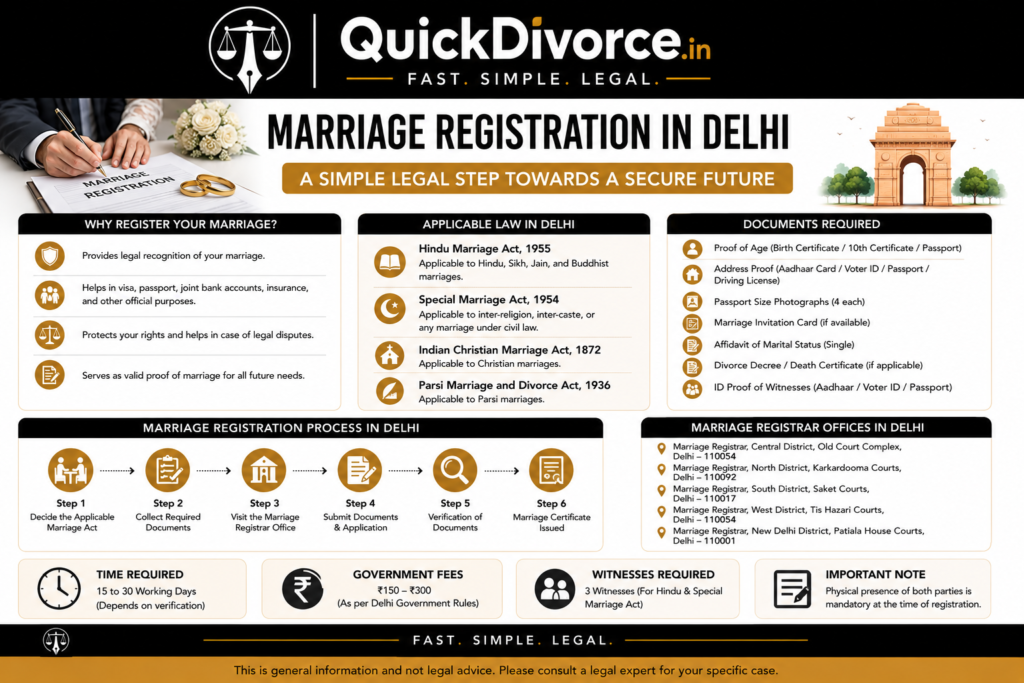
Documents Required for Marriage Registration in Delhi
While specific requirements can vary slightly depending on the SDM office, most applications for marriage registration in Delhi require the following:
Identity Proof (Both Parties)
- Aadhaar Card
- Voter ID Card
- Passport
Age Proof (Both Parties)
- Birth certificate
- 10th class marksheet or certificate
- Passport
Address Proof (Both Parties)
- Aadhaar Card
- Passport
- Utility bill (recent)
- Rent agreement, if applicable
Proof of Marriage Having Taken Place
- Wedding photographs
- Wedding invitation card
- A certificate from the priest or officiant who conducted the ceremony
Other Required Documents
- Duly filled and signed application form
- Affidavits from both parties confirming marital status, nationality, date of marriage, and related declarations
- Recent passport-size photographs of both parties, and a joint photograph
- Identity proof and photographs of two witnesses present at the time of the marriage ceremony
Most documents must be uploaded in PDF or JPG/JPEG format on the online portal, and a notable share of application delays stem not from missing documents, but from uploads being rejected due to incorrect file formats or unclear scans.
Step-by-Step Process for Online Marriage Registration in Delhi
Marriage registration in Delhi is processed entirely through the e-District Delhi portal (edistrict.delhigovt.nic.in). Here’s how the process typically unfolds:
- Create an account on the portal. Visit the e-District Delhi website and register using your mobile number and email ID. You’ll receive an OTP for verification before you can create your login credentials.
- Navigate to the Marriage Registration service. After logging in, go to the Revenue Department section and select “Registration of Marriage.”
- Choose the applicable Act. Select either the Hindu Marriage Act, 1955 or the Special Marriage Act, 1954, based on your specific circumstances.
- Select your district. Choose the district corresponding to the SDM office under whose jurisdiction either spouse resides.
- Fill in the application form. Enter details of the husband, wife, and witnesses accurately, including names, addresses, dates of birth, and marriage details.
- Upload the required documents. Attach scanned copies of identity, age, and address proofs, affidavits, photographs, and any supporting marriage documentation.
- Pay the prescribed fee online. Complete the payment through the portal’s integrated payment gateway.
- Book your SDM appointment. Once the application is submitted, you’ll be allotted a date and time to visit the relevant SDM office in person.
What Happens at the SDM Office
On the scheduled appointment date, both spouses (and, where applicable, their witnesses) must appear in person at the designated SDM office, generally during working hours between 9:30 a.m. and 1:00 p.m. on a working day. At this stage:
- Original documents are verified against the uploaded copies
- The application form is reviewed and signed before a Gazetted Officer or the designated Marriage Registrar
- For Hindu Marriage Act applications, once verification is complete, the marriage registration certificate is processed and typically issued within the standard timeline
- For Special Marriage Act applications, the marriage can only be formally registered after the 30-day public notice period has lapsed without any valid objection
It’s worth noting that tatkal processing is not available for Special Marriage Act registrations under any circumstances, given the statutory notice period — so couples with time-sensitive requirements (such as an upcoming visa deadline) should plan well in advance if they fall under this category.
Fees and Processing Timelines
| Marriage Type | Fee (Approx.) | Notice Period | Processing Time |
|---|---|---|---|
| Hindu Marriage Act | ₹100 | None | 7–15 working days |
| Hindu Marriage Act (Tatkal) | ₹100 + additional tatkal charge | None | As fast as 24 hours |
| Special Marriage Act | ₹150 | 30 days (mandatory) | 30+ days |
These figures are indicative and may be revised periodically by the Delhi government, so it’s advisable to check the current fee schedule on the e-District portal before applying.
What’s New for Marriage Registration in Delhi in 2026
The process for marriage registration in Delhi has continued to modernise, with a few notable updates:
- DigiLocker integration: The e-District portal now allows applicants to pull verified documents directly from DigiLocker instead of manually uploading scans, which reduces physical verification scrutiny at the SDM office and can meaningfully speed up approval.
- QR-coded marriage certificates: Certificates issued in Delhi now carry QR codes that can be digitally verified by banks, embassies, and other institutions, reducing the risk of forged or disputed certificates.
- e-Sanad linkage for Apostille processing: For couples planning to move abroad, the portal’s integration with the Ministry of External Affairs’ e-Sanad platform helps streamline Apostille certification for countries under the Hague Convention.
These updates make marriage registration in Delhi noticeably faster and more globally usable than it was just a few years ago, particularly for couples with international relocation or visa plans.
Common Mistakes That Delay Marriage Registration
- Choosing the wrong Act — selecting the Hindu Marriage Act when the marriage actually requires registration under the Special Marriage Act (or vice versa) leads to application rejection and re-filing.
- Mismatched names or spellings across documents — even a minor spelling inconsistency between your Aadhaar card and passport can trigger delays or rejection at the verification stage.
- Uploading documents in unsupported formats — many applications stall simply because scans are uploaded in the wrong file type or are too low-resolution to verify.
- Applying in the wrong jurisdiction — registration must be filed with the SDM office covering the area where either spouse resides, not necessarily where the wedding ceremony took place.
- Missing the SDM appointment — failing to appear on the scheduled verification date typically requires rebooking, adding further delay.
- Inconsistent passport and certificate names — for couples planning to apply for a spouse visa abroad, even small spelling mismatches between the passport and the marriage certificate can create downstream complications.
Why Legal Assistance Helps
While the e-District portal has made marriage registration in Delhi largely self-serviceable, many couples still run into avoidable delays — incorrect Act selection, document formatting issues, or jurisdictional confusion being the most common. A family law professional can review your documents before submission, confirm the correct Act and jurisdiction for your specific case, and help resolve any objections raised during the Special Marriage Act notice period, saving you from restarting the process from scratch.
How QuickDivorce.in Can Help
Beyond divorce and separation matters, our family law team at QuickDivorce.in also assists couples with marriage registration in Delhi — verifying your documents in advance, confirming the correct applicable Act, and guiding you through the e-District portal and SDM appointment process so your certificate is issued without unnecessary delays or rejections.
Frequently Asked Questions (FAQs)
1. Is marriage registration compulsory in Delhi?
Yes, under the Delhi (Compulsory Registration of Marriage) Order, 2014, registration is mandatory for marriages solemnised in Delhi or where either spouse resides in Delhi.
2. How long does marriage registration take in Delhi?
Under the Hindu Marriage Act, certificates are typically issued within 7 to 15 working days, with a tatkal option available for issuance within 24 hours. Under the Special Marriage Act, the process takes at least 30 days due to the mandatory public notice period.
3. Can an interfaith couple register their marriage in Delhi?
Yes, interfaith couples register under the Special Marriage Act, 1954, which involves a mandatory 30-day notice period before the certificate can be issued.
4. Do I need to register my marriage in the city where the wedding took place?
No. Registration must be filed with the SDM office covering the area where either spouse currently resides, regardless of where the actual wedding ceremony occurred.
5. Is tatkal processing available for Special Marriage Act registrations?
No. The 30-day public notice period under the Special Marriage Act is a statutory requirement and cannot be expedited, regardless of urgency.
Conclusion
Marriage registration in Delhi has evolved into a largely digital, fairly straightforward process — provided you choose the correct Act, prepare your documents accurately, and apply through the right jurisdiction. With recent updates like DigiLocker integration and QR-coded certificates, the system has also become significantly more useful for couples with international plans, not just domestic record-keeping.
If you’re approaching this step, the smartest move is to get your documentation right the first time, rather than discovering an avoidable error after weeks of waiting.
For assistance with marriage registration in Delhi, document verification, or resolving any objections during the process, reach out to the family law team at QuickDivorce.in.
Get Expert Advice on Marriage Registration in Delhi
🟡QuickDivorce offers trusted online legal services across India, including mutual divorce, contested divorce, child custody, alimony, marriage registration, and expert family law consultation.
👉 Mutual Consent Divorce
👉 Contested Divorce Filing
👉 Child Custody and Maintenance
👉 Matrimonial Property Settlement
👉 NRI Divorce Services
👉 Alimony and Maintenance
🟡 Protect Your Rights
👉 Domestic Violence Legal Support
👉 Stridhan Recovery
🟡For other Legal and Trademark related services visit
👉 Money Recovery Cases
👉 Property Disputes
👉 Business & Licence Registrations
📞 Call Now: +91 8595439395
🕐 Free Consultation: Monday to Saturday, 10 AM to 6 PM

Adv. Manish Kashyap is a Family Law & Divorce Lawyer with extensive experience in Mutual & Contested Divorce, NRI Divorce, Child Custody, Alimony, Domestic Violence, Judicial Separation, and Family Court matters, providing professional legal guidance to clients.

