

Views: 7
Planning a court marriage under Special Marriage Act? Check the complete list of documents required for bride, groom, and witnesses, along with the step-by-step process for 2026
Table of Contents
- 1 Introduction
- 2 What Is the Special Marriage Act, 1954?
- 3 Eligibility Conditions Before You Apply
- 4 Why Document Accuracy Matters So Much
- 5 Complete List of Documents Required for Court Marriage
- 6 Additional Documents for Special Categories
- 7 Documents Required for Witnesses
- 8 Step-by-Step Court Marriage Procedure
- 9 Common Mistakes Couples Make With Documents
- 10 How QuickDivorce.in Can Help You
- 11 Frequently Asked Questions (FAQs)
- 12 Conclusion
- 13 Get Expert Mutual Divorce Legal Assistance
Introduction
Getting married is one of the biggest decisions of a person’s life, and when two individuals from different religions, castes, or even nationalities decide to spend their lives together, the Special Marriage Act, 1954 becomes the most reliable legal route. Unlike religious marriages that involve rituals and ceremonies, a court marriage under this Act is a purely civil process, free from religious conditions, and recognised uniformly across India.
However, before you can stand in front of a Marriage Officer and exchange your vows, there is one critical step that decides whether your marriage will be solemnised smoothly or get delayed for weeks — submitting the correct set of documents. Many couples assume that court marriage is “just paperwork,” but a single missing affidavit, an unattested photocopy, or an expired notice can push your wedding date back by months.
This guide breaks down, in complete detail, every document required for a court marriage under the Special Marriage Act in 2026 — for the bride, the groom, the witnesses, and even special categories like divorcees, widows/widowers, and foreign nationals. By the end, you will know exactly what to carry, what to avoid, and how to make your court marriage process completely hassle-free.
What Is the Special Marriage Act, 1954?
The Special Marriage Act, 1954 is a secular law enacted by the Parliament of India to allow any two adults to marry through a civil process, regardless of their religion, caste, or community. It does not require either party to convert their religion, and it applies equally to Hindus, Muslims, Christians, Sikhs, Buddhists, Parsis, Jews, atheists, and foreign nationals marrying within India.
The Act applies to the entire territory of India, including Jammu and Kashmir after the 2019 reorganisation, and it also extends to Indian nationals living abroad. Because it is purely a civil contract, there is no requirement for any wedding ceremony, priest, or religious ritual — the marriage becomes legally valid the moment it is solemnised before a Marriage Officer in the presence of three witnesses.
This is exactly why interfaith couples, inter-caste couples, NRIs, and people who simply prefer a legal-only wedding choose this route over personal marriage laws like the Hindu Marriage Act or Muslim Personal Law.
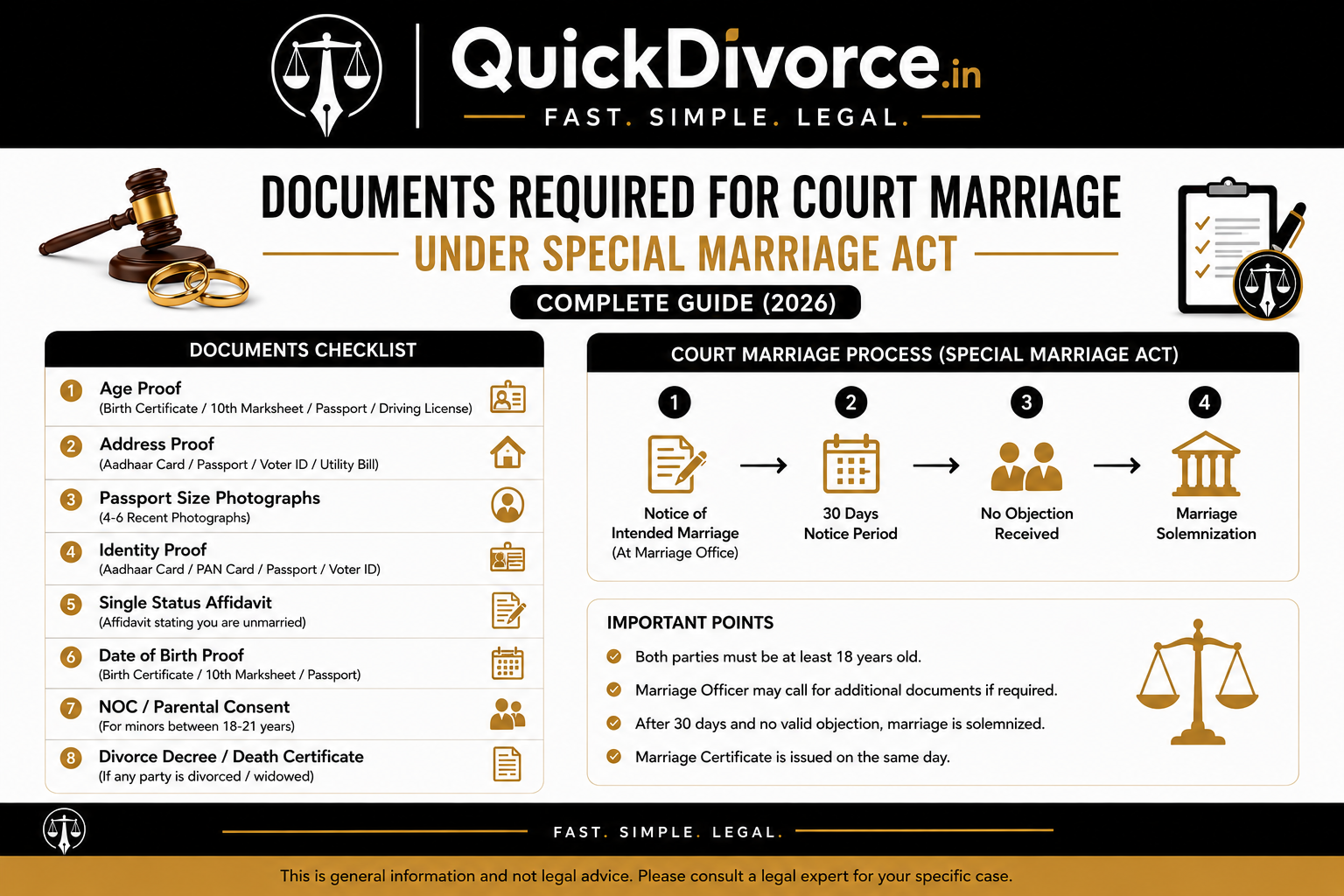
Eligibility Conditions Before You Apply
Before collecting documents, it’s important to confirm that both parties meet the basic eligibility conditions laid down under Section 4 of the Act:
- The groom must be at least 21 years old, and the bride must be at least 18 years old. (Note: A proposal to raise the minimum marriage age for women to 21 has been discussed in Parliament for some time, but as of 2026 it has not been passed into law — the existing 18/21 rule still applies.)
- Neither party should have a living spouse at the time of marriage (i.e., no ongoing valid marriage).
- Both parties must be of sound mind and capable of giving valid consent.
- Neither party should fall within the “prohibited degree of relationship” unless their customs specifically permit such a union.
- No parental or family consent is required once both parties are legal adults — the Marriage Officer cannot demand a parental NOC.
Once these conditions are satisfied, the real work begins: assembling the documents.
Why Document Accuracy Matters So Much
A court marriage under the Special Marriage Act is processed by a government-appointed Marriage Officer, and every document you submit becomes part of an official legal record. Unlike a private religious wedding, this record can later be used for:
- Visa and immigration applications
- Passport name change or addition of spouse details
- Property and inheritance matters
- Bank account and insurance nominations
- Future legal proceedings, including maintenance or divorce, if required
Because the marriage certificate issued under this Act carries permanent legal validity, any error or mismatch in your documents — a wrong spelling, an expired ID, or an unattested affidavit — can create complications years down the line. This is precisely why couples are advised to get their paperwork reviewed by a legal professional rather than handling it casually.
Complete List of Documents Required for Court Marriage
Below is the standard list of documents that both the bride and groom must submit individually to the Marriage Officer of the district where at least one party has resided for a minimum of 30 days before filing the notice.
1. Proof of Date of Birth (Age Proof)
This establishes that both parties meet the minimum age requirement. Any one of the following is generally accepted:
- Birth certificate issued by the Municipal Corporation
- 10th class (Secondary School) marksheet or certificate showing date of birth
- Passport
- PAN card (in some states, accompanied by another supporting document)
2. Proof of Identity
- Aadhaar Card (original plus self-attested photocopies)
- Voter ID Card
- Passport
- Driving Licence
3. Proof of Residence
Since the notice must be filed in the district where a party has resided for at least 30 days, residence proof is mandatory. Accepted documents include:
- Aadhaar Card with current address
- Voter ID Card
- Passport
- Utility bill (electricity/water/gas) not older than 2–3 months
- Rent agreement, if residing as a tenant
4. Passport-Size Photographs
Both parties must submit recent passport-size photographs, generally 4 to 6 copies each, as required by the specific Marriage Registrar’s office.
5. Notice of Intended Marriage (Form)
This is the official application form prescribed under Section 5 of the Act, duly filled and signed by both parties, stating their intention to marry.
6. Affidavits
Each party must submit a notarised affidavit confirming:
- Date of birth and age
- Current marital status (unmarried, divorced, or widowed)
- Nationality
- That the marriage is not in violation of the conditions laid down under Section 4 of the Act
- That neither party is related to the other within the “prohibited degree of relationship”
These affidavits must be notarised by a notary public or executed before a competent authority, and unnotarised affidavits are one of the most common reasons applications get rejected.
7. Application Fee Receipt
A nominal government fee is charged for filing the notice and issuing the marriage certificate, which varies slightly by state and district. The receipt of this payment must be retained and submitted as proof.
Additional Documents for Special Categories
Not every couple’s situation is identical, and the Act accounts for several special circumstances. Here is what additional paperwork is needed:
If One or Both Parties Are Divorced
- Certified copy of the divorce decree issued by the court
- If the divorce was granted by a foreign court, an apostilled copy along with a certified English translation is required
If One or Both Parties Are Widowed
- Original death certificate of the deceased spouse, or a certified copy issued by the municipal authority
If a Party Previously Married Under Religious Customs
- Documentary proof that the earlier marriage has been legally dissolved (such as a court decree), since a religious-only separation (like a verbal or customary divorce) is not sufficient under civil law
If One Party Is a Foreign National
- Valid passport with an appropriate visa (with sufficient remaining validity)
- A “Certificate of No Impediment” or “Certificate of Single Status,” apostilled or attested by the home country’s competent authority, confirming the person is free to marry
- Proof of having resided in the relevant district for the mandatory 30-day period
- A copy of the visa and entry stamp showing the duration of stay in India
If One Party Is an NRI
- Valid Indian passport
- Proof of current overseas address
- Single status / no-objection certificate from the Indian Embassy or Consulate in the country of residence, where applicable
Documents Required for Witnesses
A court marriage under the Special Marriage Act requires three witnesses to be present at the time of solemnisation. These witnesses do not need to be related to the couple — they can be friends, colleagues, or even acquaintances, as long as they are adults with valid identification. Each witness must carry:
- A valid government-issued photo ID (Aadhaar Card, Voter ID, or Passport)
- Two self-attested photocopies of the chosen ID
- One recent passport-size photograph
Witnesses are required to sign a declaration in the presence of the Marriage Officer at the time the marriage is solemnised, as prescribed under the Act.
Step-by-Step Court Marriage Procedure
Understanding how these documents fit into the overall process makes the paperwork far less confusing. Here is a simplified breakdown:
Step 1: Filing the Notice of Intended Marriage Both parties submit the notice, along with all required documents, to the Marriage Officer of the district where either party has resided for at least 30 days.
Step 2: Publication of Notice The Marriage Officer displays this notice on the office notice board for 30 days, as mandated under Section 6 of the Act. If the parties belong to different districts, a copy is also sent to the Marriage Officer of the other district for similar publication.
Step 3: Objection Period During these 30 days, any person may raise a formal, written objection — but only on the legal grounds mentioned in Section 4 (such as an existing marriage, underage party, or unsound mind). Objections based on caste, religion, or family disapproval have no legal standing and must be rejected by the officer.
Step 4: Inquiry (If an Objection Is Raised) If an objection is filed, the Marriage Officer conducts an inquiry. If the objection is found invalid, the marriage proceeds; if upheld, the couple can appeal to the District Court.
Step 5: Solemnisation of Marriage Once the 30-day period passes without a valid objection (or after a rejected objection), the couple, along with three witnesses, appears before the Marriage Officer. A declaration is read out and signed by both parties and the witnesses, in line with the Third Schedule of the Act.
Step 6: Issuance of Marriage Certificate After solemnisation, the Marriage Officer issues the official Marriage Certificate, which is the conclusive legal proof of marriage and is valid for life across India and abroad.
It’s worth noting that if the marriage is not solemnised within three months of filing the notice, the entire notice lapses, and the couple must restart the process from Step 1.
Common Mistakes Couples Make With Documents
Even well-prepared couples sometimes face delays. Here are the most frequent errors to avoid:
- Submitting unnotarised affidavits — every affidavit must carry a notary’s seal and signature.
- Mismatched names across documents — if your Aadhaar card spells your name differently from your passport or birth certificate, this must be corrected before applying.
- Outdated address proof — utility bills older than the accepted timeframe are often rejected.
- Choosing witnesses without valid ID — many couples realise on the day of solemnisation that a witness’s ID has expired.
- Filing in the wrong district — the 30-day residency requirement must genuinely be met in the district where the notice is filed; courts treat this condition strictly.
- Ignoring previous marriage documentation — for divorcees or widows/widowers, skipping the decree or death certificate is one of the most common reasons for rejection.
- Ignoring the three-month validity — couples who delay solemnisation beyond three months of filing the notice must file a fresh application, including fresh document submission in some cases.
How QuickDivorce.in Can Help You
Filing for a court marriage on your own can feel overwhelming — between notarising affidavits, verifying residence proof, coordinating witnesses, and tracking the 30-day notice period, even a small oversight can delay your big day. At QuickDivorce.in, our legal team assists couples through every stage of the Special Marriage Act process — from preparing and notarising your documents correctly, to filing the notice with the right Marriage Officer, to ensuring your solemnisation happens without unnecessary objections or delays.
Whether you are an interfaith couple, an NRI planning to marry in India, or someone who simply wants a smooth, paperwork-perfect court marriage, our experienced family law professionals can guide you end-to-end so that your only focus on your wedding day is each other — not the paperwork.
Frequently Asked Questions (FAQs)
1. Can a marriage already performed through religious rites be registered under the Special Marriage Act?
Yes. Section 15 of the Act allows couples who have already married through religious ceremonies to register their marriage under the SMA, provided they meet the eligibility conditions under Section 4.
2. Is parental consent required for adults marrying under this Act?
No. Once both parties are legal adults (21 for men, 18 for women), parental or family consent is not required, and no Marriage Officer can lawfully demand it.
3. How long does the entire court marriage process take?
At minimum, the process takes about 30–35 days, factoring in the mandatory 30-day notice publication period, followed by a few additional days for scheduling the solemnisation.
4. What happens if someone objects to the marriage during the notice period?
The objection is only valid if it relates to the conditions under Section 4 (such as an existing marriage or being underage). Objections based on caste, religion, or family disapproval are legally invalid and must be dismissed by the Marriage Officer.
5. Can a foreign national marry an Indian citizen under the Special Marriage Act?
Yes. The foreign national must fulfil the 30-day residency requirement, hold a valid visa, and submit a Certificate of No Impediment or Single Status, apostilled by their home country’s relevant authority.
6. Is the marriage certificate issued under the Special Marriage Act valid for life?
Yes. The certificate issued under this Act is a permanent legal document with lifetime validity and is recognised throughout India and internationally.
7. What if the notice lapses before the marriage is solemnised?
If the marriage is not solemnised within three months of filing the notice, the notice automatically lapses, and the couple must file a new notice and resubmit the required documents.
Conclusion
A court marriage under the Special Marriage Act is one of the most transparent and legally secure ways for two adults to begin their married life together, regardless of religion or background. But its success depends heavily on getting the documentation right the first time — from age and identity proof to notarised affidavits and witness verification.
If you’re planning your court marriage in 2026, take the time to organise every document carefully, double-check names and dates across all papers, and seek professional guidance wherever you’re unsure. A little preparation today can save you weeks of delay tomorrow — and let you focus on what truly matters: starting your new chapter together.
Get Expert Mutual Divorce Legal Assistance
🟡For personalised assistance with court marriage documentation, notarisation, and filing under the Special Marriage Act, get in touch with the legal experts at QuickDivorce.in.
🟡Visit LegalTax.in for other Legal and Trademark related services as 👉 Money Recovery Cases 👉 Property Disputes 👉 Business & Licence Registrations
🟡Visit Business24hub for IT services
👉 Mutual Consent Divorce at QuickDivorce.in 👉 Contested Divorce Filing 👉 Child Custody and Maintenance 👉 Matrimonial Property Settlement 👉 NRI Divorce Services 👉 Alimony and Maintenance
🟡 Protect Your Rights 👉 Domestic Violence Legal Support at QuickDivorce.in 👉 Stridhan Recovery
📞 Call Now: +91 8595439395 🕐 Free Consultation: Monday to Saturday, 10 AM to 6 PM
Adv. Manish Kashyap is a Family Law & Divorce Lawyer with extensive experience in Mutual & Contested Divorce, NRI Divorce, Child Custody, Alimony, Domestic Violence, Judicial Separation, and Family Court matters, providing professional legal guidance to clients.

