

Views: 0
Table of Contents
- 1 A Question Worth Asking Before You Trust a Screen With Your Legal Problem
- 2 Is Online Legal Advice Legally Valid in India?
- 3 Why This Question Has Become So Much More Common in 2026
- 4 What Can Genuinely Be Done Online — In Detail
- 5 What Cannot Be Replaced by an Online Process — In Detail
- 6 How to Tell If an Online Legal Service Is Reliable
- 7 The Specific Reliability Concerns in Family Law Matters
- 8 Why Reliability Matters More in Legal Matters Than in Most Other Online Services
- 9 A Practical Checklist Before You Commit to an Online Legal Service
- 10 Frequently Asked Questions
- 11 Get Expert Mutual Divorce Legal Assistance
A Question Worth Asking Before You Trust a Screen With Your Legal Problem
Five years ago, almost nobody would have considered resolving a legal matter — a divorce, a property dispute, a custody question — entirely through video calls and shared documents, without ever sitting across a desk from a lawyer in person. Today, it is increasingly the norm, particularly for people juggling work, distance, or simply preferring not to spend a day traveling to and from a lawyer’s office for a conversation that could happen on a screen.
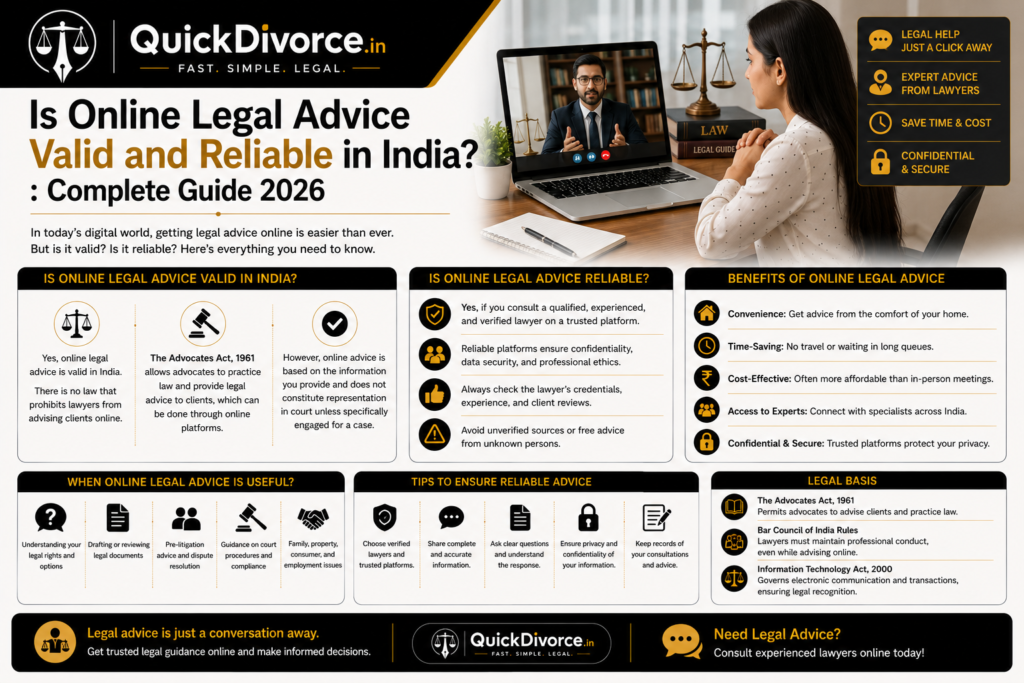
Online Legal Advice provides convenient access to professional legal guidance, allowing individuals to consult experienced lawyers from anywhere and receive timely solutions to their legal concerns.
The question that naturally follows is whether this is actually valid — whether advice given online carries the same weight, the same confidentiality, and the same legal standing as advice given in person, and whether it is reliable enough to act on for something as important as a divorce, a custody dispute, or a property matter. This guide answers that question properly, rather than with a quick reassurance, because the honest answer has real nuance worth understanding before you rely on any online legal service.
Is Online Legal Advice Legally Valid in India?
Yes. There is nothing in Indian law that requires legal advice to be given in person to be valid, or that treats advice given over video call, phone, or written consultation as somehow lesser or non-binding. A lawyer enrolled with a State Bar Council remains bound by the same professional and ethical obligations — confidentiality, competence, and duty to the client under the Bar Council of India’s rules — regardless of whether the consultation happens in their office or over a video call.
What actually requires personal, physical presence are specific procedural steps within a legal case itself — appearing before a judge, signing certain documents in person, or, as covered in our detailed guides on the mutual divorce process, the First and Second Motion hearings where both spouses must personally confirm their consent before the court. The advice and strategy leading up to those steps, however, can be — and routinely is — handled entirely online.
This distinction is the single most important thing to understand in this entire guide: the advice is fully valid online; certain procedural acts within the legal process are not. Confusing these two categories is where most misunderstandings about online legal services come from.
Why This Question Has Become So Much More Common in 2026
The shift toward online legal consultation did not happen by accident. A few genuine forces have driven it.
Geography stopped being a barrier the moment video calling became reliable and universal. A person in a small town no longer needs to travel to a larger city to access a specialized family law advocate; a person in Delhi can consult a lawyer without taking time off work to sit in a waiting room.
NRIs created sustained demand for genuinely remote legal services. As covered in our detailed guide on Power of Attorney for NRI divorce cases, a significant proportion of NRI legal matters in India are now managed almost entirely through online consultation, with personal presence reserved only for the specific hearings the law actually requires.
The pandemic-era normalization of remote interaction did not reverse afterward. Courts themselves adopted video conferencing protocols for certain hearings during that period, and many of these systems and the broader comfort with virtual interaction have persisted well beyond it.
People increasingly prefer the lower-pressure environment of a video call for sensitive personal matters. Discussing a divorce, a custody dispute, or a domestic violence situation from a familiar, private space is, for many people, genuinely easier than doing so in an unfamiliar office on a fixed schedule.
None of this changes the underlying law. It simply means more people are now asking, reasonably, whether the convenience comes at any cost to validity or reliability.
What Can Genuinely Be Done Online — In Detail
The consultation itself. A lawyer assessing your situation, asking the right questions, explaining your legal options, and giving a realistic strategy and timeline — this is the actual substance of legal advice, and it transfers to a video or phone call without any loss of legal validity. As covered in our guide on documents to prepare before an online divorce consultation, what determines the quality of this consultation is your preparation and the lawyer’s expertise, not the medium through which it happens.
Document review and drafting. Settlement agreements, divorce petitions, legal notices, and custody arrangements can all be drafted, reviewed, revised, and finalized through shared documents and video discussion, exactly as covered in our detailed guide on drafting a mutual divorce settlement agreement.
Ongoing case strategy and updates. As a case moves through its stages — filing, hearings, mediation, as covered in our guide on how long mutual divorce takes in India — your lawyer can brief you, take your instructions, and adjust strategy entirely through remote communication between the specific points where your physical presence is legally required.
Coordination across cities and countries. For NRI clients in particular, an enormous proportion of the overall legal process — document preparation, Power of Attorney arrangements, embassy coordination, apostille processing — can be managed remotely, with India visits reserved specifically for the hearings that cannot be delegated, as covered in detail in our guide on Power of Attorney for NRI divorce cases.
Sensitive disclosures in a safer environment. For matters involving domestic violence or matrimonial cruelty, some clients find it genuinely easier to disclose difficult details from a private, familiar space rather than an unfamiliar office, and a properly conducted online consultation does not compromise the seriousness or confidentiality with which this information is treated.
What Cannot Be Replaced by an Online Process — In Detail
Personal appearance before a court where the law requires it. As covered extensively in our guide on the mutual divorce process and what happens after the first motion, both spouses must physically appear before the judge at the First Motion and Second Motion to confirm their consent. No video call, however formal, substitutes for this in current Indian procedure for these specific steps.
Certain physical signatures. While many documents can be reviewed and finalized in draft form online, specific execution steps — including signing in the presence of witnesses or a notary for certain affidavits — generally still require physical presence at the relevant point.
Marriage solemnization itself, as covered in our detailed guide on registering an NRI marriage when one partner cannot travel to India. Just as a marriage cannot be solemnized by proxy, a court appearance confirming consent to end one cannot be given by proxy either — the same underlying legal principle, that certain personal acts cannot be delegated, runs through both situations.
Cross-examination and oral evidence in contested proceedings. Where a case proceeds to a contested trial rather than mutual consent, personal examination and cross-examination before the court generally require physical presence, as the credibility assessment courts conduct depends substantially on direct, in-person testimony.
How to Tell If an Online Legal Service Is Reliable
This is where genuine caution is warranted, because the same convenience that makes online legal services valuable also makes it easier for low-quality or even fraudulent services to present themselves convincingly through a website and a phone number alone.
Check that the lawyer or firm is genuinely identifiable. A named advocate, a real bar council enrollment number, and a verifiable office address are basic, reasonable things to expect and to ask about directly, rather than dealing with an anonymous “legal team” with no individual accountability behind it.
Be cautious of guaranteed outcomes. No legitimate lawyer promises a specific result — a guaranteed custody outcome, a guaranteed timeline, a guaranteed maintenance figure — before reviewing your actual facts. As covered in our guide on mutual divorce vs contested divorce, even something as seemingly straightforward as mutual divorce depends on both parties genuinely agreeing and a court being satisfied that consent is real; no service can guarantee this in advance regardless of what it claims.
Confidentiality should be treated seriously, with visible practices around it. Ask how your documents are stored, who has access to them, and what happens to your information once the matter concludes. A professional service should be able to answer this clearly rather than deflecting the question.
A reliable service will tell you plainly what cannot be done remotely, rather than implying the entire legal process — including court appearances — can be avoided. As covered in detail in our guide on whether mutual divorce can be done entirely without going to court, any service claiming a fully court-free legal divorce process is being inaccurate about Indian law, and this kind of overstatement is itself a meaningful warning sign about the service’s overall reliability.
Look for transparency about fees from the outset. A reliable service quotes clearly, explains what is included, and does not pressure you into payment before you have had a genuine opportunity to understand your situation and options.
Be specifically wary of services that claim to bypass mandatory government processes for a fee. As covered in our guide on registering on the Udyam portal, certain government processes — including Udyam registration — are explicitly free, with the government portal itself warning against private services charging fees while implying official status. The same basic caution applies broadly: where a private service claims to circumvent a process the government has made free or where the law has made personal appearance mandatory, treat the claim skeptically until verified independently.
The Specific Reliability Concerns in Family Law Matters
Family law carries its own particular reliability risks worth naming directly, since this is the area where most online legal consultations in India actually occur.
Settlement terms that sound reasonable but are vague or unenforceable. As covered in detail in our guide on drafting a mutual divorce settlement agreement, vague language around maintenance, custody schedules, or property division is one of the most common sources of future disputes, and a rushed or low-quality online drafting service is just as capable of producing this problem as an in-person one — arguably more so, if the consultation itself was too brief to properly understand your specific situation.
Misrepresentation of how quickly a case can be resolved. As covered in our guide on the mutual divorce timeline and our dedicated guide on the cooling-off period, real timelines depend on specific legal conditions being met, not simply on paying for a faster service. Any online service promising an unrealistically fast divorce regardless of your specific facts is overselling what the law actually permits.
Inadequate attention to NRI-specific complexity. As covered in our guide on Power of Attorney for NRI divorce cases, NRI matters genuinely require careful sequencing of what can be delegated and what cannot. A generic online service without specific NRI experience may not properly advise on this distinction, leading to wasted trips to India or procedural missteps.
Overlooking parallel proceedings that need coordinated handling. Where a matter involves, for instance, both a divorce and a pending criminal complaint such as a 498A FIR, as covered in our guide on defending false 498A cases, these need to be handled with awareness of each other, and a service treating the divorce consultation in isolation, without asking about other pending legal matters, risks giving incomplete advice.
Why Reliability Matters More in Legal Matters Than in Most Other Online Services
A mistaken online purchase can usually be returned. A poorly advised legal step — a wrongly drafted settlement clause, a missed filing deadline, an incorrect choice of legal route, an ex-parte decree obtained or suffered due to inadequate guidance, as covered in our detailed guide on challenging ex-parte divorce decrees — can take months or years and significant cost to correct, and in some cases cannot be fully undone at all.
This asymmetry — low cost of a bad decision in most online services, genuinely high cost of a bad decision in a legal matter — is precisely why verifying the credentials, transparency, and approach of an online legal service matters considerably more here than it might for almost any other category of online transaction.
A Practical Checklist Before You Commit to an Online Legal Service
- Confirm the lawyer’s name and bar council enrollment, and verify this independently rather than taking the website’s word for it
- Ask directly what parts of your specific process will require your physical presence, and be wary if the answer is vague or evasive
- Request a clear fee structure before sharing detailed personal documents
- Ask how your documents and personal information will be stored and who will have access
- Be specific about your situation in the first consultation, as covered in our guide on documents to prepare before an online divorce consultation, since a generic answer to a generic question tells you very little about whether the advice is genuinely tailored to you
- Trust your own read of whether the lawyer is asking thoughtful, specific questions about your situation, or simply moving through a script
Frequently Asked Questions
Q1. Is advice given over a video call as legally valid as advice given in a lawyer’s office?
Yes. There is no requirement under Indian law or bar council rules that legal advice must be given in person to be valid. The lawyer’s professional obligations remain identical regardless of the medium.
Q2. Can an entire divorce case be handled without ever meeting a lawyer in person?
Most of the process can be, but specific court appearances — the First and Second Motion in mutual divorce, or evidence and cross-examination in a contested case — generally require personal presence, regardless of how much of the rest of the process was handled remotely.
Q3. How do I verify that an online lawyer is actually registered to practice?
Ask for their bar council enrollment number and the specific state bar council they are registered with, which can generally be independently verified through that bar council’s own records.
Q4. Are online legal consultations as confidential as in-person ones?
They should be, provided the service follows proper confidentiality practices. This is worth asking about directly rather than assuming, since the standard of professional confidentiality applies regardless of medium, but how a specific service implements that standard in practice can vary.
Q5. Can NRIs handle their entire legal matter online without ever traveling to India?
Generally no, if the matter is governed by Indian law and involves any of the personal-appearance-required steps, such as marriage registration or specific divorce hearings. What can genuinely be minimized through online handling is everything else, often reducing required trips to a small number of brief, essential appearances.
Q6. What is the biggest warning sign that an online legal service may not be reliable?
Guaranteed outcomes, vague or evasive answers about what requires physical presence, and a lack of clear, verifiable lawyer identity or bar council registration are the most significant warning signs to watch for.
Get Expert Mutual Divorce Legal Assistance
🟡 QuickDivorce.in provides complete mutual divorce services — petition drafting, settlement negotiation and drafting, first and second motion representation, waiver applications, NRI video conferencing appearances, and post-decree implementation support across all jurisdictions in India.
🟡Visit LegalTax.in for other Legal and Trademark related services as 👉 Money Recovery Cases 👉 Property Disputes 👉 Business & Licence Registrations
🟡Visit Business24hub for IT services
👉 Mutual Consent Divorce 👉 Contested Divorce Filing 👉 Child Custody and Maintenance 👉 Matrimonial Property Settlement 👉 NRI Divorce Services 👉 Alimony and Maintenance
🟡 Protect Your Rights 👉 Domestic Violence Legal Support👉 Stridhan Recovery
📞 Call Now: +91 8595439395 🕐 Free Consultation: Monday to Saturday, 10 AM to 6 PM

Adv. Manish Kashyap is a Family Law & Divorce Lawyer with extensive experience in Mutual & Contested Divorce, NRI Divorce, Child Custody, Alimony, Domestic Violence, Judicial Separation, and Family Court matters, providing professional legal guidance to clients.

