

Views: 18
Table of Contents
- 1 A Ground That No Longer Sends Anyone to Jail, But Can Still End a Marriage
- 2 The Legal Status of Adultery as a Ground for Divorce
- 3 The Standard of Proof — Why It Matters So Much Here
- 4 What Courts Have Accepted as Evidence of Adultery
- 5 What Courts Have Generally Not Accepted as Sufficient on Its Own
- 6 How Evidence Is Actually Gathered — And the Legal Limits Around It
- 7 How Adultery Fits Into a Broader Divorce Strategy
- 8 What Happens If the Adultery Allegation Is False or Cannot Be Adequately Proven
- 9 Frequently Asked Questions
- 10 Why Choose Quick Divorce
- 11 Get Expert Legal Help for Matrimonial Matters
A Ground That No Longer Sends Anyone to Jail, But Can Still End a Marriage
Adultery occupies an unusual position in Indian law in 2026. It is no longer a criminal offence — the Supreme Court struck down Section 497 of the Indian Penal Code in 2018, removing the possibility of one spouse having the other’s affair partner criminally prosecuted. What remains, fully intact, is adultery as a civil ground for divorce, where the standard of proof is meaningfully lower than what criminal law ever required, and where Indian courts have, over decades, developed a fairly settled body of principles on what kind of evidence is actually sufficient.
This guide focuses specifically on proof: what courts have accepted, what they generally have not, and how a realistic adultery-based divorce case is actually built, given that direct eyewitness evidence of the act itself is, almost by definition, rare.
The Legal Status of Adultery as a Ground for Divorce
Adultery remains a valid ground for divorce under:
- Section 13(1)(i) of the Hindu Marriage Act, 1955
- Section 27(1)(a) of the Special Marriage Act, 1954
- Section 10(1)(i) of the Indian Divorce Act, 1869, for Christians
- Equivalent provisions under personal law for other communities, with some variation in how adultery interacts with other grounds
The legal definition is voluntary sexual intercourse by one spouse with a person other than their partner, after the marriage. The relevant word here is voluntary — sexual intercourse forced upon someone is not adultery for this purpose, since the act must be willing on the part of the spouse to be relevant as adultery.
It is worth noting the 2018 decriminalization specifically: Joseph Shine v. Union of India (2018), in which the Supreme Court struck down Section 497 IPC as unconstitutional, was specifically about criminal liability — the Court held that treating adultery as a crime, historically framed in a way that treated the wife as essentially the property of the husband whose consent mattered while hers did not, violated constitutional guarantees of equality and dignity. The judgment was explicit that this did not affect adultery’s continued validity as a ground for civil divorce, which operates on entirely separate legal logic and a different standard of proof.
The Standard of Proof — Why It Matters So Much Here
This is the single most important concept to understand before discussing evidence, because it changes what you are actually trying to establish.
Criminal cases require proof beyond reasonable doubt. This was the standard that applied when adultery was still prosecutable as a crime, and it is a deliberately high bar, designed to avoid wrongful conviction.
Divorce proceedings require only the civil standard — preponderance of probability, or balance of probabilities. This means the court needs to be satisfied that it is more likely than not that adultery occurred, not that it is certain or proven to the exclusion of all other explanation.
Indian courts have repeatedly and explicitly recognized that this lower civil standard is appropriate for adultery in divorce proceedings precisely because direct proof of a sexual act is, by its nature, almost never available — people do not generally commit adultery in front of witnesses. The law has adapted to this reality by accepting that adultery can be proved through circumstantial evidence that, taken together, makes the inference of adultery more probable than not, rather than insisting on direct proof that will almost never exist.
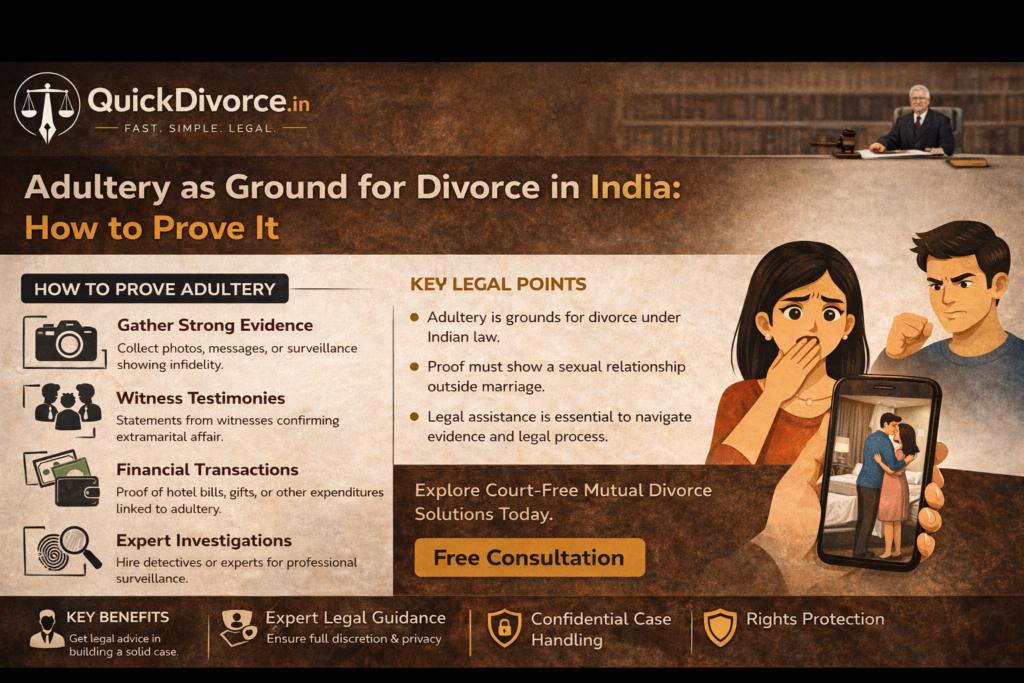
What Courts Have Accepted as Evidence of Adultery
Circumstantial Evidence, Taken as a Whole
Indian courts have consistently held that adultery can be inferred from a combination of circumstances that, individually, might not prove much, but together point clearly toward the conclusion. Commonly accepted categories include:
Evidence of opportunity and inclination. Courts have looked at whether the spouse and the alleged third party had both the opportunity to be alone together and a demonstrated romantic or sexual inclination toward each other, established through other evidence, rather than requiring proof of the act itself.
Visits to or stays at the same residence or hotel, particularly overnight or at suspicious hours. Hotel registration records, hotel staff testimony, or documented stays showing the spouse and the alleged third party checking into the same room or staying overnight together have been accepted as strong circumstantial evidence.
Communication records showing an intimate or romantic relationship. Messages, call logs, and similar records that establish the nature of the relationship — not merely friendly but romantically or sexually charged — support an inference of adultery, particularly when combined with evidence of opportunity.
Birth of a child that the husband could not have fathered. Where paternity is genuinely in question, DNA evidence establishing that a child born during the marriage is not biologically the husband’s is treated as strong, direct evidence supporting an adultery finding, since it points to a specific act rather than mere suspicion.
Admission or confession by the adulterous spouse. Where one spouse has admitted to the affair, whether in writing, in messages, or through testimony, this is naturally strong and direct evidence, though courts will still examine whether any such admission was genuinely voluntary.
Cohabitation as husband and wife with another person. Where a spouse has been living with another person in a manner presenting themselves as a couple, this is generally treated as compelling circumstantial evidence, even without direct proof of sexual relations during that cohabitation.
Witness Testimony
Testimony from people who observed relevant circumstances — a private investigator’s findings, a hotel employee, a neighbor, or a family member who witnessed specific incidents — is admissible and frequently used, though courts assess witness credibility carefully, including any potential bias, such as a witness being a close relative of the petitioner with an obvious interest in the outcome.
Private Investigator Reports
Reports from licensed private investigators documenting surveillance findings — photographs, observed meetings, travel patterns — are commonly used in adultery cases in India and can be presented as evidence, generally supported by the investigator’s own testimony establishing how the findings were obtained. Courts will scrutinize the methodology and reliability of such evidence rather than accepting it uncritically, and how this evidence was gathered matters considerably, a point covered further below.
What Courts Have Generally Not Accepted as Sufficient on Its Own
Mere suspicion or a generally described feeling of distrust, without specific supporting facts, dates, or circumstances, does not meet even the lower civil standard.
A single ambiguous photograph or message, without context establishing what it actually shows or means, taken entirely in isolation, is generally insufficient on its own, though it may form part of a larger circumstantial picture.
Evidence obtained through clearly illegal means, raising serious questions about admissibility and reliability — this is addressed in more detail below, since how evidence is gathered genuinely matters, not just what it appears to show.
Testimony from a witness with an obvious and significant motive to fabricate, where that motive is not adequately addressed or corroborated by anything independent.
How Evidence Is Actually Gathered — And the Legal Limits Around It
This is a part of adultery cases that deserves direct, honest treatment, because the desire to “catch” a cheating spouse can lead people toward methods that create serious legal problems of their own.
Private investigators are commonly engaged and their findings are generally usable, provided the methods used do not themselves violate the law — for instance, surveillance conducted in genuinely public spaces or through legitimate observation is different from methods involving trespass, illegal interception of communications, or other unlawful conduct.
Recording conversations or intercepting communications without consent raises real legal risk of its own. Indian law around the interception of communications, including unauthorized access to a spouse’s phone, messages, or email accounts, is genuinely complex, and depending on the specific method used, gathering evidence this way can expose the person doing the gathering to separate legal liability, entirely apart from whether the evidence helps the adultery case. This is not a technical footnote — it is a genuine risk that should be discussed with a lawyer before, not after, attempting any kind of covert evidence gathering.
Evidence obtained through a third party without the knowledge of either spouse, such as hotel records obtained through proper legal process rather than improper access, is generally more defensible than evidence obtained through methods that themselves involve unlawful conduct.
The safest and most reliable approach is to involve a lawyer before any evidence-gathering begins, specifically to assess what methods are both legally sound and likely to be accepted by the court, rather than gathering evidence first and discovering its legal vulnerabilities only after the fact.
How Adultery Fits Into a Broader Divorce Strategy
Adultery can be pleaded alongside cruelty. In many cases, the discovery of an affair is accompanied by other conduct — deception, neglect, public humiliation — that independently supports a cruelty claim under Section 13(1)(ia) of the Hindu Marriage Act, covered in our broader guide on divorce grounds generally. Pleading both grounds together, where the facts support it, gives the court more than one path to granting the divorce, reducing the risk that a case fails entirely if the adultery evidence alone is found insufficient.
Adultery findings can affect maintenance and alimony. While not automatically determinative, the conduct of the parties, including adultery, can be a factor courts weigh when deciding maintenance, particularly where it bears on the overall fairness of the financial outcome.
Adultery does not need to be proven if the case proceeds as mutual consent divorce instead. If, despite the affair, both spouses are willing to divorce by mutual consent, none of this evidentiary burden is necessary at all, since mutual consent divorce, as covered in our detailed guide on that process, does not require proving any specific ground. Many cases that begin with a spouse gathering adultery evidence ultimately resolve this way once the other spouse, faced with the evidence, agrees to a mutual settlement rather than contesting a finding in court.
What Happens If the Adultery Allegation Is False or Cannot Be Adequately Proven
It is worth addressing the other side of this honestly. If you are facing an adultery allegation that you believe is false, or exaggerated from an innocent friendship or association, the defense generally focuses on directly challenging the sufficiency of the circumstantial evidence presented — showing alternative, innocent explanations for the specific circumstances relied upon, challenging the reliability or motive of witnesses, and where private investigator evidence is involved, scrutinizing the methodology used to gather it. Given the lower civil standard of proof, a bare denial alone is often a weaker defense than affirmatively and specifically addressing each piece of circumstantial evidence presented.
Frequently Asked Questions
Q1. Is adultery still a crime in India that can lead to imprisonment?
No. The Supreme Court in Joseph Shine v. Union of India (2018) struck down Section 497 IPC, decriminalizing adultery. It remains, however, a valid civil ground for divorce.
Q2. Do I need to catch my spouse in the act to prove adultery in a divorce case?
No. Indian courts have consistently accepted that direct proof of the act itself is rarely available and have allowed adultery to be established through circumstantial evidence considered together, assessed against the civil standard of probability rather than the criminal standard of certainty.
Q3. Can I use evidence from a private investigator in my divorce case?
Generally yes, provided the methods used to gather that evidence were themselves lawful. Evidence gathered through illegal means, such as unauthorized interception of communications, raises serious concerns about both its admissibility and potential legal exposure for the person who gathered it.
Q4. What if I only have suspicious messages but no proof of an actual meeting?
Messages alone, particularly if ambiguous, are often insufficient by themselves, but can form part of a broader circumstantial case if combined with other evidence, such as proof of opportunity or witnessed meetings.
Q5. Can a DNA test be used as evidence of adultery?
Yes, where paternity is genuinely in question, DNA evidence establishing that a child is not biologically the husband’s is treated as strong, direct evidence supporting an adultery finding.
Why Choose Quick Divorce
Adultery cases live or die on the quality and legality of the evidence behind them. We help clients understand realistically what they already have, what additional evidence would meaningfully strengthen the case, and which evidence-gathering methods are legally sound versus which carry risk of their own — so that the case presented in court is both strong and built on a foundation that will not unravel under cross-examination.
Book your free consultation today: 📞 Call / WhatsApp: 8595439395 🌐 Website: www.quickdivorce.in
Get Expert Legal Help for Matrimonial Matters
🟡 QuickDivorce.in provides complete mutual divorce filing, settlement drafting, court representation, and NRI divorce services across all jurisdictions in India.
🟡Visit LegalTax.in for other Legal and Trademark related services as 👉 Money Recovery Cases 👉 Property Disputes 👉 Business & Licence Registrations
🟡Visit Business24hub for IT services
👉 Mutual Consent Divorce at QuickDivorce.in 👉 Contested Divorce Filing 👉 Child Custody and Maintenance 👉 Matrimonial Property Settlement 👉 NRI Divorce Services 👉 Alimony and Maintenance
🟡 Protect Your Rights 👉 Domestic Violence Legal Support at QuickDivorce.in 👉 Stridhan Recovery
📞 Call Now: +91 8595439395 🕐 Free Consultation: Monday to Saturday, 10 AM to 6 PM

Adv. Manish Kashyap is a Family Law & Divorce Lawyer with extensive experience in Mutual & Contested Divorce, NRI Divorce, Child Custody, Alimony, Domestic Violence, Judicial Separation, and Family Court matters, providing professional legal guidance to clients.

