

Views: 11
Table of Contents
- 1 The Question Everyone Asks First, and Why the Honest Answer Is “It Depends, But Here Is the Range”
- 2 The Two Numbers That Matter Most
- 3 Stage 1 — Before You Even File: Settlement and Document Preparation
- 4 Stage 2 — Filing the Petition and First Motion Hearing
- 5 Stage 3 — The Cooling Off Period (Or Its Waiver)
- 6 Stage 4 — Second Motion and Final Decree
- 7 Stage 5 — Collecting the Certified Decree
- 8 Full Timeline Side by Side
- 9 What Can Make Mutual Divorce Take Even Longer Than the Standard Range
- 10 What You Can Actually Control to Speed Things Up
- 11 Frequently Asked Questions
- 12 Why Choose Quick Divorce
- 13 Get Expert Mutual Divorce Legal Assistance
The Question Everyone Asks First, and Why the Honest Answer Is “It Depends, But Here Is the Range”
Almost every person who calls about mutual divorce asks the timeline question before they ask anything else, and that makes complete sense. You have already made the hardest decision. What you want now is to know how long you have to live in legal limbo before your life is actually, formally your own again.
The honest answer is that mutual divorce in India typically takes anywhere from about three months to just under fifteen months, and the single biggest factor separating the fast end of that range from the slow end is whether the mandatory cooling off period gets waived, a topic we cover in full depth in our dedicated guide on that exact question. This guide focuses specifically on timeline, stage by stage, so you know exactly what is happening during each part of the wait and what you can realistically influence.
The Two Numbers That Matter Most
Before the stage by stage breakdown, here are the two headline figures, because most people really just want this comparison:
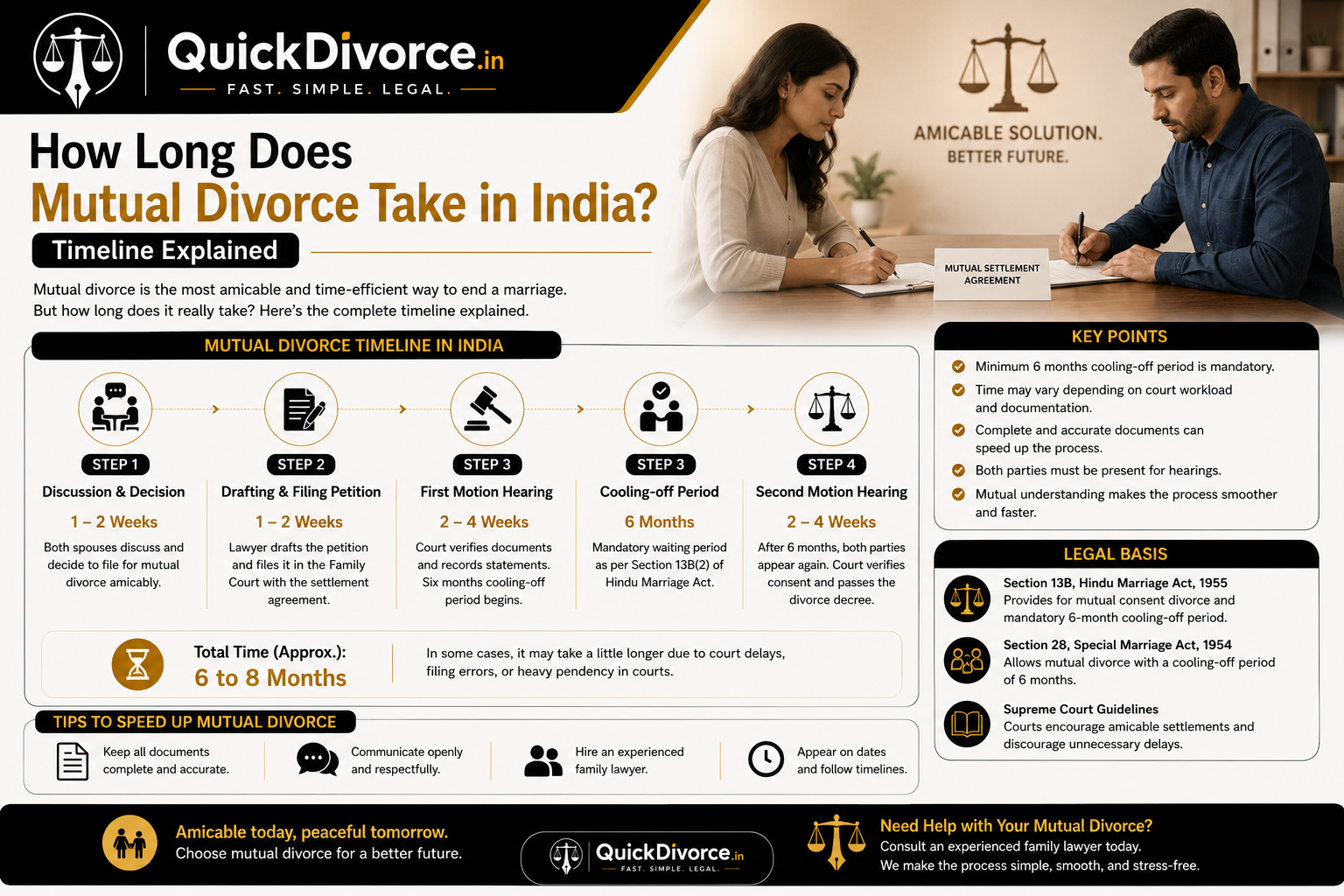
With the cooling off period waived: roughly 6 to 12 weeks from filing to final decree, in straightforward cases with a complete settlement.
Without waiver, following the standard statutory process: roughly 7 to 14 months from filing to final decree.
Everything below explains why the range exists within each of these, and what specifically determines where in that range your case lands.
Stage 1 — Before You Even File: Settlement and Document Preparation
This stage is not counted in most “how long does divorce take” answers, but it absolutely should be, because in practice it often takes longer than any single stage after filing.
Typical duration: 2 to 6 weeks, though this varies enormously depending on how settled things already are between you and your spouse.
During this stage, you and your spouse need to reach genuine agreement on maintenance, child custody if applicable, division of property, and return of any dowry or Stridhan, and have this properly documented in a settlement agreement, as covered in detail in our guide on drafting a mutual divorce settlement agreement. You also need to gather the documents covered in our checklist for divorce consultations — marriage certificate, identity proof, and proof of having lived separately for the required period.
What speeds this up: couples who arrive at their first consultation having already discussed and broadly agreed on terms, even informally, move through this stage considerably faster than couples who are still negotiating fundamental questions when they first see a lawyer.
What slows this down: unresolved disagreements on custody or maintenance amounts, missing or lost documents (our guide on replacing a lost marriage certificate is relevant if this applies to you), or one party being abroad and needing time to send notarized or apostilled documents.
Stage 2 — Filing the Petition and First Motion Hearing
Typical duration: 4 to 8 weeks from filing to the First Motion hearing, depending on the specific Family Court’s current caseload and scheduling.
Once your petition and settlement agreement are filed, the court assigns a case number and a first hearing date. At this First Motion hearing, both spouses appear personally before the judge, who records statements confirming that consent to divorce is genuine, free, and voluntary.
What speeds this up: filing in a Family Court with a less congested schedule can mean an earlier first date, though jurisdiction is determined by law, not by which court is fastest, so this is not something you can simply choose for speed.
What slows this down: incomplete paperwork at filing, which can result in the matter being listed for refiling rather than proceeding straight to hearing, and basic scheduling backlogs that vary by city and specific court.
Stage 3 — The Cooling Off Period (Or Its Waiver)
This is where the timeline genuinely forks, and it is worth understanding both paths clearly.
Without Waiver — The Standard 6 Month Wait
Section 13B(2) of the Hindu Marriage Act, and the equivalent provisions under the Special Marriage Act and Indian Divorce Act, require a minimum gap of six months between the First Motion and the Second Motion, extendable up to eighteen months if the Second Motion is not filed within that window. In practice, most couples proceeding without waiver file the Second Motion as close to the six month mark as scheduling allows.
With Waiver — Reduced to Weeks
Following the Supreme Court’s judgment in Amardeep Singh v. Harveen Kaur (2017), covered in full detail in our dedicated guide on waiving the cooling off period, courts have discretion to waive this six month wait where the parties have genuinely settled all disputes, have already been separated well beyond the minimum one year, and confirm there is no possibility of reconciliation.
Typical duration with waiver granted: 1 to 4 weeks between the First Motion and the Second Motion being scheduled.
What determines whether you get waiver: primarily the completeness of your settlement agreement and how clearly your case demonstrates the conditions laid out in Amardeep Singh. This is the single highest-leverage decision point in your entire timeline, and it is worth investing properly in a strong settlement agreement and a well-drafted waiver application specifically because of how much time it can save.
Stage 4 — Second Motion and Final Decree
Typical duration: same day as the Second Motion hearing, in straightforward, uncontested cases where both parties appear and reaffirm consent.
At the Second Motion, both spouses appear again, confirm that their consent has not changed, and the court passes the final decree of divorce, generally on the same day or within a few days.
What speeds this up: both parties appearing promptly and consent remaining clearly unchanged from the First Motion.
What slows this down, in rare cases: if either party expresses any hesitation or the court has reason to question whether consent remains genuine, the matter may be adjourned for further clarification rather than decided immediately. This is uncommon where the settlement was genuinely solid from the outset.
Stage 5 — Collecting the Certified Decree
Typical duration: a few days to about two weeks after the decree is pronounced.
The certified copy of the divorce decree, which you will need for name changes, remarriage, property matters, and any future legal purpose, is generally collected from the court registry a short time after the decree itself is passed. This is usually handled by your lawyer’s office and does not require you to personally return to court for this specific step in most cases.
Full Timeline Side by Side
| Stage | With Waiver | Without Waiver |
|---|---|---|
| Settlement and document preparation | 2 to 6 weeks | 2 to 6 weeks |
| Filing to First Motion | 4 to 8 weeks | 4 to 8 weeks |
| Cooling off period | 1 to 4 weeks | 6 months (up to 18 months max) |
| Second Motion to decree | Same day | Same day |
| Decree collection | Days to 2 weeks | Days to 2 weeks |
| Total, approximate | 6 to 12 weeks from filing | 7 to 14 months from filing |
What Can Make Mutual Divorce Take Even Longer Than the Standard Range
A few specific situations push the timeline beyond even the “without waiver” range above, and it is worth knowing about these so you are not caught off guard.
One spouse is an NRI with limited ability to travel. As covered in our guide on Power of Attorney for NRI divorce cases, both spouses must personally appear for the First Motion and Second Motion regardless of any Power of Attorney arrangement. If aligning two international trips around court dates is difficult, this can stretch the practical timeline considerably even with waiver granted, simply due to travel logistics rather than legal process.
The settlement unravels partway through. If one party withdraws consent before the Second Motion is filed, mutual divorce cannot proceed at all, and the matter would need to convert to a contested divorce, a dramatically longer process covered in our guide comparing mutual and contested divorce.
The marriage certificate or other key documents are missing and need to be reconstructed. As covered in our guide on obtaining a duplicate Arya Samaj marriage certificate, this process itself can take anywhere from several days to a few weeks, and ideally should be resolved before filing rather than discovered as a problem partway through.
Pending criminal complaints, such as a 498A FIR, have not been addressed. Since 498A is non-compoundable, a private settlement does not automatically end such proceedings, as covered in our guide on defending false 498A cases. Coordinating the quashing of any pending FIR alongside the divorce settlement adds a parallel legal step that needs to be properly sequenced rather than assumed to resolve itself.
What You Can Actually Control to Speed Things Up
Realistically, three things are within your control, and they matter more than anything else on this list:
Arrive at your first consultation with a clear, complete picture of what you want to settle on. Our guide on documents to prepare before an online divorce consultation covers exactly this. The fewer open questions remain when drafting begins, the faster drafting finishes.
Draft a settlement agreement that is specific rather than vague. Settlement terms with exact figures, exact dates, and exact custody schedules, rather than phrases like “reasonable amount” or “as mutually agreed,” both prevent future disputes and make a stronger case for cooling off period waiver, since courts specifically look for genuine, comprehensive resolution of all matters.
Apply for waiver from the outset, not as an afterthought. Filing the waiver application alongside or immediately after the First Motion, rather than waiting to see how things go, is the single biggest lever on your overall timeline.
Frequently Asked Questions
Q1. What is the absolute fastest a mutual divorce has been completed in India?
In ideal circumstances, with a complete settlement from the outset and a court that grants waiver promptly, some cases have been completed in as little as 4 to 6 weeks from filing. This is the fast end of the range and not a typical guarantee for every case.
Q2. Does the one year separation requirement before filing count toward the divorce timeline?
No. The one year of living separately is generally a precondition that must already be satisfied before you can file the joint petition at all, so it is separate from, and prior to, the timeline that starts running from the date of filing.
Q3. If we are unsure whether we qualify for waiver, should we still apply for it?
Generally yes, since applying does not extend the timeline if refused, you simply proceed on the standard schedule, while applying gives you the chance at a dramatically shorter timeline if the conditions are met.
Q4. Can the timeline differ significantly between cities?
Yes, court scheduling backlogs vary by city and even by specific Family Court bench, which affects how quickly a First Motion or Second Motion date is assigned within the general ranges described above.
Q5. Does having children involved make mutual divorce take longer?
Not inherently, provided custody and child maintenance terms are clearly and completely settled in the agreement. Vague or incomplete custody arrangements are more likely to slow things down than the mere presence of children itself.
Q6. What happens to the timeline if my spouse is abroad?
If your spouse is an NRI, the legal stages remain the same, but practical scheduling around international travel for the First and Second Motion appearances, which cannot be delegated through Power of Attorney, often becomes the real bottleneck rather than the court process itself.
Why Choose Quick Divorce
The timeline of your mutual divorce is shaped far more by preparation than by luck. We help clients build a complete, specific settlement agreement from the first consultation, file waiver applications proactively rather than as an afterthought, and coordinate NRI travel schedules around court dates so the legal process moves as quickly as the law genuinely allows.
Book your free consultation today: 📞 Call / WhatsApp: 8595439395 🌐 Website: www.quickdivorce.in
Get Expert Mutual Divorce Legal Assistance
🟡 QuickDivorce.in provides complete mutual divorce services — petition drafting, settlement negotiation and drafting, first and second motion representation, waiver applications, NRI video conferencing appearances, and post-decree implementation support across all jurisdictions in India.
🟡Visit LegalTax.in for other Legal and Trademark related services as 👉 Money Recovery Cases
👉 Property Disputes 👉 Business & Licence Registrations
🟡Visit Business24hub for IT services
👉 Mutual Consent Divorce at QuickDivorce.in 👉 Contested Divorce Filing 👉 Child Custody and Maintenance 👉 Matrimonial Property Settlement 👉 NRI Divorce Services 👉 Alimony and Maintenance
🟡 Protect Your Rights 👉 Domestic Violence Legal Support at QuickDivorce.in 👉 Stridhan Recovery
📞 Call Now: +91 8595439395 🕐 Free Consultation: Monday to Saturday, 10 AM to 6 PM

I’m Aryan Yadav, passionate about SEO and Digital Marketing with a strong interest in helping businesses grow online. I enjoy learning new strategies, exploring digital trends, and creating ideas that deliver value. I believe in continuous growth, creativity, and building meaningful results through smart work and dedication.

