

Views: 23
Table of Contents
- 1 Mediation Is a Detour That Sometimes Turns Into the Destination
- 2 Why Mediation Happens at All in Indian Divorce Cases
- 3 How Long a Single Mediation Session Typically Takes
- 4 How Many Sessions Are Typically Needed
- 5 Stage-by-Stage Timeline
- 6 Total Realistic Timeline for the Mediation Phase Itself
- 7 What Speeds Mediation Up
- 8 What Slows Mediation Down
- 9 Can Mediation Be Skipped Entirely?
- 10 Does Mediation Apply to Mutual Consent Divorce Too?
- 11 Frequently Asked Questions
- 12 Why Choose Quick Divorce
- 13 Need Help With Divorce Mediation or any Legal Sevices ?
Mediation Is a Detour That Sometimes Turns Into the Destination
Divorce mediation is a practical and cost-effective method for resolving disputes between spouses without engaging in lengthy court battles. In this process, a neutral mediator helps both parties communicate, negotiate, and reach mutually acceptable agreements on important issues such as child custody, visitation rights, alimony, property division, and financial settlements. Unlike traditional litigation, mediation encourages cooperation and confidentiality while giving couples greater control over the outcome of their divorce. In India, divorce mediation is increasingly being preferred as it reduces emotional stress, saves time and legal expenses, and often leads to more amicable post-divorce relationships, especially when children are involved.
Most people encounter mediation as something a Family Court tells them to do, not something they chose, which means most people’s first real question about it is simply: how much time is this going to add to a process that already feels too slow?
The honest answer is that mediation itself, as a structured process, is usually one of the shorter stages in a divorce case, typically resolved within a few weeks to a couple of months. What confuses the timeline question is that mediation does not happen in isolation from everything else — it sits inside a contested divorce proceeding that, as covered in our guide comparing mutual and contested divorce, can independently run for years regardless of what happens in mediation. Understanding where mediation fits, and what it can actually save you in time, is the real question worth answering.
Why Mediation Happens at All in Indian Divorce Cases
Family Courts in India are generally required to refer matrimonial disputes to mediation before proceeding with a contested trial, reflecting a broader judicial policy preference for resolving family disputes through agreement rather than adversarial litigation wherever genuinely possible. This typically happens early in a contested divorce, after the petition has been filed and the respondent has at least entered appearance, but before the case moves into the lengthy evidence and trial stage.
Mediation centres attached to Family Courts, generally staffed by trained mediators, some of whom are practicing advocates with specific mediation training, conduct these sessions. The process is confidential, meaning what is discussed in mediation generally cannot be used as evidence against either party if the matter proceeds to trial, which is specifically designed to encourage open and honest discussion rather than tactical positioning.
How Long a Single Mediation Session Typically Takes
A typical session runs roughly 45 minutes to 2 hours, depending on the mediator’s style, how many issues are on the table, and how the conversation is going on that particular day. Some mediators prefer shorter, more frequent sessions; others prefer fewer, longer sessions that go deeper into specific issues each time.
How Many Sessions Are Typically Needed
This varies more than almost any other part of the timeline, because it depends heavily on how far apart the parties actually are on the substance of their dispute, not on any fixed procedural rule.
Straightforward cases, where both parties are broadly willing to settle and disagreement is mainly about specific numbers or schedules: often resolved in 2 to 4 sessions, sometimes fewer.
More complex cases, involving significant property, business interests, or deeply contested custody arrangements: can run to 6 to 10 sessions or more, since each major issue — maintenance, custody, property division, return of Stridhan — may need its own dedicated discussion, and agreement on one issue sometimes unlocks movement on others.
Cases where one party is not genuinely willing to engage, even if formally present: mediators will generally not continue indefinitely where there is no real movement, and such cases are typically returned to the court as unsuccessful within a relatively small number of sessions, often 2 to 3, rather than being drawn out further.
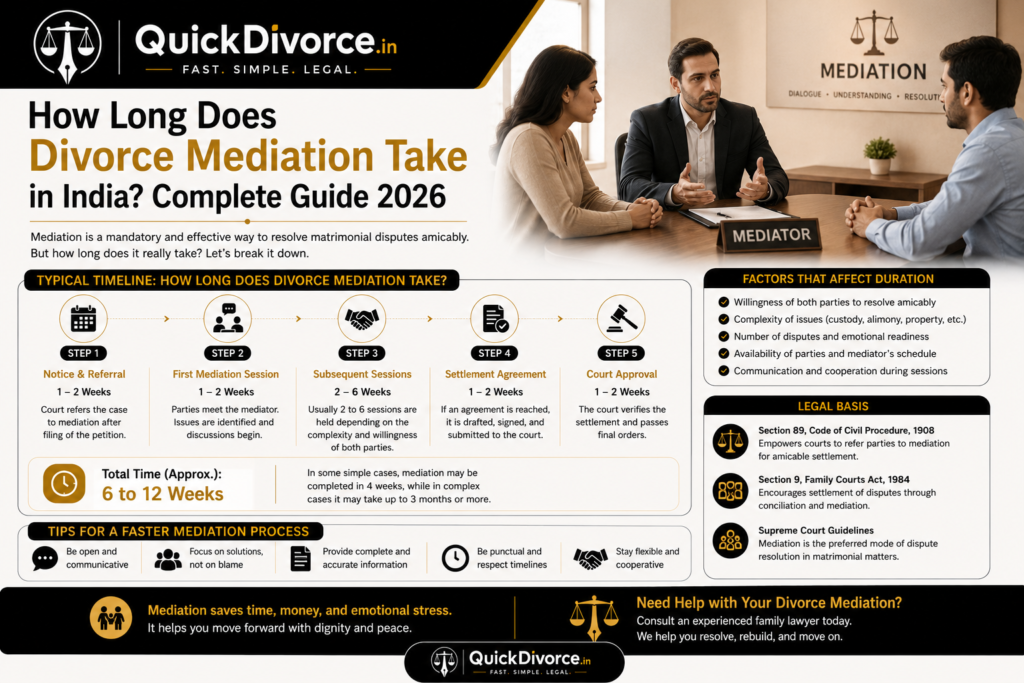
Stage-by-Stage Timeline
Stage 1 — Referral to Mediation
Typical duration: built into the early hearings of a contested case, generally occurring once the respondent has appeared and before the matter is set down for full evidence and trial. This is not really a separate waiting period so much as a point reached naturally within the first few months of a contested case’s procedural timeline.
Stage 2 — Scheduling the First Session
Typical duration: 2 to 6 weeks from referral to the first actual mediation session, depending on the specific mediation centre’s current caseload and the availability of both parties and their lawyers.
Stage 3 — The Mediation Sessions Themselves
Typical duration: 4 to 12 weeks from the first session to either a settlement or a declaration that mediation has failed, depending on the number of sessions needed as described above, and on how frequently sessions are scheduled, since centres do not always offer sessions weekly and gaps of two to three weeks between sessions are common depending on mediator and party availability.
Stage 4 — Outcome
If mediation succeeds: the agreed terms are documented, typically converted into a formal settlement agreement as covered in our detailed guide on drafting a mutual divorce settlement agreement, and the case is generally converted to a mutual consent divorce petition. From this point, the timeline shifts entirely to the mutual divorce process described in our dedicated guide on that timeline, including the possibility of seeking a cooling-off period waiver.
If mediation partially succeeds: some issues are resolved and narrowed, while remaining disputed issues return to the court for trial, meaning the case proceeds as a contested matter, but on a narrower and often faster set of issues than originally pleaded.
If mediation fails entirely: the case returns to the regular contested divorce track, continuing through written statements, evidence, and trial, as covered in our guide on mutual versus contested divorce timelines.
Total Realistic Timeline for the Mediation Phase Itself
| Scenario | Approximate Total Mediation-Phase Duration |
|---|---|
| Straightforward case, full settlement reached | 6 to 16 weeks |
| Complex case, full settlement eventually reached | 3 to 6 months |
| Partial settlement, narrowed issues return to trial | 2 to 4 months |
| No genuine engagement, mediation fails quickly | 4 to 8 weeks |
It is worth being clear about what this table does and does not capture: it covers only the mediation phase itself. Where mediation succeeds, it can save years compared to a fully contested trial. Where it fails, the case simply continues on the contested track, and the weeks spent in mediation, while not wasted in the sense of attempting resolution, do add to the overall timeline rather than shortening it.
What Speeds Mediation Up
Both parties arriving with a realistic, specific sense of what they actually want, rather than starting purely from emotional positions, lets sessions move from venting toward genuine negotiation faster.
Lawyers who prepare clients properly before each session, including reviewing what was discussed last time and what specifically needs to move forward, rather than starting fresh each session.
Addressing the most contentious single issue first, when both sides are willing to do this, since resolving the hardest point often makes the remaining issues considerably easier and faster to settle.
A mediator with genuine experience in family matters specifically, rather than general civil mediation experience alone, since family disputes carry emotional dynamics that benefit from a mediator skilled at managing them productively.
What Slows Mediation Down
One party using mediation primarily as a delay tactic, attending sessions without genuine intent to settle, simply to be seen as cooperating with the court’s process while the underlying contested case continues regardless.
Significant, complex assets requiring valuation or detailed disclosure before any meaningful negotiation can occur, such as business interests or property whose value is genuinely disputed, which sometimes means mediation needs to pause while these are independently assessed.
Unresolved emotional conflict that has not yet allowed either party to engage practically, where sessions are still substantially about processing hurt and anger rather than reaching workable terms, which is a normal part of many people’s experience but does extend the practical timeline before substantive agreement becomes possible.
Scheduling conflicts, particularly where one party is an NRI, and aligning international travel or video participation, where the specific mediation centre allows it, with both the mediator’s and the other party’s availability adds its own delay, similar to the broader NRI scheduling challenges covered in our guide on Power of Attorney for NRI divorce cases.
Can Mediation Be Skipped Entirely?
In some circumstances, yes, though this is generally for the court to decide rather than either party unilaterally. Courts have shown willingness to dispense with mediation where there is a clear, documented history of domestic violence making genuine negotiation between the parties inappropriate or unsafe, or where one party has already demonstrated, through prior conduct, that mediation would serve no real purpose. This is not something to assume applies to your case without discussing it specifically with your lawyer, since the default expectation remains that mediation will be attempted.
Does Mediation Apply to Mutual Consent Divorce Too?
Generally less so as a mandatory step, since mutual consent divorce by definition already involves both parties’ agreement to divorce. However, where a couple has agreed to divorce but is still working out specific terms — particularly around custody or maintenance amounts — a mediator can still be genuinely useful in finalizing those details even outside a formally court-referred contested mediation process, and some couples engage a mediator privately for exactly this purpose before filing their mutual consent petition at all, which is a different and generally faster process than court-referred mediation within an already-pending contested case.
Frequently Asked Questions
Q1. Is mediation legally mandatory in every contested divorce case in India?
Generally yes, Family Courts typically refer matrimonial disputes to mediation as a matter of standard practice before proceeding to trial, though courts retain discretion to dispense with it in specific circumstances, such as documented domestic violence.
Q2. What happens if I don’t want to attend mediation at all?
You can express this to your lawyer and the court, but courts generally expect at least an initial good-faith attempt at mediation as part of standard process. Outright refusal without a substantial reason is uncommon and may not be well received by the court.
Q3. Is anything said during mediation used against me later in court if it fails?
No, mediation is generally treated as a confidential process, and what is discussed there is not meant to be used as evidence in subsequent contested proceedings if mediation does not result in settlement.
Q4. Can I bring my own private mediator instead of using the court-appointed one?
This depends on the specific court and circumstances. Some courts permit parties to use a private, mutually agreed mediator, while court-referred mediation often defaults to the mediation centre attached to that Family Court. Discuss this option with your lawyer if you have a strong preference.
Q5. If mediation succeeds, does that mean the divorce is finalized immediately?
No, a successful mediation typically results in the case converting to a mutual consent divorce petition, which then follows its own timeline, including the standard cooling-off period or a possible waiver, as covered in our dedicated guides on those topics.
Q6. How does mediation work if one spouse is an NRI and cannot easily attend sessions in person?
This varies by mediation centre and is worth raising directly with your lawyer and the court. Some centres have accommodated video participation in appropriate cases, though this is not universal, and scheduling around international availability often becomes the practical bottleneck rather than the mediation process itself.
Why Choose Quick Divorce
We prepare clients properly before every mediation session, rather than treating it as a formality to get through, because a well-prepared mediation genuinely has the power to turn a years-long contested case into a matter resolved in months. Where mediation is not the right fit for a specific situation, we say so honestly and focus instead on building the strongest possible contested case.
Book your free consultation today: 📞 Call : 8595439395 🌐 Website: www.quickdivorce.in
Need Help With Divorce Mediation or any Legal Sevices ?
🟡 QuickDivorce.in provides complete mediation legal services — settlement negotiation, alimony structuring, property division, stridhan recovery, MoU drafting, court representation, and post-decree implementation: across all jurisdictions in India.
🟡Visit LegalTax.in for other Legal and Trademark related services as 👉 Money Recovery Cases
👉 Property Disputes 👉 Business & Licence Registrations
🟡Visit Business24hub for IT services
👉 Mutual Consent Divorce at QuickDivorce.in 👉 Contested Divorce Filing 👉 Child Custody and Maintenance 👉 Matrimonial Property Settlement 👉 NRI Divorce Services 👉 Alimony and Maintenance
🟡 Protect Your Rights 👉 Domestic Violence Legal Support at QuickDivorce.in 👉 Stridhan Recovery
📞 Call Now: +91 8595439395 🕐 Free Consultation: Monday to Saturday, 10 AM to 6 PM

Adv. Manish Kashyap is a Family Law & Divorce Lawyer with extensive experience in Mutual & Contested Divorce, NRI Divorce, Child Custody, Alimony, Domestic Violence, Judicial Separation, and Family Court matters, providing professional legal guidance to clients.

