

Views: 7
Table of Contents
- 1 Filing the Case Is the Easy Part. Knowing Which Case to File Is Not.
- 2 Step 1 — Determine Whether You Even Need to File a Separate Custody Case
- 3 Step 2 — Identify Which Law Applies to Your Petition
- 4 Step 3 — Identify the Correct Court
- 5 Step 4 — Gather the Required Documents
- 6 Step 5 — Draft and File the Petition
- 7 Step 6 — Notice to the Other Parent
- 8 Step 7 — Interim Custody and Urgent Applications
- 9 Step 8 — Investigation and Evidence
- 10 Step 9 — Final Order
- 11 Step 10 — Modification, If Circumstances Change Later
- 12 Frequently Asked Questions
- 13 Why Choose Quick Divorce
- 14 Need Consutation
Filing the Case Is the Easy Part. Knowing Which Case to File Is Not.
When parents separate or divorce, one of the most important legal issues is deciding the custody of their child. Understanding how to file for child custody is essential for protecting the child’s welfare and ensuring their future is secure. In India, child custody petitions can be filed before the appropriate family court, where the primary consideration is always the best interests of the child. The court examines various factors such as the child’s age, education, emotional well-being, financial stability of the parents, and the ability of each parent to provide a safe and nurturing environment. Whether you are a mother or a father seeking custody, knowing the legal procedure, required documents, and court process can help you present a stronger case and safeguard your parental rights.
By the time most parents are ready to actually file for custody, the emotional decision has already been made. What they need at that point is not reassurance — it is a clear, practical map of what filing actually involves: which law applies, which court to approach, what documents to gather, and what happens in the weeks immediately after filing.
This guide walks through that procedure step by step. The substantive question of how courts decide who gets custody — the welfare principle, age factors, parental fitness — is covered in full in our guides on how Indian courts decide custody and on mother versus father custody rights. This guide assumes you already understand the substance and focuses specifically on the mechanics of filing.
Step 1 — Determine Whether You Even Need to File a Separate Custody Case
Before anything else, it is worth establishing whether custody needs to be a standalone case at all.
If you are already filing for divorce, custody is generally included as part of that same petition rather than filed separately, whether the divorce is mutual or contested. In mutual consent divorce, custody terms are part of the settlement agreement, as covered in our guide on drafting that document. In contested divorce, custody is one of the reliefs claimed within the divorce petition itself.
If you are not filing for divorce, or divorce proceedings are already over and a new custody dispute has arisen, or if you were never married to the other parent at all, a standalone custody petition is the correct route, generally filed under the Guardians and Wards Act, 1890, which applies regardless of religion or marital status.
If there is an immediate, urgent concern — a child has been taken away suddenly, or there is a real fear of imminent removal from the country — the procedure shifts toward urgent interim relief, including potentially a habeas corpus petition before the High Court, which moves on a dramatically faster timeline than a standard custody filing. If this applies to you, say so clearly to your lawyer at the outset rather than following the standard procedure below.
Step 2 — Identify Which Law Applies to Your Petition
This determines which specific provisions you cite and, to some extent, which court has jurisdiction.
Guardians and Wards Act, 1890 — the secular, default statute applicable to all communities, and the one most commonly used for standalone custody petitions regardless of religion.
Hindu Minority and Guardianship Act, 1956 — applies specifically to Hindus, Sikhs, Jains, and Buddhists, generally read alongside the Guardians and Wards Act rather than as a complete standalone alternative to it.
Personal law provisions for other communities — Muslim personal law principles on Hizanat, the Indian Divorce Act for Christians, or the Special Marriage Act framework, depending on the nature of the marriage and the parties’ religion, as relevant to your specific situation.
In practice, most standalone custody petitions in India are filed under the Guardians and Wards Act, with personal law principles argued as relevant factors within that proceeding rather than as a wholly separate legal basis. Your lawyer will confirm the precise combination applicable to your specific facts.
Step 3 — Identify the Correct Court
Custody petitions under the Guardians and Wards Act are filed before the Family Court (in cities where Family Courts have been established) or the District Court exercising guardianship jurisdiction, in the area where the child ordinarily resides.
This is an important and sometimes overlooked point: jurisdiction for a custody petition follows the child’s residence, not necessarily the petitioner’s residence or even where the marriage took place. If the child currently lives with the other parent in a different city or state, the petition generally needs to be filed where the child actually is, which can mean filing in a court far from where you yourself live.
For NRI situations, where a child has connections to both India and another country, jurisdiction itself can become a contested question, as covered in detail in our dedicated guide on Indian courts’ powers in NRI custody cases. Confirm jurisdiction carefully before filing in these situations rather than assuming the obvious court is necessarily the correct one.
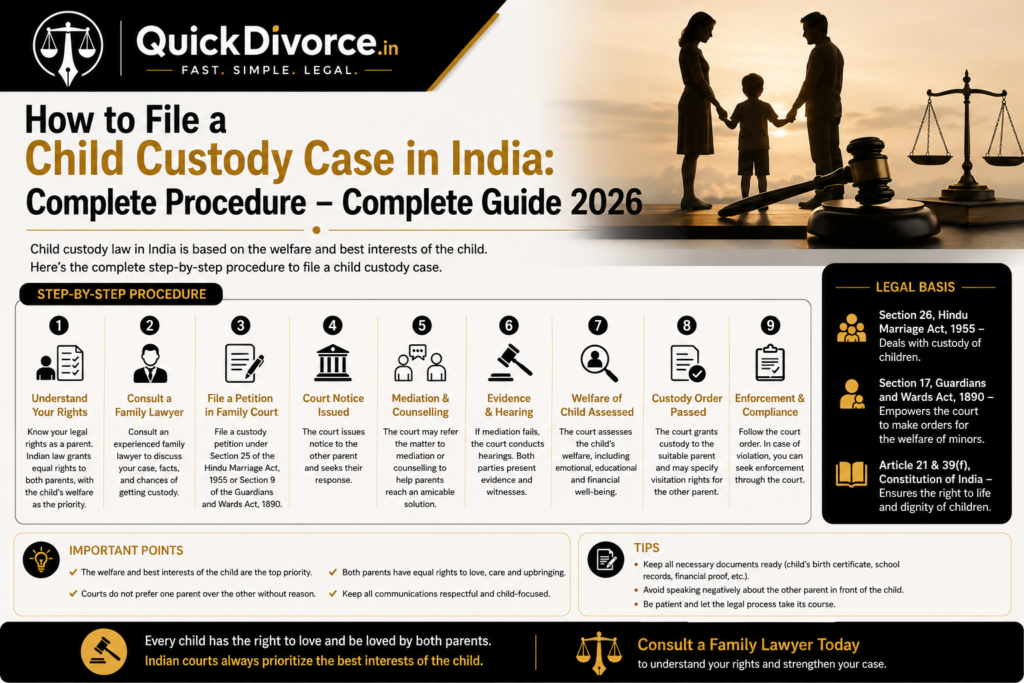
Step 4 — Gather the Required Documents
Identity and relationship proof:
- Birth certificate of the child, establishing parentage
- Marriage certificate of the parents, if applicable
- Identity proof of the petitioner — Aadhaar, passport, or voter ID
Evidence of current custody and care arrangement:
- School records showing which parent has been managing the child’s education
- Medical records showing involvement in the child’s healthcare
- Any informal or prior custody arrangement, even if undocumented formally, described clearly with dates
Evidence supporting your fitness as custodian, and where relevant, the other parent’s fitness:
- Income proof — salary slips, bank statements, income tax returns
- Proof of stable residence
- Any evidence relevant to specific concerns, such as documented incidents of cruelty or domestic violence, as covered in our guides on filing an FIR for matrimonial disputes and on domestic violence complaints, where these are relevant to your custody claim
If divorce or other matrimonial proceedings are connected to this case:
- Copies of the divorce petition or decree, if applicable
- Any existing maintenance or settlement orders
For NRI petitioners or respondents:
- Passport and visa documentation
- Proof of the child’s residence history, particularly relevant to establishing habitual residence in cross-border cases
Step 5 — Draft and File the Petition
The petition itself, prepared by your lawyer, will generally include:
- Full details of both parents and the child, including date of birth
- The relationship between the parties and the background of the marriage or relationship
- A clear statement of the current custody and living arrangement
- The specific relief sought — sole custody, joint custody, a specific visitation schedule, or modification of an existing order
- The factual basis supporting why the requested arrangement serves the child’s welfare
- Any urgent interim relief sought alongside the main petition, such as a restraint on international travel or a request for interim custody pending final decision
The petition is filed before the Registry of the relevant Family or District Court, along with the prescribed court fee, which is generally nominal for guardianship matters, and the case is assigned a number and a first hearing date.
Step 6 — Notice to the Other Parent
Once filed, the court issues notice to the respondent — generally the other parent — informing them of the petition and directing them to appear and respond. Standard modes of service apply, including personal service, registered post, or, where the respondent cannot be located through ordinary means, substituted service through newspaper publication or other court-approved methods.
For NRI respondents, service abroad follows applicable rules for international service of legal process, which can take longer than domestic service, and this is worth factoring into your expectations for how quickly the first substantive hearing will actually occur.
Step 7 — Interim Custody and Urgent Applications
Where the petition includes a request for interim relief — interim custody while the case is pending, or a restraint on removing the child from the jurisdiction — the court can hear and decide this specific application on an expedited basis, often well before the main custody question is finally resolved, precisely because the law recognizes that some custody-related harms cannot wait for a full trial to be prevented.
If your situation involves any genuine urgency — a specific, credible risk of the child being taken away, for instance — make sure this is flagged prominently in the petition and raised explicitly with the court at the first opportunity, rather than left to be addressed only as part of the general timeline.
Step 8 — Investigation and Evidence
Depending on the complexity and contentiousness of the case, the court may:
- Direct a home study or welfare report from a court-appointed officer or social worker, assessing each parent’s living situation and care arrangement
- Appoint a child psychologist to assess the child’s wellbeing, preferences, and any signs of distress or parental alienation, particularly relevant where the child is old enough for their preference to carry weight, as covered in our detailed guide on the factors courts consider
- Speak to the child directly, sometimes in chambers without either parent present, particularly for children above approximately nine years of age
Both parties present their evidence, including witness testimony where relevant, and the matter proceeds through the standard trial process if it is not resolved through settlement along the way.
Step 9 — Final Order
The court passes a final custody order specifying physical custody, legal custody, and a detailed visitation schedule, generally including specific provisions for holidays, communication, and, where relevant to NRI cases, travel and relocation conditions, as covered in our dedicated guide on Indian courts’ powers in cross-border custody matters.
Step 10 — Modification, If Circumstances Change Later
A custody order is not necessarily final forever. Either parent can apply for modification later if there has been a genuine, material change in circumstances — relocation, a change in either parent’s situation, or the child’s own evolving needs and preferences as they grow older. This generally requires filing a fresh application before the same court that passed the original order, rather than starting an entirely new case from scratch.
Frequently Asked Questions
Q1. Do I need to be divorced before I can file for child custody?
No. Custody can be sought as part of divorce proceedings, but a standalone custody petition under the Guardians and Wards Act can also be filed independently of any divorce case, including by unmarried parents.
Q2. Which court has jurisdiction over a custody case?
Generally the Family Court or District Court in the area where the child ordinarily resides, not necessarily where the petitioner lives or where the marriage took place.
Q3. How long does it take to get an interim custody order after filing?
This varies by court, but interim applications are generally heard on a faster timeline than the main custody petition itself, particularly where genuine urgency is shown, sometimes within weeks rather than months.
Q4. Can I file for custody if my child currently lives in a different city than me?
Yes, but the petition itself is generally filed in the court where the child resides, which may mean filing in that other city rather than your own.
Q5. What if the other parent refuses to accept service of the custody notice?
Substituted service, including through newspaper publication or other court-approved methods, can be used where a respondent cannot be served through ordinary means, allowing the case to proceed regardless.
Q6. Can grandparents or other relatives file a custody case?
Yes, the Guardians and Wards Act allows any person, including grandparents, to apply for guardianship of a minor child, generally in situations where neither parent is able or fit to have custody.
Why Choose Quick Divorce
Filing a custody case correctly from the outset, with the right law cited, the right court identified, and the right evidence organized, meaningfully affects both how quickly the case moves and how strong your position is from day one. We help parents file custody petitions, whether standalone or as part of divorce proceedings, with urgent relief sought wherever genuinely needed and a clear strategy built around the specific welfare factors relevant to your child.
Book your free consultation today: 📞 Call / WhatsApp: 8595439395 🌐 Website: www.quickdivorce.in
Need Consutation
🟡 QuickDivorce.in provides complete legal assistance for child custody and cpmplete divorce process including : NRI divorce , Contested Divorce, legal documentation and all legal services across India.
🟡Visit LegalTax.in for other Legal and Trademark related services as
👉 Money Recovery Cases
👉 Property Disputes
👉 Business & Licence Registrations
🟡Visit Business24hub for IT services
👉 Mutual Consent Divorce
👉 Contested Divorce Filing
👉 Child Custody and Maintenance
👉 Matrimonial Property Settlement
👉 NRI Divorce Services
👉 Alimony and Maintenance
🟡 Protect Your Rights
👉 Domestic Violence Legal Support
👉 Stridhan Recovery
📞 Call Now: +91 8595439395
🕐 Free Consultation: Monday to Saturday, 10 AM to 6 PM

Adv. Manish Kashyap is a Family Law & Divorce Lawyer with extensive experience in Mutual & Contested Divorce, NRI Divorce, Child Custody, Alimony, Domestic Violence, Judicial Separation, and Family Court matters, providing professional legal guidance to clients.

