

Views: 4
Table of Contents
- 1 What “From Abroad” Actually Means in This Process
- 2 The One Fixed Rule Underneath Everything Else
- 3 Path 1 — Marry at an Indian Embassy Abroad Instead of Traveling to India
- 4 Path 2 — Do the Preparation From Abroad, Register in India in One Efficient Trip
- 5 Path 3 — Married Abroad Already? Register the Existing Marriage in India Remotely-ish
- 6 A Word on Power of Attorney, Because It Comes Up Constantly Here
- 7 Frequently Asked Questions
- 8 Why Choose Quick Divorce
- 9 Need Consutation
What “From Abroad” Actually Means in This Process
Couples searching for this topic are usually trying to solve one of two different problems, and it matters which one applies to you.
This is genuinely the closest thing to “registering an NRI marriage in India from abroad” that the law actually permits, because it substitutes an Indian Embassy abroad for Indian soil, while still satisfying the physical presence requirement.
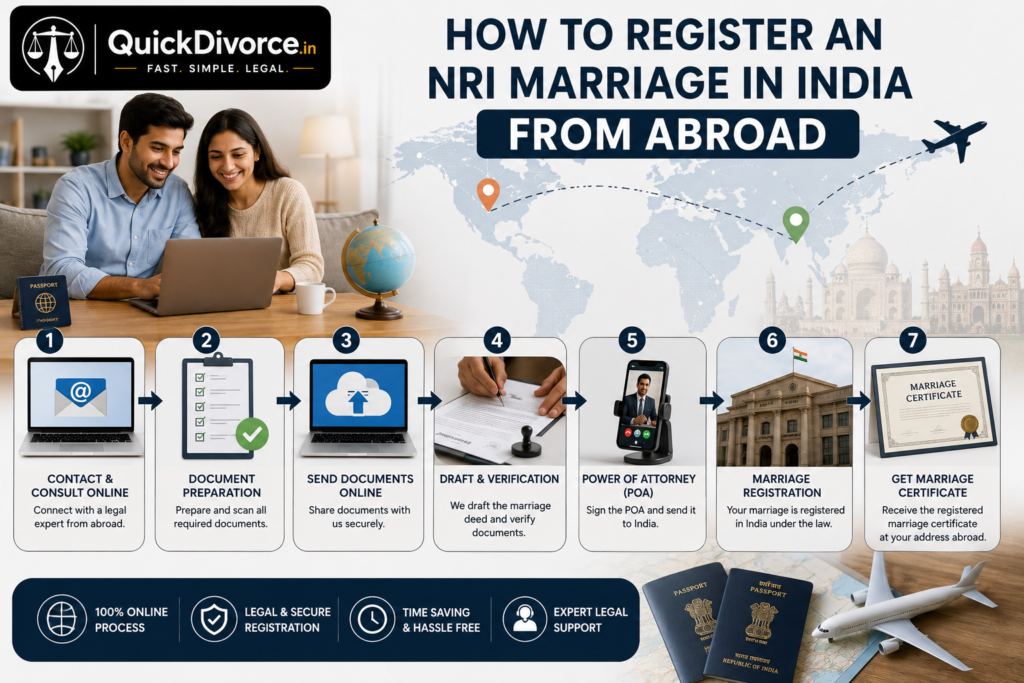
The accurate legal answer is: you cannot complete the actual marriage registration itself “from abroad” in the sense of never setting foot in India or an Indian Embassy — personal presence at the point of solemnization and registration is legally required, as covered in detail in our earlier guide on this exact issue. What can genuinely be done from abroad is everything around that — preparation, documentation, embassy coordination, and (for NRIs marrying abroad) registration at an Indian mission rather than in India itself.
Problem one: “We are both NRIs, we want to get married, and we’d rather not deal with travel to India for the legal part if we can avoid it.”
Problem two: “The wedding is happening, but one or both of us will be abroad for parts of the documentation process, and we want to know what we can handle remotely versus what requires us to physically show up somewhere.”
The honest answer to the first problem is that you cannot avoid physical presence entirely — but you can choose where that presence happens, including potentially at an Indian Embassy in your own country rather than traveling to India at all. The honest answer to the second is that a great deal of the process genuinely can be done remotely, just not the final act of marrying and signing the register.
This guide covers both, clearly separated.
The One Fixed Rule Underneath Everything Else
Before anything else: under the Hindu Marriage Act, 1955, the Special Marriage Act, 1954, and the Foreign Marriage Act, 1969, the act of marrying — taking vows, giving consent, and signing the marriage register — must happen with both parties physically present in the same place, before whoever is legally solemnizing the marriage (a priest for a Hindu ceremony followed by registration, or a Marriage Officer for Special Marriage Act or Foreign Marriage Act proceedings).
No video call, Power of Attorney, or remote authorization satisfies this requirement under any of the three Acts. This is covered in more depth in our earlier guide on registering a marriage when one partner cannot travel to India, and it applies equally here — the question isn’t really “from abroad” versus “in India,” it’s “where will both of you physically be.”
Everything below is about minimizing how much that physical presence requirement disrupts your lives, not about avoiding it.
Path 1 — Marry at an Indian Embassy Abroad Instead of Traveling to India
If both of you are based abroad — in the same country, or able to travel to each other’s country — this is usually the most genuinely “remote from India” option available, even though it isn’t remote in an absolute sense.
How This Works Under the Foreign Marriage Act, 1969
The Foreign Marriage Act allows an Indian citizen to marry before a Marriage Officer at an Indian Embassy, High Commission, or Consulate abroad. At least one party must be an Indian citizen; both must meet the standard age and marital status requirements.
What you handle remotely, well in advance:
- Confirming with the specific Embassy or Consulate whether they conduct marriage solemnization (not all do — some only register marriages already performed elsewhere)
- Understanding their notice period requirement, commonly around 30 days, though this varies by mission
- Gathering and preparing documents — passports, proof of address and marital status, affidavits — many of which can be assembled and even notarized in your country of residence before any appointment is booked
What requires physical presence:
- Both parties appearing together at the Embassy on the appointed date, along with the required witnesses
- Signing the marriage register before the Marriage Officer
What you get: A Certificate of Marriage under the Foreign Marriage Act, which is recognized in India for all legal purposes — visa sponsorship, property, future legal proceedings — without either of you having traveled to India at all.
This is genuinely the closest thing to “registering an NRI marriage in India from abroad” that the law actually permits, because it substitutes an Indian Embassy abroad for Indian soil, while still satisfying the physical presence requirement.
Path 2 — Do the Preparation From Abroad, Register in India in One Efficient Trip
If a wedding ceremony in India is happening regardless — for family, cultural, or personal reasons — then “from abroad” really means: front-load everything possible before traveling, so the India trip itself is short and the registration is fast once you land.
What Can Genuinely Be Done From Abroad
Document collection and authentication. Passport copies, visa documentation, proof of address abroad, and — critically for inter-country couples — any required Embassy NOC or Certificate of Single Status, can all be obtained, notarized, and apostilled in your country of residence before traveling. Apostille and embassy attestation processes are designed to be completed at origin; trying to do this after arriving in India usually adds weeks.
Translation of foreign documents. Any document not in English should be professionally translated before travel, since this is a process with its own lead time that has nothing to do with being physically in India.
Engaging a lawyer in India remotely. A family law advocate can review your documents, confirm which Act applies to your situation (covered in depth in our earlier comparison guide on the Hindu Marriage Act versus Special Marriage Act for NRIs), identify the correct SDM office or Marriage Officer jurisdiction, and — for Special Marriage Act registrations — help prepare the Notice of Intended Marriage in advance.
Booking appointments. In Delhi and other major cities, SDM appointment booking happens through online government portals and can be done from abroad once travel dates are fixed.
Starting the residency clock, if using the Special Marriage Act. This one has a wrinkle worth being precise about: the 30-day residency requirement under the Special Marriage Act requires actual physical presence in the relevant district for those 30 days — it cannot be satisfied remotely. What you can do from abroad is plan so that whichever partner can arrive earliest starts that 30-day period immediately on arrival, rather than losing time figuring this out after landing.
What Cannot Be Front-Loaded
- The marriage ceremony or civil solemnization itself
- Signing the marriage register
- The final appearance before the SDM or Marriage Officer
- For Special Marriage Act marriages, the actual 30 days of residency and the subsequent 30-day public notice period — these are time that has to pass, not paperwork that can be pre-completed
Realistic Timeline With Good Preparation
| Approach | Typical Timeline Once in India |
|---|---|
| Hindu Marriage Act, fully prepared in advance | 1 to 2 weeks |
| Special Marriage Act, fully prepared in advance | Still a minimum 60 days (30-day residency plus 30-day notice), but with zero time lost to document gathering |
The preparation does not shorten the Special Marriage Act’s statutory waiting period — nothing legally can. What it does is make sure none of your limited time in India is wasted figuring out documentation instead of moving through the actual legal steps.
Path 3 — Married Abroad Already? Register the Existing Marriage in India Remotely-ish
If you married abroad under a foreign country’s civil law — a registry office wedding, for instance — and now want that marriage recognized and usable in India, this is a slightly different and genuinely more remote-friendly process.
Step 1 — Get the foreign marriage certificate apostilled or attested in the country where you married, which is done entirely outside India.
Step 2 — Translate it into English if needed, also done abroad.
Step 3 — Decide whether Indian registration is necessary. A validly performed foreign marriage does not legally require separate Indian registration to be valid — but Indian registration is strongly advisable for practical purposes such as property, banking, and any future legal proceedings in India, as covered in our broader NRI marriage documentation guide.
Step 4 — If you do pursue Indian registration, this generally still requires both parties to eventually be in India (or to use the Foreign Marriage Act route at an Embassy) for any formal registration step — but the underlying marriage is already legally valid based on the foreign ceremony, so the urgency and complexity is considerably lower than a first-time registration.
A Word on Power of Attorney, Because It Comes Up Constantly Here
As with our earlier guide on registering a marriage when one partner cannot travel, it bears repeating clearly: a Power of Attorney cannot authorize anyone to marry, give consent, or sign a marriage register on your behalf, under any of the three Acts discussed here. This is different from Power of Attorney’s genuinely useful role in NRI divorce proceedings, where many procedural steps — filing, document submission, receiving notices — can be delegated. Marriage itself, at the point of solemnization, cannot.
If you’ve seen claims online suggesting otherwise, treat them with real skepticism before relying on them.
Frequently Asked Questions
Q1. Can we complete an NRI marriage registration entirely online without either of us traveling anywhere?
No. Whether at an Indian Embassy abroad or in India itself, both parties must be physically present together at the point of solemnization and registration. Preparation and documentation can be handled remotely; the marriage itself cannot.
Q2. Is marrying at an Indian Embassy abroad as legally valid as registering in India?
Yes. A marriage solemnized and registered under the Foreign Marriage Act, 1969 at an Indian Embassy, High Commission, or Consulate is fully recognized under Indian law.
Q3. If we marry abroad in a civil ceremony, do we have to also register in India?
Not as a strict legal requirement for the marriage’s validity, but Indian registration is strongly advisable for practical purposes in India such as property, banking, and any future legal matters.
Q4. Can a lawyer in India handle our entire registration process while we stay abroad?
A lawyer can handle document review, jurisdiction assessment, appointment booking, and (for Special Marriage Act cases) preparing the notice in advance. They cannot complete the solemnization or registration appointment on your behalf — that requires your personal presence.
Q5. Does the 30-day notice period under the Special Marriage Act apply differently for NRIs registering from abroad?
No. The 30-day residency and subsequent 30-day notice period apply equally to NRIs and cannot be waived or completed remotely.
Q6. What’s the fastest realistic way to register an NRI marriage without spending months in India?
Using the Hindu Marriage Act (if applicable to your religion) with all documents fully prepared and apostilled in advance, registering through an Arya Samaj ceremony followed by SDM registration — this can realistically be completed within one to two weeks once both parties are in India.
Why Choose Quick Divorce
The genuinely useful work in an NRI marriage registration happens before you ever board a flight — confirming which Act applies, getting documents apostilled at origin, booking the right appointment, and knowing exactly what will happen the moment you land. We handle that preparation remotely with NRI clients regularly, so the India portion of the process is as short as the law allows.
Book your free consultation today, from wherever you are: 📞 Call / WhatsApp: 8595439395 🌐 Website: www.quickdivorce.in
Need Consutation
🟡 QuickDivorce.in provides complete legal assistance for NRI marriage — including documentation, affidavits, registration support, embassy attestation guidance, and legal compliance across India and abroad.
🟡 For other Legal and Trademark related services
👉 Money Recovery Cases
👉 Property Disputes
👉 Business & Licence Registrations
🟡To explore IT services Click here
👉 Mutual Consent Divorce
👉 Contested Divorce Filing
👉 Child Custody and Maintenance
👉 Matrimonial Property Settlement
👉 NRI Divorce Services
👉 Alimony and Maintenance
🟡 Protect Your Rights
👉 Domestic Violence Legal Support
👉 Stridhan Recovery
📞 Call Now: +91 8595439395
🕐 Free Consultation: Monday to Saturday, 10 AM to 6 PM

Adv. Manish Kashyap is a Family Law & Divorce Lawyer with extensive experience in Mutual & Contested Divorce, NRI Divorce, Child Custody, Alimony, Domestic Violence, Judicial Separation, and Family Court matters, providing professional legal guidance to clients.

