

Views: 9
Table of Contents
- 1 They Took Everything She Brought Into That House. Can the Law Make Them Give It Back?
- 2 What Is Stridhan? The Legal Definition
- 3 The Legal Foundation — What Indian Law Says About Stridhan
- 4 Can In-Laws Be Made Respondents in Stridhan Cases? — The Direct Answer
- 5 Laws Under Which In-Laws Can Be Made Respondents
- 6 Landmark Supreme Court Judgments on In-Laws in Stridhan Cases
- 7 What Stridhan Recovery Cases Look Like in Practice
- 8 Evidence Required to Prove Stridhan and Make In-Laws Liable
- 9 Step-by-Step Process to File a Stridhan Case Against In-Laws
- 10 Can In-Laws Claim That Gifts Were Given to the Entire Family?
- 11 What Happens When Stridhan Cannot Be Returned in Kind?
- 12 Protection Against Disposal of Stridhan During Legal Proceedings
- 13 Frequently Asked Questions
- 14 Why Choose Quick Divorce for Stridhan Recovery Cases
- 15 Final Word
- 16 Need Help With Stridhan Recovery Cases?
They Took Everything She Brought Into That House. Can the Law Make Them Give It Back?
She came into the marriage with jewelry her mother saved for years. Cash gifts from relatives who traveled from distant cities to celebrate with her. Clothes, utensils, electronics — everything a family sends with a daughter to start her new life.
She left the marriage with nothing.
The gold bangles her grandmother gave her are sitting in her mother-in-law’s locker. The cash gifts — envelope after envelope collected at the wedding — went into her father-in-law’s account. The jewelry she wore on her wedding day has not been seen since the first week of marriage.
And now, sitting in her parents’ home after walking out of an abusive marriage, she asks the question that millions of Indian women have asked before her — can I get it back? And can I go after not just my husband, but his entire family who took it and kept it?
The answer to both questions is yes. And Indian law is clearer on this than most people realize.
This guide tells you everything — what Stridhan is, what the law says about it, whether in-laws can be made respondents in Stridhan cases, and exactly how to file a case to recover what is rightfully yours.
What Is Stridhan? The Legal Definition
Stridhan — derived from the Sanskrit words “Stri” (woman) and “Dhan” (wealth) — refers to the absolute property of a woman. It is the wealth that belongs exclusively to her — not to her husband, not to her in-laws, not to the joint family.
The Supreme Court of India has defined Stridhan comprehensively in multiple landmark judgments. Stridhan includes:
Gifts received at the time of marriage All gifts — jewelry, cash, clothes, utensils, household items, electronics — given to the bride by her parents, relatives, friends, and well-wishers at the time of the marriage ceremony.
Gifts received before marriage Property and gifts given to the woman by her family before the wedding — including jewelry purchased specifically for her by her parents.
Gifts received during the marriage Any gifts received by the wife during the subsistence of the marriage — from her parents, her husband’s family, or any other person — on occasions like birthdays, anniversaries, festivals, and childbirth.
Property inherited or acquired independently Property inherited by the wife from her own family, or property purchased by the wife from her own earnings or resources during the marriage.
Mehr in Muslim marriages The Mehr — the mandatory gift from husband to wife specified in the Nikahnama — is part of the Muslim wife’s Stridhan.
What Stridhan does NOT include:
- Property given to the husband by his family
- Joint family property
- Property purchased from the husband’s income in the husband’s name
- Dowry given to the husband’s family (as opposed to gifts to the bride)
The critical legal principle — Stridhan belongs absolutely and exclusively to the woman. The husband has no ownership right over it. He may use it during the marriage — but he must return it on demand.
The Legal Foundation — What Indian Law Says About Stridhan
Hindu Law
Under the Hindu Succession Act, 1956 and the principles of Hindu personal law, a Hindu woman has absolute ownership over her Stridhan. This position was comprehensively clarified by the Supreme Court in Pratibha Rani v. Suraj Kumar (1985) — one of the most important Stridhan judgments in Indian legal history.
The Supreme Court held that:
- A Hindu woman’s Stridhan is her absolute property
- She has complete authority to use, sell, mortgage, gift, or bequeath it as she pleases
- The husband has no ownership rights over Stridhan — he is at best a trustee during the marriage
- Misappropriation of Stridhan by the husband or his family is a criminal offence
Muslim Law
Under Muslim personal law, the Mehr and all gifts given to the wife at the time of marriage are her exclusive property. The husband and his family have no right to retain or appropriate these items.
Christian and Other Communities
The principles of Stridhan protection apply across communities through secular criminal law provisions — particularly the Indian Penal Code provisions on criminal breach of trust and theft.
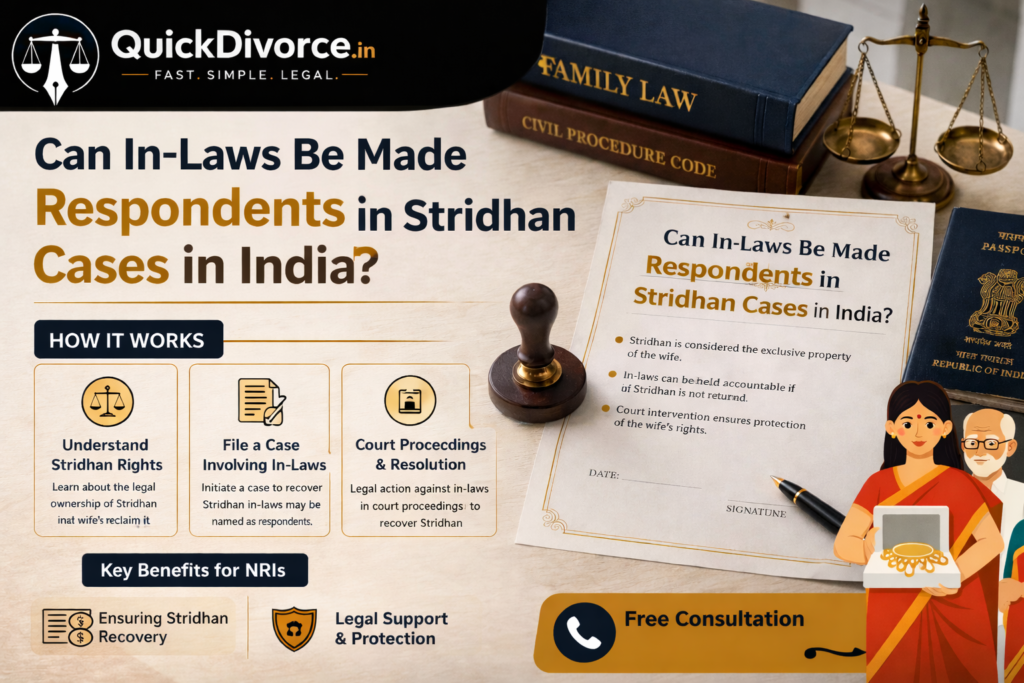
Can In-Laws Be Made Respondents in Stridhan Cases? — The Direct Answer
Yes. Absolutely and unequivocally yes.
In-laws — mother-in-law, father-in-law, sister-in-law, brother-in-law, or any other member of the husband’s family — can be made respondents, accused, or named parties in Stridhan recovery cases in India.
This is not a theoretical legal position. It is established law, confirmed by the Supreme Court and multiple High Courts, and routinely implemented in Family Courts, Criminal Courts, and Civil Courts across India.
The basis for making in-laws respondents in Stridhan cases rests on several legal foundations:
They were in physical possession of the Stridhan items If the mother-in-law took charge of the bride’s jewelry after the wedding and kept it in her locker, she is in possession of the Stridhan. She can be named as a respondent or accused.
They participated in the refusal to return Stridhan If in-laws actively refused to return Stridhan when the wife demanded it back — or hid, disposed of, or transferred the Stridhan items — they have participated in the wrongful withholding and can be held liable.
They participated in the matrimonial dispute that led to the Stridhan being withheld In cases where the in-laws were actively involved in the matrimonial cruelty or harassment that forced the wife out of the matrimonial home — leaving her Stridhan behind — their role in the overall situation makes them proper respondents.
Criminal breach of trust applies to anyone who holds property in trust Since both the husband and in-laws who hold Stridhan are effectively trustees of the wife’s property, any of them who misappropriates it commits criminal breach of trust — regardless of their specific familial relationship to the wife.
Laws Under Which In-Laws Can Be Made Respondents
Criminal Law Provisions
Section 316 BNS / Section 406 IPC — Criminal Breach of Trust This is the most powerful and most commonly used criminal provision in Stridhan cases.
The Supreme Court in Pratibha Rani v. Suraj Kumar (1985) specifically held that when a husband or his family members retain Stridhan and refuse to return it on demand, they commit criminal breach of trust under Section 406 IPC — now Section 316 BNS.
Criminal breach of trust is a cognizable offence. Police can register an FIR. The accused — including in-laws — can be arrested. Upon conviction, punishment extends to three years imprisonment and fine, or both.
Who can be named as accused under Section 316 BNS:
- Husband
- Mother-in-law
- Father-in-law
- Sister-in-law
- Brother-in-law
- Any other family member who was in possession of or participated in withholding the Stridhan
Section 303 BNS / Section 378 IPC — Theft If Stridhan items were taken from the wife’s possession without her consent — for example, jewelry removed from her person or her personal belongings — it constitutes theft. In-laws who participated in this can be named as accused.
Section 318 BNS / Section 420 IPC — Cheating If in-laws made false promises about returning Stridhan to induce the wife to delay legal action — and then disposed of or concealed the items — it may attract cheating provisions.
Section 85 BNS / Section 498A IPC — Cruelty Where the withholding of Stridhan is part of a broader pattern of cruelty and harassment — connected to dowry demands or designed to coerce the wife — in-laws who participated in the cruelty can be named as accused under Section 85 BNS.
Sections 3 and 4 — Dowry Prohibition Act, 1961 Where items claimed as Stridhan were actually given under dowry demand — or where the in-laws demanded additional dowry using the retained Stridhan as leverage — the Dowry Prohibition Act provisions are attracted against the in-laws.
Civil Law Provisions
Civil Suit for Recovery of Stridhan The wife can file a civil suit before the Civil Court for recovery of Stridhan items — or their market value if the items cannot be recovered in kind. In-laws who are in possession of or responsible for the Stridhan can be named as defendants in the civil suit.
Declaratory Suit Where the ownership of specific items is disputed — with in-laws claiming certain items belong to the joint family or were given to the husband — the wife can file a declaratory suit asking the court to declare her ownership of the items.
Protection of Women from Domestic Violence Act, 2005
Section 2(q) — Definition of Respondent The PWDVA specifically includes not just the husband but any relative of the husband in the definition of respondent. This means mother-in-law, father-in-law, sister-in-law, brother-in-law — all can be named as respondents in a domestic violence complaint.
Section 12 — Application for Relief The wife can file an application before the Magistrate under Section 12 of the PWDVA seeking:
- Return of Stridhan as monetary relief
- Compensation for the value of Stridhan that cannot be returned
- Protection orders preventing further disposal or concealment of Stridhan
The PWDVA route is particularly powerful because:
- Emergency orders can be obtained quickly
- In-laws can be directly named as respondents
- Monetary compensation can be awarded even if the physical items cannot be recovered
- Protection orders prevent further disposal of assets while the case is pending
Hindu Minority and Guardianship Act / Family Court Jurisdiction
In divorce proceedings before the Family Court, the court has jurisdiction to direct return of Stridhan as part of the matrimonial relief — and can issue directions against both the husband and in-laws who are in possession of the items.
Landmark Supreme Court Judgments on In-Laws in Stridhan Cases
Pratibha Rani v. Suraj Kumar (1985) — Supreme Court The foundational Stridhan judgment. The Supreme Court held that:
- Stridhan is the wife’s absolute property
- The husband is merely a trustee — not an owner
- Misappropriation of Stridhan is criminal breach of trust under Section 406 IPC
- This principle applies to in-laws who hold Stridhan as much as to the husband
This judgment established the criminal law framework for Stridhan recovery that courts continue to follow in 2026.
Vinod Kumar Sethi v. State of Punjab (1982) — Punjab and Haryana High Court Held that all items given to the wife — whether by her family or the husband’s family — at the time of marriage constitute Stridhan and belong exclusively to the wife.
Rashmi Kumar v. Mahesh Kumar Bhada (1997) — Supreme Court The Supreme Court reiterated that a husband who misappropriates his wife’s Stridhan is guilty of criminal breach of trust — and that the wife’s demand for return followed by the husband’s refusal is sufficient to establish the offence.
Hiral P. Harsora v. Kusum Narottamdas Harsora (2016) — Supreme Court While primarily about the DV Act’s definition of respondent, this judgment confirmed that female relatives — including mother-in-law and sister-in-law — can be named as respondents under the DV Act, including in applications related to Stridhan recovery.
Commissioner of Police v. Acharya Jagadishwarananda Avadhuta (2004) Reinforced the position that the police cannot refuse to register an FIR for criminal breach of trust in Stridhan cases on the ground that it is a matrimonial dispute.
What Stridhan Recovery Cases Look Like in Practice
Scenario 1 — Mother-in-Law Kept the Jewelry
At the time of marriage, the bride’s family gave her jewelry worth Rs. 15 lakhs — gold sets, bangles, necklaces, earrings. After the wedding, her mother-in-law said she would “keep it safe” and took all the jewelry into her own locker.
After the wife left the matrimonial home due to abuse, she demanded the jewelry back. The mother-in-law refused, claiming the jewelry was given to the family — not just to the daughter-in-law.
Legal position: The jewelry is Stridhan. The mother-in-law is in wrongful possession. An FIR for criminal breach of trust under Section 316 BNS can be filed naming both the husband and the mother-in-law as accused. A PWDVA application can also be filed naming both as respondents.
Scenario 2 — Father-in-Law Deposited Cash Gifts in His Account
At the wedding, the bride received cash gifts from her relatives — totaling Rs. 5 lakhs. Her father-in-law collected all the envelopes “for safekeeping” and deposited the cash in his own bank account. He later claimed it was given to the family as dowry.
Legal position: Cash gifts received by the bride at her wedding are Stridhan. The father-in-law has committed criminal breach of trust by depositing them in his account and refusing to return them. He can be named as accused in a criminal complaint. Bank statements showing the deposit can serve as evidence.
Scenario 3 — Brother-in-Law Disposed of Stridhan Items
The wife’s jewelry was kept in the matrimonial home. After she left, her brother-in-law — who lived in the same house — sold some of the jewelry items to a goldsmith. When the wife filed a case, the jewelry was no longer available.
Legal position: The brother-in-law has committed criminal breach of trust and potentially theft. He can be named as accused. The goldsmith who purchased stolen property may also face legal consequences. The wife can claim the market value of the disposed items as compensation in the PWDVA application or civil suit.
Scenario 4 — In-Laws Deny Receiving Any Stridhan
The in-laws claim no jewelry or valuables were given to the daughter-in-law — denying the existence of the Stridhan entirely.
Legal position: The wife must establish the existence of the Stridhan through evidence — wedding photographs showing her wearing the jewelry, witness testimony from relatives who gave gifts, receipts from jewelry purchases made by her family, account statements showing cash withdrawals for gift purchases. Video recordings from the wedding are particularly powerful evidence in such cases.
Evidence Required to Prove Stridhan and Make In-Laws Liable
Building a strong Stridhan recovery case against in-laws requires comprehensive evidence. Here is what to gather:
Wedding Photographs and Videos Photographs and videos from the wedding showing the bride wearing jewelry and receiving gifts are among the most powerful evidence. They establish what Stridhan existed and that it was in the possession of the bride at the time of marriage.
Receipts and Invoices Purchase receipts for jewelry, electronics, and other items given as Stridhan — from jewelers, shops, and online platforms. These establish the existence and value of the items.
Bank Statements Statements showing withdrawals made by the bride’s family for purchase of Stridhan items. Statements of the in-laws’ accounts showing deposits of cash Stridhan are equally important evidence against them.
Witness Testimony Statements from relatives and friends who attended the wedding and witnessed the giving of Stridhan — and who can testify about what was given and to whom it was given.
Written Records Wedding invitation list with gift records, any written acknowledgment by in-laws of receiving items for safekeeping, messages or emails discussing Stridhan items.
WhatsApp and Digital Messages Messages in which in-laws acknowledged possession of Stridhan items, promised to return them, or refused demands for return are critical evidence.
Demand and Refusal Evidence that the wife made a demand for return of Stridhan and the in-laws refused — through messages, letters, or witnessed verbal demands. The demand and refusal is an essential element of the criminal breach of trust offence.
Insurance Documents If any jewelry items were insured — producing the insurance documents establishing the existence and value of the items.
Valuation Certificates Certificates from licensed valuers establishing the market value of Stridhan items — important for quantifying compensation claims.
Step-by-Step Process to File a Stridhan Case Against In-Laws
Step 1 — Compile Complete Evidence
Before filing any complaint, gather all available evidence of the Stridhan — photographs, receipts, witnesses, digital messages, and any written communication about the items.
Step 2 — Send a Legal Notice
Before filing a criminal complaint, send a formal legal notice through your lawyer to the husband and all in-laws who are in possession of or responsible for the Stridhan — demanding return of all items within a specified period (typically 15 to 30 days).
A legal notice serves multiple purposes:
- Creates a formal, timestamped record of the demand
- Gives the other side an opportunity to return items without litigation
- If ignored or refused, the refusal itself becomes evidence in the criminal complaint
- Demonstrates to the court that the legal remedy was sought before escalating to criminal complaint
Step 3 — File an FIR for Criminal Breach of Trust
If the legal notice is ignored or the items are not returned, file an FIR at the police station having jurisdiction over:
- The place where the matrimonial home was located, or
- The place where the in-laws currently reside
Name all persons who are in possession of or responsible for the Stridhan — husband, mother-in-law, father-in-law, and any other in-law involved — as accused in the FIR.
Cite Section 316 BNS (criminal breach of trust) as the primary provision. Also cite Section 85 BNS (cruelty) if the withholding is part of broader matrimonial cruelty, and Dowry Prohibition Act provisions if dowry demands are connected.
Step 4 — File a PWDVA Application Simultaneously
Simultaneously file an application under Section 12 of the Protection of Women from Domestic Violence Act before the Judicial Magistrate — naming the husband and all relevant in-laws as respondents.
Seek:
- Monetary relief equivalent to the value of all Stridhan not returned
- Compensation for mental trauma caused by wrongful retention of Stridhan
- Protection order preventing further disposal or concealment of Stridhan
The PWDVA route can yield quicker monetary relief than the criminal case — which focuses on punishment rather than recovery.
Step 5 — File a Civil Suit for Recovery
If the Stridhan items have been disposed of and cannot be recovered in kind — or if the criminal and PWDVA routes do not fully address the financial value — file a civil suit for recovery of the monetary value of all Stridhan items.
Name the husband and all relevant in-laws as defendants. Seek decree for payment of the market value of all Stridhan items along with interest from the date of demand.
Step 6 — Include Stridhan Recovery in Divorce Proceedings
If divorce proceedings are already underway, include Stridhan recovery as a specific prayer in the divorce petition or as an ancillary application before the Family Court.
Family Courts have jurisdiction to direct return of Stridhan as part of matrimonial relief — and can pass directions against both the husband and in-laws who are holding the Stridhan.
Can In-Laws Claim That Gifts Were Given to the Entire Family?
This is the most common defense raised by in-laws in Stridhan cases — and it consistently fails before Indian courts.
In-laws often claim:
- The jewelry was given to the family — not just to the daughter-in-law
- The cash gifts were given at the wedding as blessings for the family
- The items were contributed toward family expenses
- The items were given as dowry to the husband’s family — not as Stridhan to the wife
Indian courts have repeatedly and consistently rejected these arguments.
The Supreme Court has held that gifts given at the time of a woman’s marriage — whether by her family or by the husband’s family — are her Stridhan. It does not matter whether the gifts were physically handed to the wife personally or whether they were placed in the matrimonial home or with the family.
The intention of the giver determines the nature of the gift. Jewelry given to a bride by her parents, relatives, or the husband’s relatives at the time of marriage is given to the bride — not to the family.
The burden of proof to show that specific items were NOT Stridhan lies on the in-laws who claim ownership — not on the wife who asserts her Stridhan rights.
What Happens When Stridhan Cannot Be Returned in Kind?
Sometimes Stridhan items have been sold, melted down, lost, or otherwise disposed of by the husband or in-laws by the time the case is filed. In such situations:
Compensation in Money The court can — and routinely does — award compensation equivalent to the market value of the Stridhan items that cannot be returned in kind. The wife must establish the value through valuation certificates, original purchase receipts, or expert testimony.
Interest on Value Courts also award interest on the value of the Stridhan from the date of demand or from the date of marriage — reflecting the loss of use of the property over the intervening period.
Criminal Consequences Remain Even if compensation is awarded in the civil or PWDVA proceedings, the criminal breach of trust case proceeds independently. The accused in-laws face criminal prosecution regardless of whether they compensate the wife.
Protection Against Disposal of Stridhan During Legal Proceedings
A common concern — what if in-laws dispose of or conceal Stridhan items after the wife files a case?
Indian courts provide remedies to prevent this:
Injunction in Civil Suit At the time of filing the civil suit, the wife can simultaneously apply for a temporary injunction — restraining the in-laws from disposing of, transferring, or concealing any Stridhan items until the case is decided.
Protection Order Under PWDVA The Magistrate can pass a protection order preventing the respondents — including in-laws — from alienating or disposing of any property connected to the domestic violence complaint.
Attachment Before Judgment In civil proceedings, if there is reason to believe that in-laws may dispose of assets to defeat the decree, the court can order attachment before judgment — freezing specified assets until the case is decided.
These interim remedies are critical — apply for them at the earliest stage of the proceedings.
Frequently Asked Questions
Q1. Can a mother-in-law be arrested for not returning Stridhan?
Yes. If an FIR is registered under Section 316 BNS (criminal breach of trust) naming the mother-in-law as accused, police can arrest her. However, courts have generally been cautious about automatic arrests in matrimonial cases following the Arnesh Kumar judgment — preliminary inquiry is conducted before arrest. The criminal case proceeds regardless of whether immediate arrest occurs.
Q2. How long do I have to file a Stridhan case against in-laws?
For criminal breach of trust under Section 316 BNS, the limitation period is three years from the date of demand and refusal — not from the date of marriage. Each new refusal to return Stridhan after a fresh demand renews the limitation period. For civil suits, the limitation is three years from the date the right to sue accrues. File as early as possible.
Q3. What if in-laws live in a different city from where the marriage took place?
Jurisdiction for the FIR is typically where the matrimonial home was located or where the refusal to return Stridhan occurred. For the PWDVA application, the Magistrate of the area where you currently reside has jurisdiction. Civil suits can be filed where the defendants reside or where the cause of action arose.
Q4. Can I file a case for Stridhan even if I do not have receipts for the items?
Yes. Receipts are helpful but not mandatory. Wedding photographs, witness testimony, bank account statements showing jewelry purchases, and any digital messages acknowledging the items are all valid alternative evidence. Indian courts recognize that most families do not maintain systematic records of wedding gifts.
Q5. What if my husband says all the jewelry was stolen and files a police complaint about the theft?
This is a defense tactic occasionally used to explain away Stridhan. Courts scrutinize such claims carefully — particularly when the alleged theft conveniently covers exactly the wife’s Stridhan items and was reported only after the matrimonial dispute arose. Your lawyer will challenge this defense with evidence of the actual circumstances.
Q6. Can NRI in-laws be made respondents in Stridhan cases in India?.
Yes. If the matrimonial home was in India, the Stridhan was in India, and the in-laws were in India at the time of the marriage — they can be named as respondents or accused regardless of where they currently live. Look Out Circulars can be issued against them if they are abroad and criminal charges are pending.
Why Choose Quick Divorce for Stridhan Recovery Cases
Stridhan cases against in-laws require a legal team that understands criminal law, civil law, domestic violence law, and family law — all at the same time. Using just one of these routes when all are available leaves money and justice on the table.
At Quick Divorce, we handle Stridhan recovery cases with a comprehensive multi-forum strategy:
- Legal notice drafting and dispatch to all named in-laws
- FIR filing under Section 316 BNS naming all relevant accused including in-laws
- PWDVA application filing before the Magistrate for quick monetary relief
- Civil suit filing for recovery of Stridhan value with interim injunction
- Inclusion of Stridhan recovery in divorce proceedings before Family Court
- Evidence gathering and organization — photographs, receipts, witnesses, digital messages
- Application for Look Out Circulars against in-laws attempting to flee
- Injunction applications to prevent disposal of Stridhan during proceedings
- Complete case management across all forums simultaneously
We have helped numerous women across Delhi and India recover their Stridhan — from jewelry to cash to property — through the courts and through negotiated settlements where the evidence was strong enough to bring the other side to the table.
Your Stridhan is yours. By right. By law. And we will fight to get it back.
Book your free consultation today: 📞 Call / WhatsApp: 8595439395
Final Word
The jewelry your mother saved for years to give you. The cash gifts your relatives brought to celebrate with you. The items you carried into that house as the beginning of your new life.
None of it belongs to your in-laws. None of it belongs to your husband. All of it belongs to you — by the absolute right that Indian law has given you over your Stridhan since 1985, confirmed by the Supreme Court, and enforceable through multiple legal routes right now in 2026.
In-laws can be made respondents. They can be named as accused. They can be directed by courts to return what they took or pay its full value with interest. And criminal breach of trust — the offence they commit by keeping what is yours — carries real consequences including imprisonment.
Do not accept silence. Do not accept being told it is a family matter. Do not accept that what was taken cannot be recovered.
It can. And Quick Divorce will help you recover it.
Call us at 8595439395
Need Help With Stridhan Recovery Cases?
🟡 QuickDivorce.in provides complete recovery services —including settlement negotiation, alimony structuring, property division, stridhan recovery, MoU drafting, court representation, and post-decree implementation: across all jurisdictions in India.
🟡Visit LegalTax.in for other Legal and Trademark related services as 👉 Money Recovery Cases
👉 Property Disputes 👉 Business & Licence Registrations
🟡Visit Business24hub for IT services
👉 Mutual Consent Divorce at QuickDivorce.in 👉 Contested Divorce Filing 👉 Child Custody and Maintenance 👉 Matrimonial Property Settlement 👉 NRI Divorce Services 👉 Alimony and Maintenance
🟡 Protect Your Rights 👉 Domestic Violence Legal Support at QuickDivorce.in 👉 Stridhan Recovery
📞 Call Now: +91 8595439395
🕐 Free Consultation: Monday to Saturday, 10 AM to 6 PM

Adv. Manish Kashyap is a Family Law & Divorce Lawyer with extensive experience in Mutual & Contested Divorce, NRI Divorce, Child Custody, Alimony, Domestic Violence, Judicial Separation, and Family Court matters, providing professional legal guidance to clients.

