

Views: 3
Table of Contents
- 1 Your Marriage Ended in Your Heart Long Before You Picked Up the Phone
- 2 Why Online Legal Consultation Has Changed Divorce in India
- 3 What Happens During the Online Consultation — What to Expect
- 4 Step 1 — Decide Which Type of Divorce Applies to You
- 5 Step 2 — Gather All Required Documents
- 6 Step 3 — Drafting the Divorce Petition
- 7 Step 4 — Filing the Petition Before the Family Court
- 8 Step 5 — Service of Notice on the Other Party
- 9 Step 6 — First Hearing and Referral to Mediation
- 10 Step 7 — The Process After First Hearing
- 11 Step 8 — After the Divorce Decree — What You Need to Do
- 12 Online vs Offline Divorce Process — Key Differences in 2026
- 13 Timeline — From Online Consultation to Divorce Decree
- 14 Cost Overview — Online Consultation to Divorce Decree 2026
- 15 Frequently Asked Questions
- 16 Why Start With Quick Divorce’s Online Consultation
- 17 Final Word
- 18 Need Help With Mutual Divorce or Legal Documentation?
Your Marriage Ended in Your Heart Long Before You Picked Up the Phone
For most people, the decision to divorce does not happen in a single moment. It happens slowly — over months of silence, years of conflict, nights spent wondering if this is really how the rest of your life is supposed to look.
And then one day, quietly, you type something into a search engine. Or you call a number. Or you fill out a consultation form on a website. And you take the first real step toward ending something that has already been over for a long time.
That first step — the online consultation with a family lawyer — is braver than most people give themselves credit for. But it is only the first step. What comes after it is what actually changes your legal status, protects your rights, and gives you the clean break you need to rebuild.
This guide is for everyone who has had that first online consultation — or is about to have one — and wants to understand exactly what happens next. How does the divorce petition actually get filed? What documents do you need? Which court do you go to? How long does it take? And what should you expect at every stage of the process?
Everything you need to know — clearly, completely, and without unnecessary complexity.
Why Online Legal Consultation Has Changed Divorce in India
Five years ago, starting a divorce in India meant physically visiting a lawyer’s office — often multiple offices before finding the right fit — sitting across a desk, sharing the most painful details of your personal life with a stranger in a formal setting, and hoping the lawyer you chose was actually good.
In 2026, that experience has fundamentally changed.
Online legal consultation platforms — and law firms like Quick Divorce that offer video, phone, and chat consultations — have made the initial step dramatically more accessible, more comfortable, and more informed.
You can now speak to an experienced family lawyer from your home, your car, or your office. You can consult across cities — a person in Lucknow can consult a Delhi-based family law specialist without traveling. NRIs in the UK, USA, Canada, and Australia consult Indian family lawyers daily via video call to understand their rights before acting.
The consultation is where you get clarity. It is where the lawyer assesses your situation, tells you which type of divorce applies to you, explains the process and timeline, gives you a realistic picture of likely outcomes, and answers every question you have been too afraid or too confused to ask.
What the consultation does not do — by itself — is file the divorce petition. That requires a sequence of steps after the consultation. This guide covers all of them.
What Happens During the Online Consultation — What to Expect
Before getting into post-consultation steps, it helps to understand what a thorough online consultation should cover — so you know whether your consultation has given you everything you need to move forward.
Assessment of Your Marital Situation The lawyer will ask about the nature of your marriage, how long you have been married, whether you have children, the current living arrangements, and the reason you want to divorce. This assessment determines which type of divorce applies to your situation.
Determination of Applicable Law Based on your religion, the nature of your marriage ceremony, and the registration of your marriage, the lawyer will identify which law governs your divorce — Hindu Marriage Act, Special Marriage Act, Indian Divorce Act, Muslim Personal Law, or Parsi Marriage and Divorce Act.
Type of Divorce — Mutual or Contested The single most important determination of the consultation. If both you and your spouse are willing to divorce and can agree on terms — custody, maintenance, property — mutual consent divorce under Section 13B is available. If one spouse refuses or terms cannot be agreed upon, contested divorce is the only option.
Grounds for Divorce In contested divorce, the lawyer will identify which specific grounds apply to your situation — cruelty, desertion, adultery, or others — and assess the strength of your evidence for each ground.
Jurisdiction — Which Court The lawyer will identify the correct Family Court where your petition must be filed — based on where the marriage was solemnized, where you last lived together as a couple, or where you currently reside.
Timeline and Cost A realistic assessment of how long the process will take and what it will cost — including lawyer’s fees, court fees, and any other expenses.
Interim Reliefs Discussion of any immediate reliefs you may need — interim maintenance, interim custody, protection orders, or injunctions — that can be obtained quickly while the main divorce proceedings are pending.
Document Checklist The lawyer should give you a specific list of documents to gather before the petition is filed.
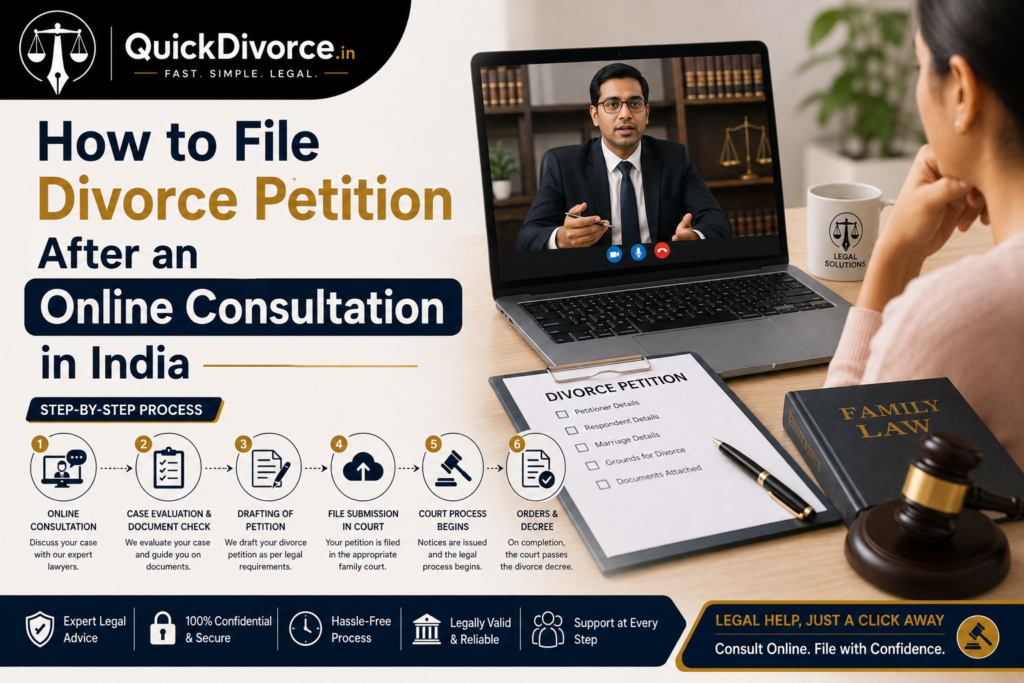
Step 1 — Decide Which Type of Divorce Applies to You
The entire post-consultation process depends on this single decision. Here is a clear breakdown:
Mutual Consent Divorce — Section 13B Hindu Marriage Act
Available when:
- Both spouses agree to divorce
- Both have been living separately for at least one year
- Both can agree on terms — maintenance, custody, property division
Advantages:
- Much faster — typically 4 to 6 months with cooling period waiver
- Far less expensive than contested divorce
- Less emotionally draining
- Both parties control the outcome
- Significantly less damaging to children
Proceed to: Drafting the settlement agreement and joint petition
Contested Divorce — Section 13 Hindu Marriage Act
Available when:
- One spouse refuses to divorce, or
- Both want divorce but cannot agree on terms, or
- Grounds exist — cruelty, desertion, adultery — that must be proven
Realities:
- Takes 3 to 7 years at trial court level
- Significantly more expensive
- Emotionally draining adversarial process
- Outcome decided by court — not by the parties
Proceed to: Drafting the contested petition with specific grounds
Step 2 — Gather All Required Documents
After the online consultation, the lawyer will give you a document checklist. Here is the comprehensive standard list — covering both mutual and contested divorce:
Documents Both Spouses Need to Provide
Marriage Proof
- Original marriage certificate — Arya Samaj, SDM-registered, or court marriage certificate
- Wedding photographs
- Wedding invitation card
- If no formal certificate exists — any other evidence of marriage such as joint bank account statements, joint property documents, or witness affidavits
Identity Proof
- Aadhaar Card
- Passport — particularly important for NRI cases
- Voter ID
- PAN Card
Age Proof
- Birth certificate
- Class 10th marksheet
- Passport
Address Proof
- Aadhaar Card
- Current utility bill — electricity, water, or gas, not older than 3 months
- Rent agreement if living in rented accommodation
- Bank statement showing current address
Proof of Separation
- Evidence that both parties have been living separately for at least one year — required for mutual divorce
- Separate utility bills, separate residence proofs, or an affidavit of separation
Additional Documents for Mutual Divorce
Signed Settlement Agreement The most important document in mutual divorce — covering maintenance, child custody, property division, and return of dowry. Drafted by your lawyer after discussions with both parties.
Joint Petition The petition jointly signed by both spouses is filed before the Family Court. Your lawyer drafts this.
Affidavit of Consent Both spouses sign individual affidavits confirming their free and voluntary consent to the divorce and to the terms of the settlement.
Additional Documents for Contested Divorce
Evidence Supporting Grounds
For cruelty:
- Medical reports documenting injuries from physical assault
- Photographs of injuries
- Screenshots of threatening or abusive messages — WhatsApp, email, social media
- Witness statements from people who witnessed incidents of cruelty
- FIR copies if police complaints were previously filed
- Psychiatric or psychological reports documenting mental cruelty
For desertion:
- Evidence of the date the spouse left — last known communication, witnessed departure
- Evidence of the continuous two-year separation period
- Evidence that departure was without the petitioner’s consent and without reasonable cause
For adultery:
- Direct evidence is rare — courts accept circumstantial evidence establishing the adulterous relationship
- Call records, photographs, witness testimony, hotel records, and similar evidence
Financial Documents
- Bank statements — last 12 to 24 months
- Salary slips — last 3 to 6 months
- Income tax returns — last 2 to 3 years
- Property ownership documents
- Investment account statements
- Business income proof if self-employed
- These are used to determine maintenance and alimony amounts
Additional Documents for Cases Involving Children
- Birth certificates of all children
- School records — admission letters, fee receipts, report cards
- Medical records if children have ongoing health conditions
- Evidence of the primary caregiver — school pickup records, medical appointment records, photographs showing involvement in children’s daily life
- Any prior custody or visitation arrangements — formal or informal
NRI-Specific Additional Documents
- Valid passport — both spouses
- Visa copies showing residency status abroad
- Proof of foreign address — utility bill or bank statement from country of residence
- NRI status proof — work permit or employment letter
- If divorce proceedings are pending abroad — copies of those proceedings
Step 3 — Drafting the Divorce Petition
After the consultation and document gathering, your lawyer drafts the divorce petition. This is a formal legal document filed before the Family Court.
What a Mutual Consent Divorce Petition Contains
Title and Court Details The petition is addressed to the Principal Judge, Family Court of the relevant district.
Identification of Parties Full names, ages, addresses, and occupations of both petitioners — yes, in mutual divorce both spouses are petitioners.
Details of Marriage Date, place, and manner of solemnization of marriage. Reference to the marriage certificate.
Details of Children Names, ages, and current custody arrangements for all children of the marriage.
Statement of Separation A clear statement that the parties have been living separately since a specified date — for at least one year.
Statement of Failed Reconciliation A statement that all attempts at reconciliation have failed and the marriage has irretrievably broken down.
Settlement Terms The agreed terms on maintenance, child custody, property division, and all other matters — either incorporated directly or by reference to the settlement agreement annexed to the petition.
Prayer The specific relief sought — dissolution of marriage by a decree of divorce under Section 13B of the Hindu Marriage Act, 1955, or the applicable law.
Verification Both petitioners verify that the contents of the petition are true to their knowledge and belief.
Signatures Signed by both petitioners and their respective lawyers.
What a Contested Divorce Petition Contains
Everything above except joint petitioner structure — only the filing spouse is the petitioner. The other spouse is the respondent.
Specific Grounds A detailed, factual narration of the specific grounds — cruelty, desertion, adultery, or others — with dates, incidents, and supporting evidence referenced.
Evidence Summary A summary of the evidence the petitioner intends to rely upon — documents, witnesses, and any other proof.
Interim Relief Applications If interim maintenance, interim custody, or injunction is sought simultaneously — these are presented as separate applications accompanying the main petition but filed together.
Step 4 — Filing the Petition Before the Family Court
Which Court — Jurisdiction
The Family Court having jurisdiction over your divorce petition is determined by:
- Where the marriage was solemnized, or
- Where the respondent resides, or
- Where both parties last resided together, or
- Where the wife is currently residing — particularly relevant in cases involving domestic violence or desertion
Your online consultation lawyer will confirm the correct court based on your specific facts.
How the Petition Is Filed
Physical Filing The petition — along with all supporting documents and court fee stamps — is physically filed at the filing counter of the Family Court. Your lawyer’s clerk typically handles this. You do not need to be physically present for the filing step itself.
Court Fee A nominal court fee is paid at the time of filing — typically between Rs. 15 and Rs. 100 depending on the nature of the petition and the state. This is separate from your lawyer’s fee.
Case Number Upon filing, the court assigns a case number — your petition’s permanent identifier in all future correspondence and proceedings.
First Date The court assigns the first hearing date — typically 4 to 8 weeks after filing depending on the court’s schedule and current backlog.
Step 5 — Service of Notice on the Other Party
In Mutual Divorce
Both parties have already consented and signed the petition. Service of notice is effectively a formality — the court may direct both parties to appear on the first date rather than formally serving notice.
In Contested Divorce
The court issues a formal notice — called a summons — to the respondent spouse. This notice:
- Informs the respondent that a divorce petition has been filed against them
- Specifies the grounds alleged
- Directs the respondent to appear before the court on the first hearing date
- Gives the respondent the opportunity to file a written reply
Modes of Service
- Personal service — a court officer or process server delivers the notice to the respondent personally
- Registered post — notice sent by registered post to the respondent’s last known address
- Substituted service — if personal service fails, service by publication in a newspaper or affixing the notice at the respondent’s last known address
- Electronic service — increasingly accepted by courts in 2026 — WhatsApp, email, and other digital modes of service have been approved by various High Courts
For NRI respondents — service is effected through diplomatic channels or by direct service abroad, following applicable international legal conventions.
Step 6 — First Hearing and Referral to Mediation
First Hearing in Mutual Divorce
On the first hearing date:
- Both parties appear before the Family Court judge
- The judge reads the petition and examines both parties briefly
- The judge satisfies herself or himself that consent is genuine and voluntary
- Statements of both parties are recorded
- The First Motion is passed
After the First Motion, the court either:
- Fixes the next date after the mandatory six-month cooling period, or
- If both parties apply for waiver of the cooling period — and the court is satisfied that the marriage has genuinely broken down and all terms are settled — the court may waive the cooling period and fix the second motion date sooner
First Hearing in Contested Divorce
On the first hearing date:
- The petitioner’s lawyer confirms that the petition has been filed and service has been completed
- The respondent either appears or their absence is noted
- The court fixes the next date for filing of the written statement by the respondent
Mandatory Mediation Indian courts — particularly Family Courts — are legally required to refer matrimonial disputes to mediation before proceeding to trial. At an early stage of the contested divorce proceedings, the court will direct both parties to appear before the court’s mediation center.
Mediation typically involves 2 to 6 sessions. If mediation succeeds — fully or partially — it saves months or years of litigation. If it fails, the case returns to the Family Court for trial.
Step 7 — The Process After First Hearing
Mutual Divorce — Second Motion and Decree
Cooling Period After the First Motion, the court waits for the cooling period — either the full six months or a shorter period if waived by the court.
During this period either party technically retains the right to withdraw consent — though doing so after having signed a settlement agreement creates legal complications.
Second Motion Both parties appear again before the Family Court. They reaffirm their consent to the divorce. The court verifies that consent remains genuine and has not been withdrawn.
Divorce Decree The court passes the decree of divorce — formally dissolving the marriage. The divorce decree is typically passed on the same day as the Second Motion in straightforward cases.
Collection of Decree Your lawyer collects the certified copy of the divorce decree from the court — typically within a few days of the decree being passed. This is the document you will need for all future legal purposes — remarriage, property, passport update, and so on.
Contested Divorce — Trial Process
Written Statement The respondent files a written statement — their formal reply to the divorce petition — within the time directed by the court.
Issues Framed The court frames the issues — the specific questions of fact and law that need to be determined in the trial. For example — Was there cruelty? Was there desertion? For how long?
Evidence Stage Both parties file their evidence by way of affidavit — a written sworn statement of their evidence. They also file all documentary evidence they rely upon.
Examination and Cross-Examination Both parties — and any witnesses they call — are examined in chief (their own side questions them) and cross-examined (the other side questions them). This is the trial proper.
Arguments After all evidence is recorded, both sides present their legal arguments — citing relevant case law and applying it to the facts proved.
Judgment The court delivers its judgment — granting or refusing divorce, and deciding on all ancillary matters including maintenance, custody, and property.
Decree If divorce is granted, the court passes a decree of divorce.
Appeal Either party can appeal to the High Court within 90 days of the judgment. From the High Court, a further appeal to the Supreme Court may be possible in appropriate cases.
Step 8 — After the Divorce Decree — What You Need to Do
Getting the divorce decree is not quite the end of the process. Several important administrative steps follow:
Update Your Name in Documents (If Applicable) If the wife has changed her name after marriage and wishes to revert to her maiden name — or if either party wishes to update their documents — the divorce decree is the basis for:
- Aadhaar Card name change
- PAN Card update
- Passport name change
- Bank account update
- Property records update
Update Nominations Change nominees in all financial instruments — life insurance policies, health insurance, provident fund, mutual funds, fixed deposits — to remove the former spouse and add a new nominee.
Property Transfers If the settlement agreement or court decree involves property transfers — execute the necessary sale deeds, gift deeds, or relinquishment deeds before the relevant registrar.
Maintenance Enforcement If the other party defaults on maintenance payments ordered by the court — file an execution petition before the Family Court immediately. Do not allow defaults to accumulate without legal action.
Child Custody Implementation Implement the custody and visitation schedule as per the decree. If the other parent violates the schedule — approach the Family Court immediately with a contempt application.
Online vs Offline Divorce Process — Key Differences in 2026
A common question after an online consultation is — can the entire divorce process be done online? Here is the honest answer:
| Stage | Online Possible? | Notes |
|---|---|---|
| Initial consultation | Yes — fully online | Video, phone, or chat |
| Document collection | Partially online | Documents can be shared digitally with lawyer |
| Petition drafting | Yes — lawyer drafts remotely | Review and feedback online |
| Petition signing | Physical signature required | Must be done in person |
| Court filing | Physical filing required | Lawyer’s office handles this |
| First hearing appearance | Physical appearance required | Both parties must be present in court |
| Mediation sessions | Some courts allow video | Check with specific court |
| Evidence recording | Physical presence required | Must appear in court |
| Second motion (mutual divorce) | Physical appearance required | Both parties must be present |
| Decree collection | Lawyer handles physically | You receive copy from lawyer |
For NRI clients — the physical appearance requirement is the biggest challenge. Indian courts generally require personal appearance at key hearings. However:
- In mutual divorce, courts have in some cases allowed one party to appear via video conference in compelling circumstances
- A Power of Attorney can authorize a representative to handle certain procedural steps — but not the oath-taking or personal statement stages
- Waiver of personal appearance can sometimes be sought in extreme circumstances
Consult your lawyer specifically about NRI appearance requirements for your case.
Timeline — From Online Consultation to Divorce Decree
Mutual Consent Divorce Timeline
| Stage | Time |
|---|---|
| Online consultation | Day 1 |
| Document gathering | 1 to 2 weeks |
| Settlement agreement drafting and finalization | 1 to 3 weeks |
| Petition drafting and signing | 1 week |
| Court filing | Day of filing |
| First hearing date | 4 to 8 weeks after filing |
| First Motion passed | First hearing |
| Cooling period (if not waived) | 6 months |
| Cooling period (if waived by court) | 1 to 4 weeks |
| Second Motion and decree | Second hearing date |
| Total — With cooling period waiver | 3 to 6 months |
| Total — Without waiver | 7 to 14 months |
Contested Divorce Timeline
| Stage | Time |
|---|---|
| Online consultation | Day 1 |
| Document and evidence gathering | 2 to 6 weeks |
| Petition drafting | 1 to 2 weeks |
| Court filing | Day of filing |
| Service of notice on respondent | 2 to 8 weeks |
| First hearing | 4 to 8 weeks after filing |
| Mediation | 1 to 3 months |
| Written statement by respondent | 1 to 3 months after first hearing |
| Issues framing | 1 to 3 months |
| Evidence stage | 6 months to 2 years |
| Arguments | 1 to 6 months |
| Judgment | 1 to 6 months after arguments |
| Total at trial court level | 2 to 7 years |
| Total with High Court appeal | 5 to 15 years |
Cost Overview — Online Consultation to Divorce Decree 2026
| Service | Mutual Divorce | Contested Divorce |
|---|---|---|
| Online consultation fee | Rs. 500 – Rs. 3,000 | Rs. 500 – Rs. 3,000 |
| Lawyer’s fee — petition to decree | Rs. 15,000 – Rs. 50,000 | Rs. 1,00,000 – Rs. 10,00,000+ |
| Court filing fee | Rs. 15 – Rs. 100 | Rs. 15 – Rs. 100 |
| Affidavit and notarization | Rs. 500 – Rs. 2,000 | Rs. 500 – Rs. 5,000 |
| Document preparation | Rs. 1,000 – Rs. 5,000 | Rs. 5,000 – Rs. 50,000 |
| Mediation fee (if ordered) | Usually free at court | Usually free at court |
| Total Approximate Range | Rs. 20,000 – Rs. 60,000 | Rs. 1,50,000 – Rs. 15,00,000+ |
Frequently Asked Questions
Q1. Can I file a divorce petition without ever visiting the lawyer’s office in person?
The initial consultation, document review, and petition drafting can all happen online. However, your physical signature is required on the petition and related documents, and you must appear personally in court at key hearings. Your lawyer can arrange for document signing at a location convenient to you.
Q2. How soon after the online consultation can the petition be filed?
In mutual divorce — once documents are gathered and the settlement agreement is finalized — typically 2 to 4 weeks after the consultation. In contested divorce — once documents and evidence are organized — typically 3 to 6 weeks after the consultation.
Q3. Do both spouses need to be in the same city for a mutual divorce?
Not for the consultation or drafting stages. However, both spouses must appear in person before the Family Court for the First Motion and Second Motion hearings. If they are in different cities, they both travel to the court on the hearing dates.
Q4. Can an NRI file for divorce in India through an online consultation?
Yes. The online consultation can happen from anywhere in the world. Filing the petition requires a lawyer in India to handle the physical filing. Personal appearance requirements at hearings depend on the court and the specific circumstances — consult your lawyer about options for NRI clients.
Q5. What if my spouse refuses to accept the divorce notice?
If the respondent refuses to accept the notice or evades service, substituted service options — newspaper publication, affixing at last known address, electronic service — are available. The court proceeds even if the respondent refuses to engage.
Q6. Can the divorce be filed in a city different from where we live?
Jurisdiction is determined by law — not by preference. The petition must be filed in a court that has jurisdiction based on where the marriage was solemnized, where you last lived together, or where the respondent or petitioner currently resides. Your lawyer will confirm the correct jurisdiction.
Q7. What if I want to convert a contested divorce to mutual consent during the proceedings?
This can be done at any stage — even years into contested proceedings. Both parties inform the court of their agreement, a settlement agreement is drafted and signed, and the court converts the proceedings to mutual consent. This is one of the most cost and time-saving options in any contested divorce.
Q8. Is the online consultation confidential?
Yes. Lawyers are bound by professional confidentiality obligations — everything you share in a consultation is privileged and cannot be disclosed without your consent. Reputable firms like Quick Divorce additionally maintain strict data privacy standards for all online consultations.
Why Start With Quick Divorce’s Online Consultation
The quality of your first legal consultation determines the quality of your entire divorce process. A good consultation gives you clarity, strategy, and confidence. A poor one leaves you confused, misdirected, and potentially pursuing the wrong type of proceedings entirely.
At Quick Divorce, our online consultations are conducted by experienced family law advocates — not paralegals or call center agents — who have handled hundreds of divorce cases across Delhi and India.
In your consultation, we will:
- Assess your specific situation and tell you honestly which type of divorce applies
- Identify the correct court and jurisdiction for your case
- Give you a realistic timeline and cost estimate — no hidden surprises
- Explain interim reliefs available to you immediately — maintenance, custody, protection orders
- Provide a complete document checklist specific to your case
- Answer every question you have — however basic or complex
- Outline the complete process from petition to decree in plain language
And after the consultation — we handle everything. Petition drafting, court filing, hearing appearances, mediation, decree collection, and every step in between.
You focus on rebuilding your life. We handle the legal process.
Book your free online consultation today: 📞 Call / WhatsApp: 8595439395 🌐 Website: www.quickdivorce.in
Final Word
The online consultation was your first step — the moment you decided that you deserve better than the life you have been living.
Everything after it — the petition, the court hearings, the decree — is the legal process that catches up to a decision your heart already made.
It does not have to be as complicated, as expensive, or as emotionally draining as you fear. With the right legal team, the right strategy, and a clear understanding of what to expect at every stage — it is a process with a beginning, a middle, and an end.
And at the end of it — you have your decree, your freedom, and your future.
Quick Divorce is here to get you there.
📞 Call / WhatsApp: 8595439395 🌐 www.quickdivorce.in
Need Help With Mutual Divorce or Legal Documentation?
🟡 QuickDivorce.in provides complete mutual divorce legal services — settlement negotiation, alimony structuring, property division, stridhan recovery, MoU drafting, court representation, and post-decree implementation — across all jurisdictions in India.
🟡Visit LegalTax.in for other Legal and Trademark related services as 👉 Money Recovery Cases
👉 Property Disputes 👉 Business & Licence Registrations
🟡Visit Business24hub for IT services
👉 Mutual Consent Divorce at QuickDivorce.in 👉 Contested Divorce Filing 👉 Child Custody and Maintenance 👉 Matrimonial Property Settlement 👉 NRI Divorce Services 👉 Alimony and Maintenance
🟡 Protect Your Rights 👉 Domestic Violence Legal Support at QuickDivorce.in 👉 Stridhan Recovery
📞 Call Now: +91 8595439395 🕐 Free Consultation: Monday to Saturday, 10 AM to 6 PM

Adv. Manish Kashyap is a Family Law & Divorce Lawyer with extensive experience in Mutual & Contested Divorce, NRI Divorce, Child Custody, Alimony, Domestic Violence, Judicial Separation, and Family Court matters, providing professional legal guidance to clients.

