

Views: 11
Table of Contents
- 1 When Your Home Becomes Unsafe — The Law Gives You a Voice
- 2 What Is an FIR and Why Does It Matter in Matrimonial Disputes?
- 3 What Matrimonial Disputes Can Lead to an FIR in India?
- 4 Key Legal Sections Under Which Matrimonial FIRs Are Filed
- 5 Step-by-Step Procedure to File an FIR for Matrimonial Dispute in India
- 6 What to Do If Police Refuse to Register Your FIR
- 7 Rights of the Accused in a Matrimonial FIR
- 8 FIR vs Domestic Violence Complaint — What Is the Difference?
- 9 Important Supreme Court Judgments on Matrimonial FIRs
- 10 Frequently Asked Questions
- 11 How Quick Divorce Can Help You
- 12 Final Word
- 13 Need Help With Drafting?
When Your Home Becomes Unsafe — The Law Gives You a Voice
Marriage is supposed to be a partnership built on trust, respect, and mutual support. But for thousands of families across India, that reality is very different. Behind closed doors, many men and women endure cruelty, harassment, dowry demands, physical violence, and emotional abuse — and they suffer in silence because they do not know what legal tools are available to them.
An FIR — First Information Report — is one of the most powerful legal tools available to a victim of matrimonial dispute in India. It sets the criminal justice machinery in motion. It creates an official record. It puts the other side on notice that the law is now involved.
But filing an FIR for matrimonial dispute is not as simple as walking into a police station and making a complaint. There are specific sections of law that apply, specific procedures to follow, and specific rights you must know — especially when police are reluctant to register your complaint.
This guide tells you everything you need to know about how to file an FIR for a matrimonial dispute in India in 2026 — clearly, completely, and without confusion.
What Is an FIR and Why Does It Matter in Matrimonial Disputes?
An FIR — First Information Report — is the first step in the criminal justice process. It is a written document prepared by the police when they receive information about the commission of a cognizable offence — an offence serious enough that the police can arrest the accused without a court warrant.
In matrimonial disputes, an FIR matters because:
It creates an official legal record of the complaint that cannot be easily withdrawn or denied later. Once registered, the FIR becomes part of the permanent public record of the police station.
It triggers a criminal investigation — police are legally obligated to investigate once an FIR is registered for a cognizable offence.
It provides immediate legal protection — in cases of domestic violence or serious cruelty, an FIR can lead to the arrest of the accused and provide the victim with immediate relief.
It strengthens civil proceedings — if you are also pursuing divorce, maintenance, or child custody in family court, a registered FIR and the subsequent criminal proceedings can significantly support your civil case.
It serves as a deterrent — many abusers stop their conduct the moment they realize a criminal case has been registered against them.
What Matrimonial Disputes Can Lead to an FIR in India?
Not every matrimonial dispute is a criminal matter. A disagreement over finances or a difference of opinion is a civil matter handled by family courts. However, the following situations cross the line into criminal territory and can form the basis of an FIR:
Cruelty by Husband or His Relatives Physical or mental cruelty inflicted by the husband or his family members on the wife. This is one of the most common grounds for matrimonial FIRs in India.
Dowry Harassment and Dowry Demands Any demand for dowry — before, during, or after marriage — and any harassment connected to such demands is a criminal offence.
Domestic Violence Physical assault, sexual abuse, emotional abuse, verbal abuse, and economic abuse within the domestic relationship — all covered under criminal law.
Dowry Death If a woman dies within seven years of marriage under suspicious circumstances and there is evidence of prior dowry harassment, it is treated as dowry death — a serious criminal offence.
Bigamy If a spouse enters into a second marriage while the first marriage is still legally subsisting, it is a criminal offence of bigamy.
Abandonment and Desertion with Criminal Intent In certain circumstances, deliberate abandonment can attract criminal liability.
Stalking and Harassment After Separation Repeated stalking, threatening calls, or harassment by a former spouse after separation is a cognizable offence.
Sexual Assault Within Marriage While marital rape does not yet have full criminal recognition in India as of 2026, certain forms of sexual violence within marriage can still be prosecuted under existing provisions.
Cheating and Fraud If one spouse fraudulently concealed a prior marriage, a serious medical condition, financial status, or other material facts at the time of marriage, it may attract criminal fraud provisions.
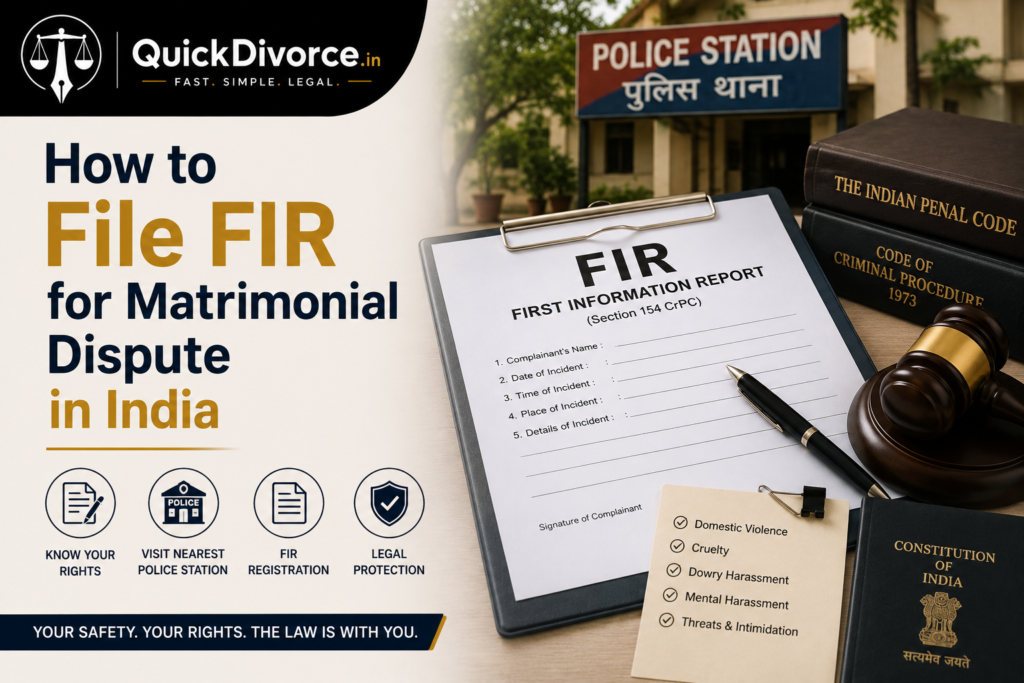
Key Legal Sections Under Which Matrimonial FIRs Are Filed
Understanding which legal sections apply to your situation is critical — it determines the seriousness of the offence, the police’s obligation to act, and the outcome of the case.
Section 498A of the Indian Penal Code / Section 85 of BNS 2023 This is the most widely invoked section in matrimonial criminal cases. It deals with cruelty by a husband or his relatives towards a married woman. Cruelty under this section includes:
- Conduct likely to drive the woman to suicide or cause grave injury
- Harassment with a view to coercing her or her family to meet unlawful dowry demands
This is a cognizable, non-bailable offence. The police can arrest without a warrant. Punishment can extend to three years of imprisonment along with a fine.
Dowry Prohibition Act, 1961 — Sections 3 and 4 Section 3 makes giving or taking dowry a punishable offence. Section 4 makes demanding dowry — even without exchange — a criminal offence. Punishment under these sections includes imprisonment of up to five years and a fine of up to fifteen thousand rupees or the value of the dowry demanded, whichever is higher.
Section 304B IPC / Section 80 BNS — Dowry Death If a woman dies within seven years of marriage by burns, bodily injury, or under suspicious circumstances, and it is shown that she was subjected to cruelty or harassment related to dowry demands before her death, it is treated as dowry death. This carries a minimum punishment of seven years imprisonment which may extend to life.
Section 306 IPC / Section 108 BNS — Abetment of Suicide If a spouse’s conduct — sustained cruelty, harassment, or humiliation — drives the other spouse to suicide, the abettor can be charged under this section. Punishment extends to ten years imprisonment.
Section 494 IPC / Section 82 BNS — Bigamy Marrying again during the lifetime of an existing husband or wife — without a valid divorce — is bigamy. Punishment is up to seven years imprisonment along with a fine.
Protection of Women from Domestic Violence Act, 2005 While primarily a civil law, violations of protection orders issued under this Act are criminal offences. A Domestic Violence complaint can be filed simultaneously with or independently of an FIR.
Section 354 IPC / Section 74 BNS — Assault or Criminal Force with Intent to Outrage Modesty Physical assault by a spouse or family member that outrages the modesty of a woman is covered under this section.
Section 506 IPC / Section 351 BNS — Criminal Intimidation Threatening a spouse or their family with injury, damage to property, or harm to reputation to force compliance is criminal intimidation.
Step-by-Step Procedure to File an FIR for Matrimonial Dispute in India
Step 1 — Gather Your Evidence Before Going to the Police
Before you walk into a police station, organize everything you have:
- Medical reports if you have suffered physical injuries
- Photographs of injuries, damaged property, or threatening messages
- Screenshots of WhatsApp messages, emails, or social media posts
- Audio or video recordings of incidents (where legally obtained)
- Written threatening letters or notes
- Witness details — names and contact information of people who have witnessed the abuse
- Bank statements or documents showing financial abuse or dowry transactions
- Any prior complaints, applications, or legal notices already sent
The stronger your documentation before filing, the stronger your FIR and the subsequent investigation will be.
Step 2 — Visit the Correct Police Station
Go to the police station that has jurisdiction over the area where:
- The incident occurred, or
- You currently reside, or
- The matrimonial home is located
In cases of domestic violence and matrimonial disputes, most states allow the victim to file the complaint at the police station nearest to where they are currently residing — even if the incident happened elsewhere. This is particularly important for women who have had to flee their matrimonial home.
Step 3 — Meet the Station House Officer (SHO)
At the police station, ask to meet the Station House Officer — the senior officer in charge. Clearly and calmly state that you want to register an FIR. Do not accept a suggestion to file a mere written complaint or a Non-Cognizable Report (NCR) if your complaint involves a cognizable offence like cruelty under Section 498A or dowry harassment.
Step 4 — Give Your Statement
The police will record your statement. Speak clearly and factually. Cover:
- Your full name, address, and relationship to the accused
- Specific incidents — dates, locations, what happened, and who was present
- The names of all accused persons
- Nature of injuries or harm suffered
- Any prior incidents and whether they were reported before
- What you are seeking — arrest, protection, investigation
Do not exaggerate and do not minimize. Stick to facts you can support with evidence or witness testimony.
Step 5 — Read the FIR Before Signing
Once the police have recorded your complaint and prepared the FIR, read it carefully before signing. Ensure:
- All names are spelled correctly
- All incidents you mentioned are included
- No facts have been altered or omitted
- The correct legal sections have been applied
You have the right to request corrections before signing. Do not sign a document you have not read.
Step 6 — Collect the Free Copy of the FIR
Under the law — specifically the Bharatiya Nagarik Suraksha Sanhita, 2023 — you are entitled to receive a free copy of the FIR immediately after it is registered. Demand this copy. Keep it safely. It is the foundation of your entire legal case going forward.
Step 7 — Medical Examination (If Physical Injury Is Involved)
If you have suffered physical injuries, request a medical examination immediately. The police are obligated to facilitate this. The medical report is critical evidence in your case and must be obtained as close in time to the incident as possible.
What to Do If Police Refuse to Register Your FIR
This is unfortunately a common problem in matrimonial dispute cases. Police sometimes try to treat matrimonial disputes as “family matters” and discourage victims from filing FIRs. Know your rights — and know your remedies.
Remedy 1 — Written Complaint to the Superintendent of Police (SP) If the local police station refuses to register your FIR, submit a written complaint to the Superintendent of Police of the district. The SP has the authority to direct the police station to register the FIR and investigate.
Remedy 2 — Online FIR Filing Most states in India now have online FIR filing portals. In Delhi, you can file an FIR through the Delhi Police website. Filing online creates a timestamped record of your complaint that the police cannot easily suppress.
Remedy 3 — Section 173 BNSS — Complaint Before Magistrate Under Section 173 of the Bharatiya Nagarik Suraksha Sanhita, 2023 (which replaced Section 156(3) CrPC), you can file a complaint directly before the Judicial Magistrate if the police refuse to register your FIR. The Magistrate can direct the police to register the FIR and investigate.
Remedy 4 — National Commission for Women (NCW) If you are a woman and the police are refusing to act on your matrimonial dispute complaint, you can approach the National Commission for Women. The NCW has the authority to intervene and direct action by the police.
Remedy 5 — High Court — Writ Petition As a last resort, you can file a writ petition before the High Court under Article 226 of the Constitution, directing the police to register your FIR. Courts have consistently upheld this right of citizens.
If police are refusing to register your FIR, do not give up. Call Quick Divorce at 8595439395 — our legal team will tell you exactly what to do next.
Rights of the Accused in a Matrimonial FIR
While this guide primarily addresses the victim’s perspective, it is important to also address what happens when someone is falsely accused in a matrimonial FIR — because this does happen, and Indian courts have acknowledged it.
Right to Bail In matrimonial cases involving Section 498A, the Supreme Court in the landmark Arnesh Kumar judgment (2014) directed that police must not arrest the accused automatically without proper inquiry. Magistrates were instructed to apply their mind before authorizing detention. This direction continues to be followed in 2026.
Right to Anticipatory Bail If you have reason to believe you may be arrested in connection with a matrimonial FIR, you can apply for anticipatory bail before the Sessions Court under Section 482 BNSS (formerly Section 438 CrPC).
Right to Quash the FIR If an FIR has been filed with false or malicious intent, the accused can approach the High Court under Section 528 BNSS (formerly Section 482 CrPC) to quash the FIR. Courts scrutinize matrimonial FIRs carefully and will quash those that are clearly motivated by personal vendetta rather than genuine grievance.
Right to Legal Representation Every accused person has the right to be represented by a lawyer from the moment of arrest. Do not make any statement to the police without your lawyer present.
FIR vs Domestic Violence Complaint — What Is the Difference?
Many people confuse an FIR under Section 498A with a complaint under the Protection of Women from Domestic Violence Act, 2005. They are different legal remedies that can be pursued simultaneously.
| Factor | FIR Under IPC / BNS | Domestic Violence Complaint |
|---|---|---|
| Nature | Criminal proceeding | Civil proceeding (primarily) |
| Filed Before | Police station | Magistrate / Protection Officer |
| Relief Available | Arrest, investigation, prosecution | Protection orders, residence orders, maintenance, compensation |
| Who Can File | Anyone (police can also act suo motu) | Aggrieved woman or on her behalf |
| Time to Get Relief | Depends on investigation | Emergency protection orders can be obtained quickly |
| Impact on Accused | Criminal record, possible imprisonment | Civil orders, not necessarily criminal record |
In serious cases of matrimonial cruelty, filing both an FIR and a Domestic Violence complaint simultaneously provides the most comprehensive legal protection.
Important Supreme Court Judgments on Matrimonial FIRs
Arnesh Kumar v. State of Bihar (2014) The Supreme Court directed that arrests under Section 498A should not be made mechanically. Police must conduct a preliminary inquiry and magistrates must apply their mind before authorizing custody. This judgment protects against misuse while not diluting the rights of genuine victims.
Rajesh Sharma v. State of UP (2017) — Modified in 2018 The Supreme Court initially directed setting up Family Welfare Committees to scrutinize 498A complaints before arrest. This was subsequently modified in 2018, restoring greater power to courts and police in genuine cases while maintaining safeguards against misuse.
Social Action Forum v. Union of India (2018) The Supreme Court reiterated that the protection under Section 498A is essential for genuine victims of matrimonial cruelty and that procedural safeguards must not be used to delay justice for real victims.
Frequently Asked Questions
1. What is an FIR in a matrimonial dispute?
An FIR (First Information Report) is a formal complaint registered by the police when a cognizable offence such as cruelty, domestic violence, dowry harassment, or criminal breach of trust is alleged in a marriage-related dispute.
2. Where can I file an FIR for a matrimonial dispute?
You can file an FIR at the police station having jurisdiction over the place where the incident occurred. In appropriate cases, a Zero FIR can also be filed at any police station and later transferred to the concerned jurisdiction.
3. What documents are required to file an FIR in a matrimonial case?
Generally, you should carry identity proof, marriage-related documents, details of the accused, evidence such as messages, emails, photographs, medical records, and any other documents supporting your allegations.
4. Can an FIR be filed for dowry harassment after several years of marriage?
Yes. An FIR can be filed if dowry demands, harassment, or cruelty continue or if there is sufficient evidence of the offence, even after several years of marriage. However, the facts and circumstances of each case are important.
5. What happens after the FIR is registered?
After registration, the police begin an investigation, collect evidence, record statements, and may take further legal action depending on the findings. The matter may eventually proceed before a court.
How Quick Divorce Can Help You
Filing an FIR in a matrimonial dispute is not just about walking into a police station. It is about knowing which sections apply, having your documents ready, knowing your rights when police resist, and protecting yourself legally throughout the process that follows.
At Quick Divorce, our experienced family and criminal law team assists clients with:
- Assessing whether your situation warrants an FIR or an alternative legal remedy
- Identifying the correct legal sections applicable to your specific case
- Preparing your statement and organizing your evidence before approaching the police
- Accompanying you to the police station or providing legal representation
- Filing applications before the Magistrate if police refuse to register the FIR
- Simultaneously filing Domestic Violence complaints for comprehensive protection
- Defending clients against false or malicious matrimonial FIRs
- Assisting with anticipatory bail and FIR quashing applications
Whatever side of a matrimonial dispute you are on — victim seeking justice or accused seeking protection — we have the legal expertise to guide you.
Get your free consultation today: 📞 Call / WhatsApp: 8595439395
Final Word
A matrimonial dispute that has turned criminal is one of the most stressful legal situations a person can face — emotionally, financially, and socially. But silence is never the answer.
The law in India gives you clear rights and clear remedies. An FIR is not a weapon to be misused — but for genuine victims of cruelty, dowry harassment, domestic violence, and matrimonial fraud, it is a legitimate and powerful tool that the legal system has provided precisely for situations like yours.
Use it correctly. Use it with proper legal guidance. And use it knowing that the law is on your side.
Quick Divorce is here to help you take that first step.
Need Help With Drafting?
🟡 QuickDivorce.in provides complete legal services — settlement negotiation, alimony structuring, property division, stridhan recovery, MoU drafting, court representation, and post-decree implementation: across all jurisdictions in India.
🟡 For other Legal and Trademark related services as
👉 Money Recovery Cases
👉 Property Disputes
👉 Business & Licence Registrations
🟡Visit Business24hub for IT services
👉 Mutual Consent Divorce
👉 Contested Divorce Filing
👉 Child Custody and Maintenance
👉 Matrimonial Property Settlement
👉 NRI Divorce Services
👉 Alimony and Maintenance
🟡 Protect Your Rights
👉 Domestic Violence Legal Support
👉 Stridhan Recovery
📞 Call Now: +91 8595439395
🕐 Free Consultation: Monday to Saturday, 10 AM to 6 PM

Adv. Manish Kashyap is a Family Law & Divorce Lawyer with extensive experience in Mutual & Contested Divorce, NRI Divorce, Child Custody, Alimony, Domestic Violence, Judicial Separation, and Family Court matters, providing professional legal guidance to clients.

