

Views: 13
Table of Contents
- 1 You Got Married — But Is It Legal on Paper?
- 2 Which Law Applies to Your NRI Marriage?
- 3 Complete List of Documents Required for NRI Marriage Registration in India
- 4 Step-by-Step Process for NRI Marriage Registration in India
- 5 Where Can NRI Marriages Be Registered?
- 6 Common Mistakes NRI Couples Make (And How to Avoid Them)
- 7 Why NRI Marriage Registration Matters
- 8 Why Choose Quick Divorce for NRI Marriage Registration?
- 9 Frequently Asked Questions (FAQs)
- 10 Conclusion
- 11 Need Consutation
You Got Married — But Is It Legal on Paper?
A beautiful wedding ceremony, emotional vows, family blessings — and yet, without a registered marriage certificate, none of it holds legal weight in the eyes of Indian law or any foreign government.
For Non-Resident Indians, marriage registration is not just a box to tick. It is the foundation on which your spouse’s visa, property inheritance, joint bank accounts, insurance nominations, and immigration status all rest.
Whether you married in India or abroad, whether your spouse is Indian or a foreign national — if you have NRI status, there is a specific documentation process you must follow to get your marriage legally registered in India.
This guide breaks it all down — the exact documents, the applicable laws, and the step-by-step process — so you walk in prepared and walk out with a valid marriage certificate.
Which Law Applies to Your NRI Marriage?
Before gathering documents, you need to know under which Act your marriage will be registered. India has three primary laws that govern NRI marriages:
1. Special Marriage Act, 1954 This is the most commonly used law for NRI marriages. It applies to all Indian citizens regardless of religion, making it ideal for inter-religious couples or NRIs marrying foreign nationals. It also works when both partners are NRIs or Overseas Citizens of India (OCI).
2. Hindu Marriage Act, 1955 This applies when both partners are Hindus, Sikhs, Jains, or Buddhists. If both of you belong to these communities, you can register under this Act at the local Sub-Divisional Magistrate (SDM) office.
3. Foreign Marriage Act, 1969 This law applies when an Indian citizen gets married on foreign soil. In such cases, the marriage can be registered at the Indian Embassy or Consulate in the country where the marriage took place.
Choosing the right Act is the first step. Getting it wrong causes delays, rejections, and unnecessary stress.
Not sure which law applies to you? Call our legal experts at 8595439395 — we’ll tell you in minutes.
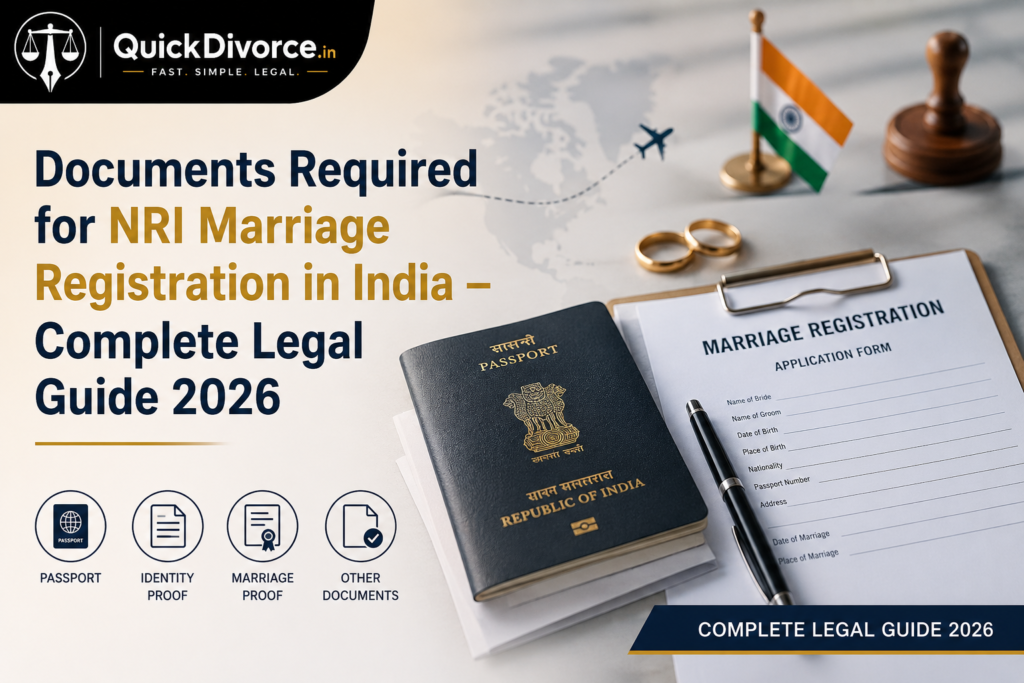
Complete List of Documents Required for NRI Marriage Registration in India
Here is the comprehensive, updated checklist of documents that both partners typically need to submit:
A. Documents Required from Both Bride and Groom
1. Duly Filled Application Form A joint application form signed by both the bride and the groom. This is available at the Sub-Divisional Magistrate (SDM) office or the local marriage registration authority.
2. Valid Passport A passport is mandatory for the NRI partner and strongly recommended for both. It serves as identity proof, nationality proof, and proof of NRI status — all in one document. Submit self-attested photocopies of all relevant pages.
3. Proof of Date of Birth Any one of the following is accepted:
- Birth Certificate
- Class 10th Marksheet (Matriculation Certificate)
- Passport (date of birth page)
- School Leaving Certificate
4. Proof of Address in India
- Aadhaar Card
- Voter ID
- Ration Card
- Utility Bills (electricity, water, gas — not older than 3 months)
- Report from the local Station House Officer (SHO) confirming stay in India
5. Proof of Residence Abroad (For NRI Partner)
- Overseas address proof such as a foreign utility bill or bank statement
- Visa copy showing current country of residence
- Overseas Residency Certificate (if applicable)
6. Passport-Sized Photographs Minimum two to four recent passport-size photographs of each partner. The exact number may vary by state.
7. Affidavit of Marital Status A sworn affidavit stating:
- Current marital status (never married / divorced / widowed)
- Date and place of birth
- Date and place of marriage
- Nationality
- Willingness to marry
This affidavit must be notarized. NRI partners should get it attested by the Indian Embassy or Consulate in their country of residence.
8. Wedding Photographs If the marriage has already been solemnized, submit photographs from the ceremony as evidence that the wedding took place.
9. Wedding Invitation Card If available, the wedding invitation card serves as supporting evidence of the marriage.
B. Additional Documents for NRI Partner Specifically
10. Copy of Valid Visa The current visa of the NRI partner showing legal stay in the country of residence.
11. NRI Status Proof Any document that establishes NRI status — a work permit, employment letter, or long-term residency proof from the country of residence.
12. No Objection Certificate (NOC) from Embassy Some registrars may require a No Objection Certificate from the Indian Embassy of the country where the NRI resides, confirming that there is no legal bar to the marriage.
13. Certificate of Single Status / Bachelorhood Certificate Issued by the Indian Embassy or the competent authority of the foreign country, this document confirms that the NRI partner is legally free to marry.
C. Additional Documents in Case of Divorce or Widowhood
14. Divorce Decree If either partner was previously married and divorced, a certified copy of the court-issued divorce decree is mandatory.
15. Death Certificate of Former Spouse If either partner is widowed, the death certificate of the deceased spouse must be submitted.
D. Documents Required from Witnesses
16. Identity Proof of Witnesses Under the Special Marriage Act, at least three witnesses are required. Each witness must provide:
- Aadhaar Card or Voter ID or Passport
- Passport-sized photographs
- Signatures on the application
E. Foreign Documents — Apostille and Attestation
If any document is issued by a foreign government or authority, it must either be:
- Apostilled — if the country is a signatory to the Hague Convention, or
- Attested by the Indian Embassy — if the country is not a Hague Convention signatory
This is a step many couples overlook and it leads to serious delays. Always get foreign documents apostilled or attested before arriving in India.
Step-by-Step Process for NRI Marriage Registration in India
Step 1 — Choose the Applicable Law Determine whether your marriage falls under the Special Marriage Act, Hindu Marriage Act, or Foreign Marriage Act based on your religion, nationality, and where the marriage is taking place.
Step 2 — Collect and Prepare All Documents Gather every document from the list above. Get foreign documents apostilled. Get affidavits notarized. Do not leave this for the last minute.
Step 3 — Submit Notice of Intended Marriage (Under Special Marriage Act) Under the Special Marriage Act, both parties must give a written notice to the Marriage Officer in the district where at least one party has resided for a minimum of 30 days. This notice is publicly displayed for 30 days to invite any objections.
Step 4 — Appear Before the Marriage Officer After the 30-day notice period (if no objections are raised), both parties and three witnesses must appear in person before the Marriage Officer for verification.
Step 5 — Solemnization and Signing The marriage is solemnized in the presence of the Marriage Officer and witnesses. All parties sign the marriage register.
Step 6 — Receive the Marriage Certificate The Marriage Certificate is issued under the official seal of the Marriage Officer. This document is legally valid across India and internationally.
Where Can NRI Marriages Be Registered?
- In India — At the Sub-Divisional Magistrate (SDM) office or the office of the Marriage Officer in the district where either partner has stayed for at least 30 days.
- At Indian Embassy or Consulate Abroad — If the marriage took place outside India, it can be registered at the nearest Indian diplomatic mission under the Foreign Marriage Act, 1969.
Common Mistakes NRI Couples Make (And How to Avoid Them)
Not getting foreign documents apostilled Any document issued abroad that is not apostilled or embassy-attested will be rejected. Plan this in advance.
Not fulfilling the 30-day residency requirement Under the Special Marriage Act, at least one partner must have resided in the district for 30 days before the notice is submitted. NRIs on short trips often miss this requirement.
Submitting expired documents Passports, visas, or address proofs that are expired will lead to immediate rejection. Check validity dates before submission.
Choosing the wrong Act Registering under the wrong law can cause the certificate to be challenged later. Always confirm with a legal expert.
Appearing without proper witnesses Witnesses must carry their own valid identity proof. Showing up without it causes unnecessary delays on the day of registration.
Why NRI Marriage Registration Matters
A registered marriage certificate is not just a piece of paper. It is what enables:
- Spouse Visa and Immigration — Most foreign embassies require a registered marriage certificate for dependent or spouse visa applications
- Property and Inheritance Rights — Without legal proof of marriage, inheritance disputes become complicated
- Joint Financial Accounts — Banks require marriage proof for joint accounts and spousal nominations
- Child Custody and Documentation — For adding a spouse’s name in a child’s documents or passport
- Legal Protection in Case of Disputes — In case of separation, divorce, or maintenance claims, only a registered marriage is recognized by courts
Why Choose Quick Divorce for NRI Marriage Registration?
At Quick Divorce, we have helped hundreds of NRI couples navigate the legal documentation process without confusion, delays, or unnecessary court visits.
Our team of experienced family law experts handles everything — from verifying which law applies to your case, to reviewing your documents, to guiding you through the registration process step by step.
We understand that NRIs work on tight schedules and cannot afford delays. That is why we make the process smooth, fast, and legally sound — the first time.
Contact us today for a free consultation: 📞 Call / WhatsApp: 8595439395 🌐 Website: www.quickdivorce.in
Frequently Asked Questions (FAQs)
Q1. Can an NRI register their marriage in India without being present for 30 days?
Under the Special Marriage Act, at least one partner must reside in the district for 30 days. However, in some states, a Power of Attorney may be permitted for certain steps. Consult a legal expert for your specific situation.
Q2. Is an Indian marriage certificate valid abroad?
Yes. A marriage certificate issued in India is internationally recognized, especially when apostilled under the Hague Convention.
Q3. What if my marriage happened abroad — can I still register it in India?
Yes. Under the Foreign Marriage Act, 1969, you can register your overseas marriage at the nearest Indian Embassy or High Commission.
Q4. How long does the NRI marriage registration process take in India?
Under the Special Marriage Act, the minimum timeline is 30 days (notice period) plus the day of solemnization. The certificate is usually issued the same day or within a few working days after registration.
Q5. What if one partner cannot come to India for registration?
In some circumstances, a Power of Attorney can be used. However, both parties generally need to be present for the final signing. Our legal team can advise on your specific case — call us at 8595439395.
Q6. Do witnesses need to be Indian citizens?
No. Witnesses do not have to be Indian citizens, but they must carry valid identity proof and be physically present.
Conclusion
NRI marriage registration in India is a process that demands the right documents, the right law, and the right guidance. One missing paper or one wrong step can delay your spouse’s visa, create property disputes, or complicate your legal standing in two countries at once.
Do not leave it to chance. Do not rely on outdated information. Consult a legal expert who understands both the Indian legal system and the unique challenges NRIs face.
Quick Divorce is here to make it simple for you.
📞 Call us now: +91 8595439395
Need Consutation
🟡 QuickDivorce.in provides complete legal assistance for NRI marriage — including documentation, affidavits, registration support, embassy attestation guidance, and legal compliance across India and abroad.
🟡 For other Legal and Trademark related services
👉 Money Recovery Cases
👉 Property Disputes
👉 Business & Licence Registrations
🟡To explore IT services Click here
👉 Mutual Consent Divorce
👉 Contested Divorce Filing
👉 Child Custody and Maintenance
👉 Matrimonial Property Settlement
👉 NRI Divorce Services
👉 Alimony and Maintenance
🟡 Protect Your Rights
👉 Domestic Violence Legal Support
👉 Stridhan Recovery
📞 Call Now: +91 8595439395
🕐 Free Consultation: Monday to Saturday, 10 AM to 6 PM

Adv. Manish Kashyap is a Family Law & Divorce Lawyer with extensive experience in Mutual & Contested Divorce, NRI Divorce, Child Custody, Alimony, Domestic Violence, Judicial Separation, and Family Court matters, providing professional legal guidance to clients.

