

Views: 3
Table of Contents
- 1 Quick Summary
- 2 📌 What Is Court Marriage in India?
- 3 📈 Why Court Marriage Is Becoming More Popular in 2026
- 4 📜 What Is the Special Marriage Act 1954?
- 5 👥 Who Can Get Court Married in India?
- 6 ✅ Eligibility Conditions for Court Marriage
- 7 🔄 Court Marriage vs Religious Marriage — Key Differences
- 8 📋 Step by Step Procedure for Court Marriage in India
- 9 📄 Documents Required for Court Marriage in India
- 10 👨⚖️ Role of the Marriage Officer
- 11 ⏱️ The 30 Day Notice Period — Why It Exists and How to Handle It
- 12 💰 Court Marriage Fees in India
- 13 🕌 Court Marriage for Different Religions
- 14 🌍 Court Marriage for NRIs
- 15 💔 Court Marriage and Divorce — Important Connection
- 16 ✅ Benefits of Court Marriage in India
- 17 🚫 Common Myths About Court Marriage in India
- 18 🚨 Common Mistakes in Court Marriage Registration
- 19 🌟 How Quick Divorce Helps with Court Marriage
- 20 💰 Cost Breakdown: Court Marriage in India
- 21 ❓ Frequently Asked Questions (FAQs)
- 22 🎯 Who Needs This Guide Right Now?
- 23 ✅ Final Recommendation
- 24 Need Help With Court Marraige
Quick Summary
Court marriage in India is a legally recognised, religion-neutral form of marriage solemnized and registered under the Special Marriage Act 1954 — available to any two adults regardless of religion, caste or community.
Here is what you need to know upfront:
- ⚖️ Legal basis — Special Marriage Act 1954 governs all court marriages in India
- 👥 Who can marry — any two adults of any religion, caste or nationality
- 📋 Key requirement — 30 day public notice period before the marriage is solemnized
- 📄 Documents — identity proof, address proof, age proof and photographs
- 💰 Cost — government fees are minimal — ₹150 total in most states
- ✅ Quick Divorce helps with complete court marriage registration assistance across India
Call Quick Divorce today: 📞 8595439395
📌 What Is Court Marriage in India?
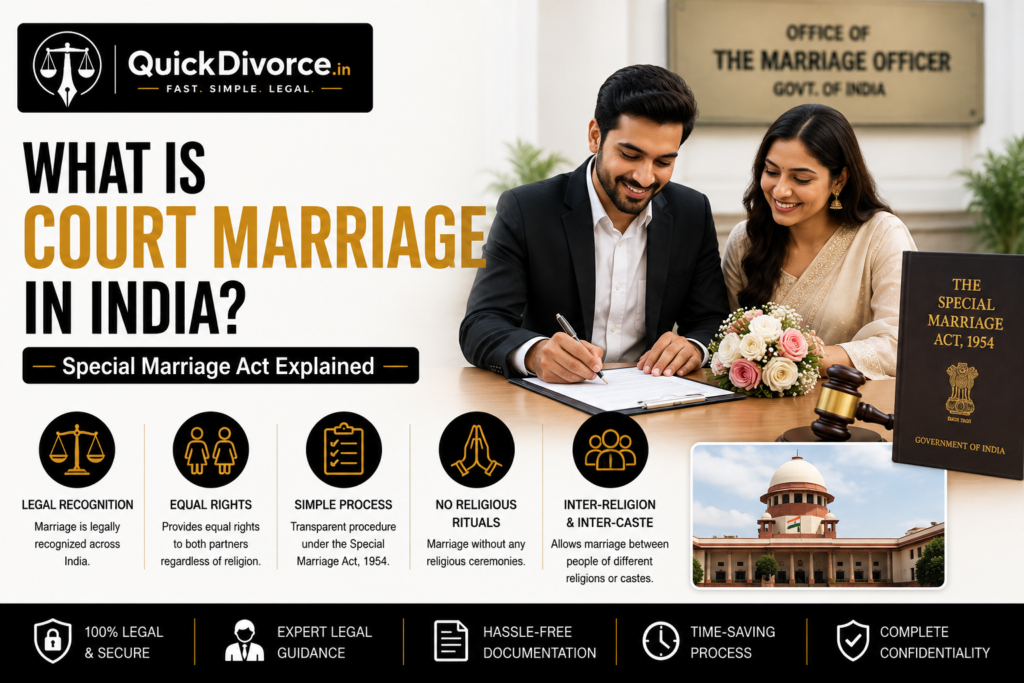
Court marriage in India is a civil marriage — solemnized and registered under the Special Marriage Act 1954 — before a Marriage Officer appointed by the government, in the presence of three witnesses.
The term “court marriage” is commonly used in India but is technically a misnomer — the marriage does not take place in a court of law. It takes place at the office of the Marriage Officer — typically the Sub-Divisional Magistrate (SDM) or the Registrar of Marriages — which is a government office, not a court.
However — the name has stuck, and “court marriage” is universally understood in India to mean a marriage registered under the Special Marriage Act 1954.
Court marriage in India is significant for several important reasons:
Religion neutral: Court marriage is completely independent of any religious ceremony or personal law. It does not require either party to follow any religious ritual or convert to any religion. It is purely a civil, legal act.
Caste and community neutral: Court marriage can be solemnized between any two adults regardless of their caste, community, religion or social background. It is the legal mechanism through which inter-caste and inter-religion marriages are registered in India.
Universally recognized: A court marriage registered under the Special Marriage Act 1954 is recognized throughout India and by Indian embassies and consulates abroad — making it particularly valuable for NRIs and couples requiring international recognition of their marriage.
Legally comprehensive: Once registered, a court marriage has the full legal status of any marriage — with all associated rights regarding maintenance, inheritance, property and custody.
The simplest explanation: Court marriage in India is how two adults — of any religion, caste or community — get legally married without any religious ceremony, through a simple government registration process.
📈 Why Court Marriage Is Becoming More Popular in 2026
Court marriages in India have grown significantly in popularity — particularly among urban, educated and younger Indians. The reasons are clear:
Inter-religion and inter-caste marriages: As social barriers reduce — particularly in metro cities — more couples from different religious and caste backgrounds choose court marriage as the legally clean solution that avoids the complexities of which religious personal law applies.
Legal certainty: A court-registered marriage provides unambiguous legal documentation — a marriage certificate issued by the government — that is accepted everywhere without question.
Simplicity and affordability: Court marriage requires minimal paperwork, minimal cost and no elaborate ceremony. For couples who want a simple, dignified and legally sound marriage — it is the ideal solution.
Privacy: Court marriage is a private legal act — between the couple, the Marriage Officer and three witnesses. Families who oppose the marriage cannot prevent it — the law provides the mechanism for adults to exercise their right to marry.
NRI requirements: Many foreign countries and Indian visa processes require officially registered marriage certificates. A court marriage certificate issued under the Special Marriage Act 1954 satisfies these requirements with the highest level of official credibility.
Protection against family opposition: For couples facing family opposition to their marriage — court marriage under the Special Marriage Act provides a legal mechanism to get married regardless of family consent (provided both parties are adults — age 21 for men, 18 for women).
📜 What Is the Special Marriage Act 1954?
The Special Marriage Act 1954 is the central legislation governing court marriage in India. It was enacted to provide:
- A uniform legal framework for marriage applicable to all citizens regardless of religion
- A mechanism for inter-religion and inter-caste marriages
- A civil registration system for marriages that does not depend on religious ceremonies
History and Background
Before the Special Marriage Act 1954, inter-community marriages in India had no clear legal framework. Couples from different religions faced enormous legal uncertainty about which personal law governed their marriage, inheritance and divorce.
The Special Marriage Act — drawing on an earlier 1872 Act — created a clean, religion-neutral system that any Indian citizen could use regardless of their personal background.
Key Features of the Special Marriage Act 1954
Applies to all citizens: The Act applies to all citizens of India — regardless of religion, caste or community. It also applies to Indian citizens abroad.
No religious ceremony required: The Act does not require any religious ceremony. The marriage is solemnized by a government Marriage Officer.
30 day notice requirement: The parties must give 30 days’ advance notice to the Marriage Officer before the marriage can be solemnized.
Three witnesses: Three adult witnesses must be present at the time of solemnization.
Uniform personal law: Marriages registered under the Special Marriage Act are governed by the Act for divorce purposes — the Hindu Marriage Act, Muslim Personal Law or other personal laws do not apply to marriages registered under the Special Marriage Act, regardless of the religion of the parties.
Registration of existing marriages: The Act also provides for registration of marriages already solemnized — under Part V — allowing religious marriages to be registered under the Act after the fact.
👥 Who Can Get Court Married in India?
Court marriage under the Special Marriage Act 1954 is available to:
By Religion
- ✅ Hindu couples
- ✅ Muslim couples
- ✅ Christian couples
- ✅ Sikh couples
- ✅ Buddhist couples
- ✅ Jain couples
- ✅ Parsi couples
- ✅ Inter-religion couples — Hindu-Muslim, Hindu-Christian, Hindu-Sikh, and any other combination
- ✅ Couples with no religion
By Caste and Community
- ✅ Any caste or community — no restriction whatsoever
- ✅ Inter-caste couples — fully covered
By Nationality
- ✅ Both Indian citizens
- ✅ One Indian citizen and one foreign national — subject to additional documentation requirements
- ✅ NRIs — Indian nationals living abroad can use the Act for marriages in India
By Sexual Orientation
As of June 2026 — court marriage under the Special Marriage Act 1954 is legally available only to heterosexual couples — one male and one female. Same sex marriage has not yet been legally recognised in India.
✅ Eligibility Conditions for Court Marriage
For a court marriage to be valid under the Special Marriage Act 1954, all of the following conditions must be satisfied:
Condition 1 — Age
- 👨 Male party must be at least 21 years of age
- 👩 Female party must be at least 18 years of age
Age proof must be provided in the form of official documents — birth certificate, passport, school leaving certificate or Aadhaar Card.
Condition 2 — Sound Mind
Both parties must be of sound mind at the time of marriage — capable of giving valid consent and understanding the nature of the marriage they are entering into.
Condition 3 — No Subsisting Marriage
Neither party must have a living spouse at the time of court marriage. If either party was previously married — that marriage must have been legally dissolved by:
- A valid divorce decree from a competent court, or
- Death of the previous spouse
A divorced person can remarry through court marriage — but must produce the divorce decree as part of the documentation.
Condition 4 — Not Within Prohibited Degrees of Relationship
The parties must not be related within the degrees of prohibited relationship specified in the First Schedule to the Special Marriage Act — which covers close blood relatives.
Exception: Where the custom or usage governing either party specifically permits such a marriage — the prohibition does not apply. This exception is relevant for certain communities where cousin marriages are traditional.
🔄 Court Marriage vs Religious Marriage — Key Differences
| Aspect | Court Marriage (Special Marriage Act) | Religious Marriage (Personal Laws) |
|---|---|---|
| Legal basis | Special Marriage Act 1954 | Hindu Marriage Act, Muslim Law, Indian Christian Marriage Act etc. |
| Religion requirement | None — completely religion neutral | Ceremony must follow the applicable religion |
| Caste requirement | None | None under law — but social pressure may exist |
| Ceremony | No religious ceremony required — civil solemnization | Religious ceremony typically required for validity |
| Registration | Mandatory and integral to the process | Separate from solemnization — often done after |
| Applicable divorce law | Special Marriage Act (Section 27 grounds) | Applicable personal law |
| Inter-religion couples | Specifically designed for this | Not available — both must follow same religious law |
| Legal recognition abroad | Universally recognised — clean government certificate | May require translation and authentication |
| Time to complete | 30 days notice plus appointment day | Varies — can be same day as ceremony |
| Family consent required | Not required — adults have absolute right | Not legally required but socially common |
| Protection against opposition | Strong — government process, cannot be stopped | Weaker — ceremony can be disrupted |
📋 Step by Step Procedure for Court Marriage in India
Step 1 — Verify Eligibility
Before beginning the process — confirm:
- Both parties meet the age requirements
- Neither party has a subsisting marriage
- Both are of sound mind
- They are not within prohibited degrees of relationship
Quick Divorce assists with eligibility verification as part of their court marriage service — call 8595439395.
Step 2 — Identify the Correct Marriage Officer
The Marriage Officer for court marriage under the Special Marriage Act is typically:
- The Sub-Divisional Magistrate (SDM) in the sub-division
- The Additional District Magistrate (ADM) in some areas
- The Registrar of Marriages in some states
The marriage must be registered with the Marriage Officer for the district where:
- Either party has resided for at least 30 days immediately before the notice is given, or
- In some states — where either party is ordinarily resident
Identifying the correct Marriage Officer for your specific case is an important first step. Quick Divorce helps identify the correct office for your location.
Step 3 — Prepare All Documents
Gather all required documents for both parties before submitting the notice. (Complete document list in the next section.)
Step 4 — Submit Notice of Intended Marriage (Form I)
Submit a written notice of intended marriage in Form I under the Special Marriage Act to the Marriage Officer.
The notice must:
- State the names and addresses of both parties
- Confirm that both parties satisfy the eligibility conditions
- Be signed by both parties
- Be accompanied by all required documents
- Be accompanied by the prescribed notice fee
Step 5 — 30 Day Public Notice Period
After receiving the notice — the Marriage Officer enters it in the Marriage Notice Book and displays it at the office for 30 days.
During this 30 day period — any person can file an objection to the marriage on the grounds that it violates any of the conditions specified in the Act (prohibited relationship, subsisting marriage, unsound mind, underage).
How to handle the 30 day period:
The 30 day notice requirement is one of the most common concerns for couples — particularly those facing family opposition. Understanding how it works:
- The notice is displayed at the Marriage Officer’s office — not necessarily in newspapers or publicly broadcast
- Only legally valid objections — based on the specific grounds in the Act — can delay the marriage
- A family member’s general opposition or disapproval is NOT a valid objection under the Act
- If a valid objection is filed — the Marriage Officer investigates. If the objection is not valid — the marriage proceeds
Quick Divorce advises couples on how to navigate the 30 day period — including protecting themselves from harassment and invalid objections.
Step 6 — Addressing Any Objections
If an objection is filed during the 30 day period:
- The Marriage Officer must inquire into the objection within 30 days
- If the objection is found to be valid — the marriage is refused
- If the objection is found to be invalid — the marriage proceeds
- Either party can appeal the Marriage Officer’s decision on an objection
In practice — most objections filed by disapproving family members are legally invalid because they are based on personal preference rather than the statutory grounds. Quick Divorce advises on responding to invalid objections.
Step 7 — Solemnization of Marriage
After the 30 day notice period (assuming no valid objection) — the marriage is solemnized at the Marriage Officer’s office:
- Both parties and three witnesses must be present
- The Marriage Officer reads out a declaration — both parties and witnesses sign it
- The marriage is entered in the Marriage Certificate Book
- The Marriage Officer signs the certificate
The declaration both parties must make:
“I, [Name], take thee [Name], to be my lawful wife/husband.”
This simple declaration — in the presence of the Marriage Officer and three witnesses — is the entirety of the “ceremony” for a court marriage.
Step 8 — Marriage Certificate Issued
Immediately after solemnization — the Marriage Officer issues the Marriage Certificate — signed by the Marriage Officer, both parties and all three witnesses.
This certificate is the primary legal document proving the marriage. Keep multiple certified copies.
📄 Documents Required for Court Marriage in India
Documents Required from Both Parties
Identity Proof (any one)
- 🪪 Aadhaar Card
- 🛂 Passport
- 🗳️ Voter ID Card
- 🚗 Driving License
Age Proof (any one)
- 📜 Birth Certificate
- 🛂 Passport (shows date of birth)
- 📚 School Leaving Certificate (Class 10 mark sheet)
- 🏥 Hospital Birth Record
Address Proof (any one — showing current residence)
- 🪪 Aadhaar Card
- 🏠 Utility Bill — electricity, water, gas (not older than 3 months)
- 🏦 Bank Passbook with address
- 📋 Rental Agreement
Photographs
- 📸 Passport size photographs — typically 4 to 6 each
Additional Documents for Specific Situations
If Previously Married (Divorced)
- ⚖️ Divorce decree from the competent court — certified copy
If Previously Married (Widowed)
- 📜 Death certificate of the deceased spouse
If Foreign National
- 🛂 Valid passport
- 📋 No Objection Certificate (NOC) from their country’s Embassy or High Commission in India — confirming no legal impediment to marriage
- 🛂 Valid visa
If NRI
- 🛂 Passport (Indian)
- 📋 Proof of current foreign address
- 📋 No Objection Certificate if required by the relevant Marriage Officer
Documents for Witnesses
Three witnesses must provide:
- 🪪 Identity proof — Aadhaar Card, Voter ID, Passport or Driving License
- 📷 Passport size photograph each
- ✍️ They must be present in person on the day of solemnization
👨⚖️ Role of the Marriage Officer
The Marriage Officer is the government official responsible for all aspects of court marriage registration under the Special Marriage Act 1954.
Powers and Duties of the Marriage Officer
Receiving and recording notice: The Marriage Officer receives the Form I notice and enters it in the Marriage Notice Book.
Publishing notice: The Marriage Officer displays the notice at the office for 30 days.
Receiving and adjudicating objections: Where an objection is filed — the Marriage Officer investigates and decides whether it is valid.
Solemnizing the marriage: The Marriage Officer presides over the solemnization ceremony — administering the declarations.
Issuing the marriage certificate: The Marriage Officer signs and issues the marriage certificate immediately after solemnization.
Maintaining records: The Marriage Officer maintains the Marriage Certificate Book — a permanent register of all marriages solemnized under the Act.
⏱️ The 30 Day Notice Period — Why It Exists and How to Handle It
The 30 day notice period is the most discussed and debated aspect of court marriage in India.
Why the 30 Day Notice Period Exists
The notice period was designed to:
- Give any person with a valid legal objection — such as knowledge of a subsisting marriage or prohibited relationship — an opportunity to raise it before the marriage is solemnized
- Prevent fraudulent or legally invalid marriages
The Controversy
Critics argue that the 30 day public notice requirement has become a tool through which:
- Disapproving families track and harass couples intending to marry
- Caste panchayats and community groups interfere with constitutionally protected marriage choices
- Couples face threats, pressure and even violence during the notice period
The Supreme Court of India has taken note of this concern — and several High Courts have held that the requirement of displaying the notice publicly is not mandatory and that the Marriage Officer can use discretion about how broadly to publicize it.
Practical Guidance for Navigating the 30 Day Period
If you are concerned about family opposition during the notice period:
- 🔒 File the notice and keep the date confidential — share only with trusted persons
- 📋 The notice is displayed at the Marriage Officer’s office — not in newspapers unless specifically requested
- ⚖️ Only legally valid objections under the Act can delay or prevent the marriage — general family disapproval is not a valid objection
- 🏠 Consider staying at a safe and different address during the notice period
- 📞 Contact Quick Divorce at 8595439395 — their team advises couples on safety and legal protection during the notice period
If an invalid objection is filed:
Quick Divorce assists couples in responding to invalid objections — demonstrating to the Marriage Officer that the objection has no legal basis and the marriage should proceed.
💰 Court Marriage Fees in India
Court marriage under the Special Marriage Act involves minimal government fees:
| Fee Item | Amount |
|---|---|
| Notice filing fee | ₹150 (in most states) |
| Marriage solemnization fee | Included in notice fee in most states |
| Marriage certificate (first copy) | Typically free or ₹50 |
| Additional certified copies of certificate | ₹50 to ₹100 per copy |
| Total government fees | ₹150 to ₹500 approximately |
Note: Government fees vary slightly by state. Quick Divorce confirms the exact fees for your specific state and Marriage Officer’s office as part of their court marriage service.
Professional Assistance Fees
While government fees are minimal — professional assistance in document preparation, verification, appointment coordination and process guidance adds significant value for most couples.
Quick Divorce’s court marriage assistance service handles everything from document preparation to Marriage Officer appointment coordination — at transparent, affordable pricing.
Call 8595439395 for Quick Divorce’s court marriage service pricing.
🕌 Court Marriage for Different Religions
Hindu Couples
Hindu couples can choose between:
- Hindu Marriage Act 1955 — religious ceremony with subsequent registration
- Special Marriage Act 1954 — court marriage without religious ceremony
Where a Hindu couple registers under the Special Marriage Act — their marriage and any subsequent divorce is governed by the Special Marriage Act, not the Hindu Marriage Act. This has implications for divorce grounds and succession — Quick Divorce advises on the choice.
Muslim Couples
Muslim marriages are traditionally governed by Muslim Personal Law. However Muslim couples can choose to marry under the Special Marriage Act — which then governs the marriage and any subsequent divorce under the Act’s provisions rather than Muslim Personal Law.
This is a significant legal choice — particularly regarding divorce — and Quick Divorce advises Muslim couples on the implications before they decide.
Christian Couples
Christian marriages in India are governed by the Indian Christian Marriage Act 1872. Court marriage under the Special Marriage Act is an alternative available to Christian couples — particularly valuable for inter-religion couples where one party is Christian.
Inter-Religion Couples
Court marriage under the Special Marriage Act is specifically designed for and most commonly used by inter-religion couples — where one party is Hindu and the other Muslim, Christian, Sikh or of any other religion.
The Special Marriage Act is the only legal framework in India that specifically accommodates inter-religion marriage — making it essential for such couples.
Quick Divorce specialises in court marriage assistance for inter-religion couples — call 8595439395.
🌍 Court Marriage for NRIs
NRIs — Non-Resident Indians — frequently need court marriage registration for various reasons:
- Foreign visa and immigration processes requiring officially registered marriage certificates
- Property transactions in India requiring proof of marriage
- Inheritance and succession matters
- Children’s nationality and passport applications
NRI Court Marriage in India
An NRI can get married in India under the Special Marriage Act 1954 — subject to:
- At least one party must have resided in the district of the Marriage Officer for at least 30 days before the notice
- NRI party must provide passport as age and identity proof
- If the NRI’s foreign spouse is a foreign national — NOC from their country’s Embassy is required
Court Marriage Abroad — At Indian Embassy
Indian citizens residing abroad can register their marriage at the Indian Embassy or High Commission in their country of residence — under the Special Marriage Act’s provisions for marriages abroad.
Quick Divorce assists NRI couples with court marriage — both in India and through Power of Attorney arrangements. Call 8595439395.
💔 Court Marriage and Divorce — Important Connection
Understanding the connection between court marriage and divorce is important for all couples considering registration under the Special Marriage Act.
Divorce Grounds Under the Special Marriage Act
Where a marriage is registered under the Special Marriage Act 1954 — divorce is governed by Section 27 of the Act — regardless of the religion of the parties.
Section 27 grounds for divorce include:
- Adultery
- Desertion for at least 2 years
- Imprisonment for 7 or more years
- Cruelty — physical or mental
- Venereal disease in communicable form
- Unsoundness of mind
- Presumption of death — not heard of for 7 years
Additional grounds available to the wife:
- Husband guilty of rape, sodomy or bestiality
- No resumption of cohabitation for 2 years after a maintenance order
Mutual Consent Divorce Under the Special Marriage Act
Section 28 of the Special Marriage Act provides for divorce by mutual consent — where both parties have been living separately for at least 1 year and agree that the marriage has broken down irretrievably.
Quick Divorce handles both court marriage registration AND mutual consent divorce under the Special Marriage Act — making them the single platform for the complete marriage and, if necessary, divorce journey under this Act.
Call 8595439395.
Why the Choice of Act Matters for Future Divorce
Couples registering under the Special Marriage Act — rather than Hindu Marriage Act — should be aware that:
- Their divorce will be governed by Special Marriage Act grounds — not Hindu Marriage Act grounds
- The succession to their property will be governed by the Indian Succession Act 1925 — not the Hindu Succession Act 1956
- Children’s rights and guardianship may be affected differently
Quick Divorce advises all couples on these implications before registration.
✅ Benefits of Court Marriage in India
Benefit 1 — Complete Legal Validity
A court marriage certificate issued by the Marriage Officer under the Special Marriage Act 1954 is one of the most legally robust marriage documents available in India. It is signed by the Marriage Officer — a government official — and three witnesses. It is maintained in the permanent Marriage Certificate Book. There is no ambiguity about its legal validity.
Benefit 2 — Religion and Caste Neutral
Court marriage is available to and valid for any two adults regardless of religion, caste, community or social background. It is the great legal equalizer in Indian marriage law.
Benefit 3 — No Religious Ceremony Required
For couples who do not want a religious ceremony — or whose families follow different religions making one ceremony impractical — court marriage provides a complete legal marriage without any religious element.
Benefit 4 — Internationally Recognised
Court marriage certificates issued under the Special Marriage Act are recognised by Indian embassies and consulates abroad — and by foreign governments — as official proof of marriage. They typically require no additional authentication beyond Apostille for most purposes.
Benefit 5 — Protects Individual Choice
For couples exercising their constitutional right to marry against family opposition — the court marriage process provides a legally protected mechanism. No family member can legally prevent an adult couple from marrying under the Special Marriage Act on grounds of personal, community or religious objection.
Benefit 6 — Affordable and Simple
With government fees of approximately ₹150 and a simple, standardised process — court marriage is one of the most accessible legal processes in India.
Benefit 7 — Instant Legal Status
Immediately upon solemnization — the marriage has complete legal status. The marriage certificate is issued the same day. There is no waiting period after the ceremony for legal recognition.
Benefit 8 — Basis for All Subsequent Rights
The court marriage certificate is the foundation document for:
- Spouse visa applications abroad
- Addition of spouse to insurance and financial accounts
- Joint property purchases
- Children’s birth certificates showing both parents
- Inheritance and succession rights
- All other matrimonial legal rights
🚫 Common Myths About Court Marriage in India
Myth 1: Court marriage happens in a court of law False. Court marriage takes place at the Marriage Officer’s office — typically the SDM’s office — not in a court of law. The name is misleading but universally used.
Myth 2: Court marriage is only for inter-religion couples False. Court marriage is available to any two eligible adults — same religion, different religion, any religion or no religion. It is particularly useful for inter-religion couples but is not limited to them.
Myth 3: Parents must give consent for court marriage False. For adults — men above 21 and women above 18 — no parental consent is required for court marriage. Adults have an absolute constitutional right to marry their partner of choice.
Myth 4: Court marriage is not valid without a religious ceremony False. A court marriage registered under the Special Marriage Act 1954 is a complete and legally valid marriage entirely on its own — without any religious ceremony.
Myth 5: Court marriage can be cancelled during the 30 day notice period by family objection False. Family disapproval is not a valid legal objection under the Special Marriage Act. Only specific statutory grounds — subsisting marriage, prohibited relationship, underage, unsound mind — are valid objections. A disapproving family member cannot legally stop a court marriage.
Myth 6: Court marriage is only for people who want to avoid a “proper” wedding False. Many couples have a religious or cultural wedding ceremony for family and social purposes — and separately register the marriage through court marriage for legal purposes. Both can coexist.
Myth 7: Court marriage does not provide the same rights as religious marriage False. A court marriage under the Special Marriage Act provides exactly the same legal rights as any religious marriage — maintenance, inheritance, custody, property rights — all apply equally.
Myth 8: Court marriage takes a very long time False. The process involves a 30 day notice period and one appointment for solemnization. With proper document preparation — Quick Divorce typically completes the entire court marriage process within 35 to 40 days.
🚨 Common Mistakes in Court Marriage Registration
❌ Incorrect or inconsistent name on documents The name stated in the notice and marriage certificate must exactly match all supporting documents. A middle name present in one document and absent in another causes problems. Ensure complete consistency before filing.
❌ Expired or outdated address proof Most Marriage Officers require address proof not older than 3 months. An old utility bill or bank statement is rejected.
❌ Age proof that does not clearly show date of birth Some school certificates or old documents do not clearly show the date of birth. Use a passport or Aadhaar Card for age proof where possible.
❌ Not bringing original documents on appointment day Bringing only photocopies on the day of solemnization. Marriage Officers require original documents for verification — bring both originals and certified copies.
❌ Witnesses not meeting requirements Witnesses must be adults — 18 years or older. They must have valid identity proof. They must be present in person. Having underage witnesses or witnesses without ID causes the ceremony to be postponed.
❌ Not accounting for the 30 day notice period in timeline planning Couples who want to get married by a specific date — such as an auspicious date or before a visa application deadline — sometimes fail to account for the mandatory 30 day notice period. Plan the timeline from Day 1.
❌ Filing notice at the wrong office Filing the notice with the Marriage Officer of a district where neither party has resided for 30 days. The notice must be filed with the Marriage Officer for the correct district.
❌ Missing the appointment after the notice period After the 30 day notice period — the marriage must be solemnized within a reasonable time. If the appointment is not taken promptly — a fresh notice may be required.
🌟 How Quick Divorce Helps with Court Marriage
Quick Divorce provides complete, end to end court marriage assistance across India — handling everything from document verification and notice filing through the 30 day period to solemnization and certificate collection.
What Quick Divorce Does for Court Marriage
Eligibility Assessment Quick Divorce confirms that both parties meet all eligibility requirements under the Special Marriage Act — age, no subsisting marriage, no prohibited relationship — before the process begins. This prevents any last minute complications.
Document Preparation and Verification Quick Divorce prepares a complete, personalised document checklist and verifies all documents before submission — ensuring everything is correct, consistent and complete.
Correct Marriage Officer Identification Quick Divorce identifies the correct Marriage Officer for your specific residential jurisdiction — preventing the error of filing at the wrong office.
Form I Notice Drafting and Filing Quick Divorce drafts and files the Form I notice of intended marriage — correctly and completely — ensuring there are no technical objections from the Marriage Officer.
30 Day Period Support Quick Divorce advises on navigating the 30 day notice period — including guidance on privacy, protection from harassment and response to any invalid objections that may be filed.
Appointment Coordination Quick Divorce coordinates the solemnization appointment with the Marriage Officer’s office — ensuring a smooth, confirmed appointment after the notice period.
Day of Solemnization Support Quick Divorce’s team guides the couple through the day of solemnization — ensuring all parties and documents are present and the process goes smoothly.
Marriage Certificate Collection Quick Divorce assists in collecting the marriage certificate and obtaining certified copies for all required purposes.
Post Marriage Legal Guidance Quick Divorce advises on post-marriage steps — updating documents, NRI certificate requirements and related matters.
Inter-Religion Couple Specialist Support Quick Divorce specialises in court marriage for inter-religion couples — including advice on legal implications and post-marriage rights under the Special Marriage Act.
NRI Court Marriage Assistance Quick Divorce handles NRI court marriage cases — including Power of Attorney arrangements for NRIs who cannot be present and assistance with Embassy documentation requirements.
Quick Divorce Court Marriage Services and Pricing
| Service | Price |
|---|---|
| Court Marriage Consultation | ₹499 |
| Complete Court Marriage Assistance | ₹4,999 onwards |
| Inter-Religion Court Marriage Package | ₹4,999 onwards |
| NRI Court Marriage Assistance | ₹9,999 onwards |
| Marriage Certificate Registration of Existing Marriage | ₹3,999 onwards |
| Court Marriage plus Divorce Advice Package | ₹5,999 onwards |
📞 Call Quick Divorce: 8595439395
Get Complete Court Marriage Assistance from Quick Divorce →
💰 Cost Breakdown: Court Marriage in India
| Cost Item | Amount |
|---|---|
| Government notice and solemnization fee | ₹150 to ₹500 |
| Document preparation and verification | Included in Quick Divorce package |
| Marriage Officer appointment coordination | Included in Quick Divorce package |
| Quick Divorce professional assistance | ₹4,999 onwards |
| Travel to Marriage Officer’s office | Variable |
| Certified copies of marriage certificate | ₹50 to ₹100 per copy |
| Total with Quick Divorce assistance | ₹5,500 to ₹7,000 approximately |
❓ Frequently Asked Questions (FAQs)
Q1. Can a Hindu and Muslim get court married in India?
Yes absolutely — and this is one of the most common reasons couples choose court marriage. The Special Marriage Act 1954 was specifically designed to facilitate inter-religion marriages. A Hindu and Muslim can get married under the Act — without either party needing to convert or follow the other’s religious personal law. Quick Divorce specialises in inter-religion court marriage assistance. Call 8595439395.
Q2. Can court marriage be done online in India?
The notice can be filed online in some states through the government’s online portal. However the actual solemnization must be done in person at the Marriage Officer’s office — both parties and three witnesses must be physically present. Quick Divorce handles the online notice filing and all preparation — minimising the number of visits to the Marriage Officer’s office required.
Q3. Is court marriage valid without a religious ceremony?
Yes — completely. A court marriage registered under the Special Marriage Act 1954 is a legally complete and valid marriage entirely on its own — no religious ceremony is required or needed. Many couples choose to have a cultural or religious celebration separately — but this is entirely optional and has no bearing on the legal validity of the court marriage.
Q4. Can parents stop a court marriage in India?
No. Adults — male above 21 and female above 18 — have an absolute constitutional right to marry their partner of choice without parental consent. Parents cannot legally stop a court marriage. Even if parents file an objection during the 30 day notice period — a general objection based on disapproval is not a valid legal objection under the Special Marriage Act. Only specific statutory grounds are valid. Quick Divorce advises couples facing family opposition on their rights and how to proceed safely.
Q5. How long does the court marriage process take?
The minimum time is 31 days — 30 days for the mandatory notice period plus one day for the solemnization appointment. In practice, with document preparation and appointment scheduling — most court marriages through Quick Divorce are completed within 35 to 45 days from the first consultation. Call 8595439395 to start the process today.
Q6. What if one party is a foreign national?
One Indian citizen and one foreign national can marry under the Special Marriage Act in India. Additional documentation is required — including the foreign national’s valid passport and a No Objection Certificate (NOC) from their country’s Embassy or High Commission in India confirming no legal impediment to the marriage. Quick Divorce assists with foreign national court marriages including Embassy NOC guidance.
Q7. Can a widow or divorcee get court married?
Yes. A widow or widower can get court married — producing the death certificate of their deceased spouse as documentation. A divorced person can get court married — producing their divorce decree. In both cases all other eligibility conditions must be met. Quick Divorce assists widows, widowers and divorced persons with court marriage.
Q8. Is the court marriage certificate accepted for visa and immigration purposes?
Yes. The marriage certificate issued under the Special Marriage Act 1954 by the Marriage Officer — a government official — is accepted by virtually all foreign embassies and immigration authorities as valid proof of marriage. For some countries an Apostille authentication may additionally be required — Quick Divorce advises on Apostille requirements for your specific destination country.
🎯 Who Needs This Guide Right Now?
If you are an inter-religion or inter-caste couple wanting to marry → Court marriage under the Special Marriage Act is your clear legal path. Quick Divorce specialises in this. Call 8595439395 today.
If you want a legally valid marriage without any religious ceremony → Court marriage is exactly what you need. Quick Divorce completes the entire process in 35 to 45 days.
If your family is opposing your marriage → You have an absolute legal right to marry as an adult. Court marriage provides the protected legal mechanism. Call Quick Divorce at 8595439395 for confidential advice.
If you are an NRI needing a legally registered marriage for visa or property purposes → A court marriage certificate under the Special Marriage Act is the strongest and most universally recognised marriage document. Quick Divorce handles NRI court marriages.
If you want to register your existing religious marriage under the Special Marriage Act → Quick Divorce handles registration of existing marriages under Part V of the Act.
If you want to understand the legal implications of court marriage before deciding → A ₹499 Quick Divorce consultation gives you complete clarity on your rights and obligations under the Special Marriage Act.
✅ Final Recommendation
Court marriage in India — under the Special Marriage Act 1954 — is one of the most important and underutilised legal tools available to Indian citizens. It provides:
- ✅ A legally valid, religion-neutral marriage for any two eligible adults
- ✅ The only legal mechanism for inter-religion marriages in India
- ✅ Complete legal rights — maintenance, inheritance, custody, property
- ✅ An internationally recognised marriage certificate
- ✅ Protection of individual choice against family or community opposition
- ✅ A simple, affordable and dignified process
Whether you are an inter-religion couple, a same-community couple preferring a civil registration, an NRI needing a legally robust marriage document or a couple wanting to register your existing marriage — court marriage under the Special Marriage Act is the clean, legally certain solution.
Quick Divorce provides India’s most trusted and complete court marriage assistance — handling every step from eligibility verification and document preparation through notice filing, 30 day period support, appointment coordination, solemnization and certificate collection.
For ₹499, speak to a court marriage specialist today. For ₹4,999, get your complete court marriage handled — correctly, confidentially and completely.
Your right to marry your partner of choice is protected by law. Quick Divorce helps you exercise that right — simply, legally and with complete confidence.
📞 Call Quick Divorce: 8595439395
Get Complete Court Marriage Assistance from Quick Divorce →
Need Help With Court Marraige
🟡 QuickDivorce.in provides complete legal assistance for Court Marriage across India — including marriage registration, documentation support, affidavit preparation, notice filing under Special Marriage Act, witness arrangement, legal consultation, court appearance assistance, and post-registration certificate services. We ensure a smooth, legally compliant, and hassle-free court marriage process in all jurisdictions in India.
🟡Visit LegalTax.in for other Legal and Trademark related services as
👉 Money Recovery Cases
👉 Property Disputes
👉 Business & Licence Registrations
🟡Visit Business24hub for IT services
👉 Mutual Consent Divorce
👉 Contested Divorce Filing
👉 Child Custody and Maintenance
👉 Matrimonial Property Settlement
👉 NRI Divorce Services
👉 Alimony and Maintenance
🟡 Protect Your Rights
👉 Domestic Violence Legal Support
👉 Stridhan Recovery
📞 Call Now: +91 8595439395
🕐 Free Consultation: Monday to Saturday, 10 AM to 6 PM

I’m Aryan Yadav, passionate about SEO and Digital Marketing with a strong interest in helping businesses grow online. I enjoy learning new strategies, exploring digital trends, and creating ideas that deliver value. I believe in continuous growth, creativity, and building meaningful results through smart work and dedication.

