

Views: 3
Table of Contents
- 1 Quick Summary
- 2 Why Jurisdiction Is the Most Critical Issue in NRI Divorce
- 3 What Is “Jurisdiction” in Divorce Law?
- 4 When Does India Have Jurisdiction Over an NRI Divorce?
- 5 When Does a Foreign Country Have Jurisdiction?
- 6 The Big Question: Is a Foreign Divorce Decree Valid in India?
- 7 The Most Common NRI Divorce Scenarios
- 8 Parallel Proceedings: When Both Countries Are Involved Simultaneously
- 9 Child Custody in NRI Divorce: A Special Concern
- 10 Maintenance and Alimony: Cross-Border Enforcement
- 11 Comparison Table: India vs. Foreign Court — Key Differences
- 12 Recommended Legal Services for NRI Divorce
- 13 Frequently Asked Questions (FAQs)
- 14 Which Approach Should You Take?
- 15 Final Recommendation
- 16 Need Help With NRI Divorce?
Quick Summary
If you are an NRI facing divorce, the single biggest question is: which country’s court has the right to handle your case?
The short answer:
- Both countries can have jurisdiction — depending on where you married, where you live, and what your spouse does
- India has jurisdiction if the marriage was solemnized in India, or both parties are Indian citizens
- Foreign court also has jurisdiction if both spouses are residents/domiciled there
- A foreign divorce decree may or may not be valid in India — depends on whether it was “mutually agreed” or “contested”
- Forum shopping is real — many NRIs strategically choose the country where laws favor them more
Getting jurisdiction wrong can cost you years and lakhs of rupees. This guide explains everything.
Why Jurisdiction Is the Most Critical Issue in NRI Divorce
Most divorce lawyers will tell you: in a domestic divorce, the hardest part is emotional. In an NRI divorce, the hardest part is legal — specifically, figuring out which country’s courts even have the authority to dissolve your marriage.
Here is why this matters so much:
- Filing in the wrong country can result in a decree that is not recognized in India
- Your spouse may simultaneously file in another country to gain an advantage
- Child custody orders from one country may be unenforceable in the other
- Property located in India cannot be divided by a foreign court
- Alimony awarded abroad may not be executable in India
Getting this right from Day 1 is everything.
What Is “Jurisdiction” in Divorce Law?
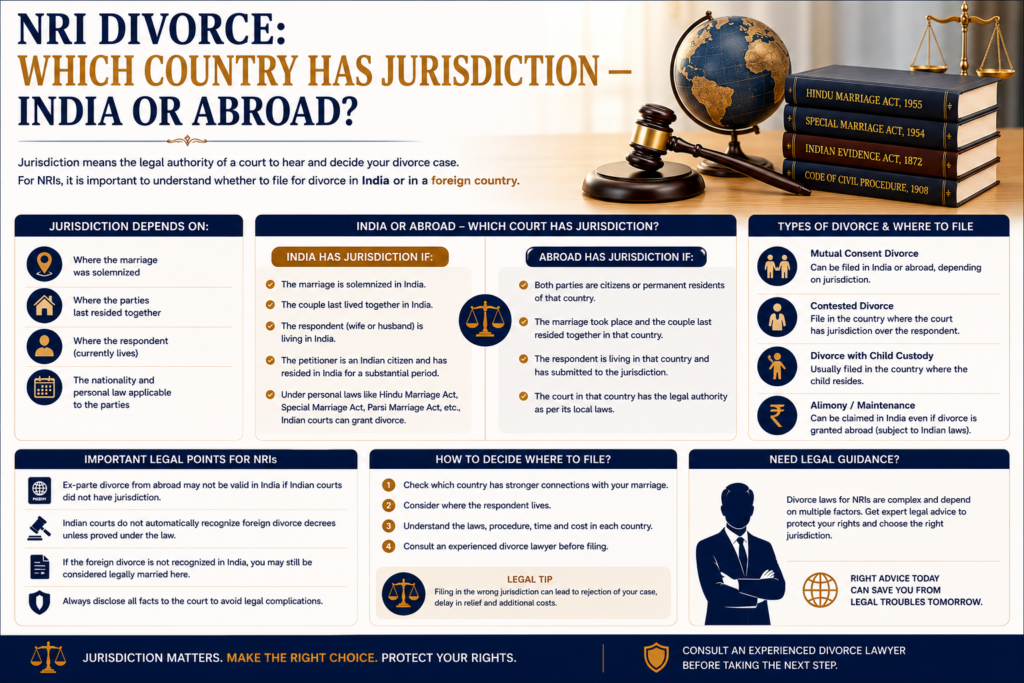
Jurisdiction simply means: which court has the legal authority to hear and decide your divorce case.
In India, jurisdiction for matrimonial matters is governed by:
- Hindu Marriage Act, 1955 (Section 19) — for Hindus
- Special Marriage Act, 1954 (Section 31) — for inter-religion or civil marriages
- Indian Divorce Act, 1869 — for Christians
- Dissolution of Muslim Marriages Act, 1939 — for Muslims
Each of these laws specifies where a petition can be filed — typically where the marriage took place, where the couple last lived together, or where the respondent currently resides.
For NRIs, this gets complicated because the foreign country also has its own jurisdiction rules — and both can apply simultaneously.
When Does India Have Jurisdiction Over an NRI Divorce?
India can claim jurisdiction in your divorce case if any of the following conditions are met:
- The marriage was solemnized in India
- Both husband and wife are Indian citizens (even if living abroad)
- The couple last lived together in India
- The respondent (the other spouse) is currently residing in India
- The wife is residing in India at the time of filing (under some acts)
Key Point: Indian courts do not require you to be physically present in India to file. An NRI can file a divorce petition in an Indian court — and the case will proceed even if one or both parties are abroad.
When Does a Foreign Country Have Jurisdiction?
A foreign court can claim jurisdiction over your divorce if:
- Both spouses are domiciled in that country (i.e., you have made it your permanent home)
- Both spouses are residents of that country for a specified period (varies by country)
- The marriage was registered in that country
- Both parties consent to that country’s jurisdiction
Country-Specific Rules (Common NRI Destinations)
USA: Jurisdiction is determined at the state level. Most US states require at least one spouse to be a resident for 6 months before filing. A US divorce decree is generally valid in the US but may not be automatically recognized in India.
UK: Either spouse must be domiciled in England/Wales, or habitually resident there for at least 1 year before filing. UK divorce decrees are often recognized in India if obtained by mutual consent.
Canada: At least one spouse must have been ordinarily resident in Canada for at least 1 year. Provincial laws also apply.
UAE / Gulf Countries: Sharia law applies for Muslims. For non-Muslims, the situation is more complex — often, the home country’s law applies. UAE divorce decrees are generally recognized in India for Muslims.
Australia: Either party must be an Australian citizen, ordinarily resident in Australia for 12 months, or domiciled in Australia. Australian mutual consent decrees are generally recognized in India.
The Big Question: Is a Foreign Divorce Decree Valid in India?
This is where most NRIs get confused — and where the stakes are highest.
When a Foreign Divorce Decree IS Valid in India
Under Section 13 of the Code of Civil Procedure, 1908, a foreign court judgment is recognized in India if it meets all of the following:
- It was pronounced by a court of competent jurisdiction
- It was decided on the merits of the case (not just on procedural grounds)
- It is not contrary to Indian law or public policy
- It was not obtained by fraud
- It does not violate natural justice (both parties had a fair opportunity to be heard)
Most importantly: mutual consent decrees obtained abroad are generally recognized in India — provided both parties genuinely agreed and participated in the proceedings.
When a Foreign Divorce Decree is NOT Valid in India
A foreign decree will not be recognized in India if:
- The foreign court had no jurisdiction (e.g., neither party was domiciled there)
- The decree was obtained ex-parte — meaning your spouse filed abroad without your knowledge and you were never properly served or heard
- The grounds for divorce do not exist under Indian law
- It was obtained by fraud or suppression of facts
- It violates Indian public policy
Warning: An ex-parte foreign divorce — where one spouse gets a “quickie divorce” abroad without the other knowing — is one of the most common and damaging situations in NRI matrimonial disputes. Indian courts routinely refuse to recognize such decrees.
The Most Common NRI Divorce Scenarios
Scenario 1: Both Spouses Are NRIs Living in the Same Country
Example: Married in India, both now living in the USA for 8 years.
Jurisdiction: Both USA and India have jurisdiction. The couple can choose where to file. A US mutual consent divorce can be recognized in India. An Indian petition can also be filed simultaneously.
Best approach: File mutually in the country where you reside. Ensure the decree is documented carefully for Indian recognition.
Scenario 2: One Spouse Is in India, One Is Abroad
Example: Husband in the USA, wife in India.
Jurisdiction: Both countries have jurisdiction. The Indian spouse can file in an Indian family court. The foreign spouse can file in their country of residence.
Risk: Both may file simultaneously — leading to parallel proceedings. Indian courts can issue injunctions restraining the foreign filing. Foreign courts may do the same.
Best approach: Consult a lawyer in both countries immediately. Whoever files first often gains a strategic advantage.
Scenario 3: NRI Husband Gets a Divorce Abroad Without Wife’s Knowledge
Example: Husband in the UK gets a “quickie divorce” without informing the wife in India.
Jurisdiction issue: The UK court may have had jurisdiction over the husband — but the wife was never heard.
India’s position: Indian courts will very likely refuse to recognize this decree. The wife can challenge it and seek maintenance, property rights, and custody in India independently.
Best approach for wife: File immediately in an Indian family court. Seek an injunction. Consult a lawyer who specializes in NRI matrimonial disputes.
Scenario 4: Marriage Under the Special Marriage Act
Example: An Indian-origin couple married under the Special Marriage Act now living in Germany.
Jurisdiction: Section 31 of the Special Marriage Act allows petitions to be filed where either party resides — including in India. Indian courts retain strong jurisdiction over Special Marriage Act marriages regardless of where the parties live.
Scenario 5: NRI Wants to Remarry After Foreign Divorce
Example: NRI got divorced in Canada. Wants to remarry in India.
Critical question: Is the Canadian divorce recognized in India?
If the divorce was mutual, documented properly, and both parties participated — it is likely recognized. The person can remarry in India. However, it is strongly advisable to get a legal opinion in India confirming the recognition before attempting to remarry, to avoid bigamy complications.
Parallel Proceedings: When Both Countries Are Involved Simultaneously
One of the most complex situations in NRI divorce is when both spouses file in different countries at the same time — or even slightly different times.
What happens then?
- Indian courts will not automatically stay proceedings just because a foreign case has been filed
- Indian courts can issue anti-suit injunctions — ordering a spouse not to continue proceedings in the foreign court
- Foreign courts can do the same
- Whichever decree comes first does not automatically “win” — Indian courts will independently assess the foreign decree’s validity
- Child custody orders from foreign courts are particularly difficult — Indian courts apply the welfare of the child principle independently
Practical Reality: Parallel proceedings are extremely expensive, emotionally draining, and can take years to resolve. Avoiding this situation through early legal consultation and mutual agreement is always the better path.
Child Custody in NRI Divorce: A Special Concern
Child custody is arguably the most sensitive and legally complex aspect of NRI divorce. Key points:
- If the child is in India, Indian courts will decide custody based on the child’s welfare — regardless of what a foreign court has ordered
- If the child is abroad, the foreign court typically has jurisdiction — but India may still intervene if the child is an Indian citizen
- Parental child abduction — where one parent brings the child to India to gain custody advantage — is increasingly common in NRI disputes. Indian courts have varying responses
- India is not a signatory to the Hague Convention on international child abduction, which significantly complicates cross-border custody enforcement
Recommendation: If children are involved in an NRI divorce, retain specialized legal counsel in both countries immediately.
Maintenance and Alimony: Cross-Border Enforcement
Even if an Indian court awards maintenance to a spouse, enforcing it when the other party is abroad is difficult. Similarly, foreign alimony orders are not automatically enforceable in India.
Key points:
- Indian courts can pass maintenance orders under Section 125 CrPC regardless of the husband’s location
- Enforcement abroad depends on whether that country has a reciprocal enforcement treaty with India
- Many NRI wives in India face this exact problem — a maintenance order they cannot collect
- Some countries (UK, some US states) have mechanisms to enforce foreign support orders — but it requires separate legal action there
Comparison Table: India vs. Foreign Court — Key Differences
| Factor | Indian Court | Foreign Court |
|---|---|---|
| Jurisdiction basis | Marriage in India / Indian citizenship / last residence | Domicile / habitual residence in that country |
| Recognition in India | Automatically valid | Valid only if conditions under Section 13 CPC met |
| Ex-parte decree | Harder to obtain without proper service | Easier in some countries — but not recognized in India |
| Child custody | Welfare of child principle; child’s presence in India key | Foreign order may not be enforceable in India |
| Alimony enforcement | Enforceable in India | Requires separate enforcement action |
| Timeline | 6 months–5 years depending on type | Varies widely by country |
| Cost | Lower for Indian residents | Can be very high (especially USA, UK) |
| Best for | When wife/family is in India; Indian assets involved | When both spouses are settled abroad |
Recommended Legal Services for NRI Divorce
1. Quick Divorce
⭐ Rating: 4.8/5
Quick Divorce specializes in NRI divorce cases — handling everything from petition drafting and court filing in India to coordinating with foreign counsel. Their team has handled hundreds of NRI mutual divorce cases.
Pros:
- Specialized NRI divorce expertise
- Full process handled remotely — no India visit required for most steps
- Hindi & English support
- Coordinates with lawyers abroad
- Transparent, affordable pricing
Cons:
- Court appearances may still be required for certain hearings
Pricing: NRI Mutual Divorce starting at ₹14,999
Best for: NRIs who want to file for divorce in India without traveling back.
Frequently Asked Questions (FAQs)
Q1. Can an NRI file for divorce in India without coming back?
Yes. An NRI can file a divorce petition in an Indian family court through a lawyer acting under a Power of Attorney. For mutual divorce, both parties can give separate Powers of Attorney to their respective lawyers. Physical presence is typically required only for the final hearing — and even this can sometimes be waived by the court.
Q2. If I got divorced abroad, do I need to do anything in India?
If your foreign divorce is a mutual consent decree where both parties participated — it is generally recognized in India automatically under Section 13 CPC. However, it is strongly advisable to obtain a legal opinion confirming recognition, especially before remarrying or transferring Indian assets.
Q3. My spouse filed for divorce in the USA without telling me. What should I do?
Act immediately. Contact an NRI family law specialist in India. File a response in the US proceedings if possible. Simultaneously, file a petition in an Indian family court — Indian courts can independently adjudicate your rights regardless of the US filing. An ex-parte US decree that did not properly serve you will very likely not be recognized in India.
Q4. Which country is better to file in — India or abroad?
It depends entirely on your specific situation: where you both live, where your assets are, where your children are, and what outcome you are seeking. Generally: if significant Indian assets or property are involved, filing in India is important. If both spouses are settled abroad and in mutual agreement, filing in the country of residence is often faster. Always consult a lawyer in both jurisdictions before deciding.
Q5. Does India recognize divorce by mutual consent obtained in the USA?
Generally yes — if both parties genuinely participated, consented, and the US court had proper jurisdiction (at least one party was a resident). Keep all documentation: the divorce decree, proof of residence, and records showing both parties participated.
Q6. What happens to Indian property when divorce is filed abroad?
A foreign court cannot directly divide or transfer property located in India. For Indian property — land, house, bank accounts, investments — you will need a separate proceeding in an Indian court, or the foreign divorce settlement agreement must be registered and enforced in India through appropriate legal channels.
Q7. Can a wife in India stop her NRI husband from divorcing her abroad?
Yes. She can approach an Indian family court and seek an anti-suit injunction — a court order restraining her husband from pursuing divorce proceedings in a foreign court. This is a recognized legal remedy in India and has been granted in multiple High Court judgments.
Which Approach Should You Take?
This depends on your situation:
If both spouses are NRIs living in the same country and want mutual divorce: → File in your country of residence. Ensure the decree is documented for Indian recognition. Use Quick Divorce for any India-side formalities.
If one spouse is in India and one is abroad: → File in India through a lawyer on Power of Attorney. Do not wait for the foreign spouse to file abroad first.
If your spouse has already filed abroad without your knowledge: → Consult a specialist immediately. File in India. Challenge the foreign decree’s recognition.
If children or significant Indian assets are involved: → Always have Indian legal representation, regardless of where the primary divorce is filed.
If you just want to understand your options first: → LegalKart (₹499 consultation) with an NRI family law specialist is the right starting point.
Final Recommendation
NRI divorce is one of the most legally complex areas of Indian family law. The jurisdiction question alone can determine whether you lose or protect your rights — to property, alimony, and your children.
Do not assume that a foreign divorce automatically settles everything in India. And do not assume that because you are abroad, Indian courts cannot touch your case.
The single best thing you can do: get proper legal advice in both countries before taking any step.
For India-side NRI divorce assistance, Quick Divorce offers:
- Specialized NRI mutual divorce handling
- Complete Power of Attorney based process — no India visit needed for most steps
- Coordination with your foreign lawyer
- Hindi & English support
Speak to an NRI divorce specialist today. First consultation is free.
Need Help With NRI Divorce?
🟡 QuickDivorce.in provides complete NRI divorce legal services — settlement negotiation, alimony structuring, property division, stridhan recovery, MoU drafting, court representation, and post-decree implementation.
🟡Visit LegalTax.in for other Legal and Trademark related services as 👉 Money Recovery Cases
👉 Property Disputes 👉 Business & Licence Registrations
🟡Visit Business24hub for IT services
👉 Mutual Consent Divorce at QuickDivorce.in 👉 Contested Divorce Filing 👉 Child Custody and Maintenance 👉 Matrimonial Property Settlement 👉 NRI Divorce Services 👉 Alimony and Maintenance
🟡 Protect Your Rights 👉 Domestic Violence Legal Support at QuickDivorce.in 👉 Stridhan Recovery
📞 Call Now: +91 8595439395 🕐 Free Consultation: Monday to Saturday, 10 AM to 6 PM

I’m Aryan Yadav, passionate about SEO and Digital Marketing with a strong interest in helping businesses grow online. I enjoy learning new strategies, exploring digital trends, and creating ideas that deliver value. I believe in continuous growth, creativity, and building meaningful results through smart work and dedication.

