

Views: 6
Table of Contents
- 1 Introduction
- 2 Which Law Applies to Your Contested Divorce?
- 3 Grounds for Contested Divorce in India
- 4 Step-by-Step Procedure for Filing a Contested Divorce
- 5 Interim Reliefs During Contested Divorce Proceedings
- 6 Documents Required for Filing a Contested Divorce Petition
- 7 Timeline: How Long Does a Contested Divorce Take?
- 8 Can a Contested Divorce Be Converted to Mutual Divorce?
- 9 What Happens If the Respondent Does Not Appear in Court?
- 10 Appeal Against a Divorce Decree
- 11 Common Mistakes to Avoid in Contested Divorce Cases
- 12 Frequently Asked Questions
- 13 Conclusion
- 14 Need Help Filing for Contested Divorce? Talk to an Expert Today.
Introduction
A contested divorce is one where the two spouses cannot agree — either on the decision to divorce itself, or on the terms of separation such as alimony, child custody, or property division. Unlike mutual divorce, where both parties jointly approach the court, a contested divorce is initiated by one spouse against the other on specific legal grounds.
Contested divorce proceedings in India can be lengthy, emotionally demanding, and legally complex. Cases can take anywhere from 1 year to 5 years or more, depending on the complexity of the dispute, the court’s docket, and whether the parties attempt mediation at any stage.
This guide provides a complete, step-by-step walkthrough of how to file for contested divorce in India in 2026 — covering the legal grounds, the applicable laws, the procedure from filing to decree, interim reliefs, and the documents required.
Which Law Applies to Your Contested Divorce?
The law governing your contested divorce depends on your religion and the nature of your marriage:
- Hindu, Sikh, Buddhist, Jain couples: Hindu Marriage Act, 1955
- Couples married under civil law: Special Marriage Act, 1954
- Christian couples: Indian Divorce Act, 1869
- Parsi couples: Parsi Marriage and Divorce Act, 1936
- Muslim couples: Muslim Personal Law — dissolution of marriage through court under the Dissolution of Muslim Marriages Act, 1939 (for wife-initiated divorce); talaq-related matters governed by personal law and the Muslim Women (Protection of Rights on Marriage) Act, 2019
The procedure described in this guide primarily covers the Hindu Marriage Act, 1955, which is the most widely applicable statute. The procedure under other acts is broadly similar with minor differences in grounds and timelines.
Grounds for Contested Divorce in India
A contested divorce can only be filed on specific grounds recognised by law. Under the Hindu Marriage Act, 1955, the following grounds are available:
Grounds available to both husband and wife:
- Adultery: The respondent has had voluntary sexual intercourse with any person other than the petitioner after solemnisation of the marriage
- Cruelty: The respondent has treated the petitioner with cruelty — physical or mental — making it unreasonable to expect the petitioner to live with the respondent
- Desertion: The respondent has deserted the petitioner for a continuous period of at least 2 years immediately before filing the petition
- Conversion: The respondent has ceased to be a Hindu by converting to another religion
- Unsoundness of mind: The respondent has been of unsound mind continuously or intermittently, of such a kind and degree that the petitioner cannot reasonably be expected to live with them
- Virulent and incurable leprosy: The respondent is suffering from a virulent and incurable form of leprosy
- Venereal disease: The respondent is suffering from venereal disease in a communicable form
- Renunciation of the world: The respondent has renounced the world by entering a religious order
- Presumed death: The respondent has not been heard of as being alive for a period of 7 years or more
Additional ground available only to the wife:
- Rape, sodomy, or bestiality: The husband has been guilty of rape, sodomy, or bestiality after solemnisation of the marriage
Note: Cruelty is the most commonly pleaded ground in Indian contested divorce cases. Mental cruelty — including sustained harassment, humiliation, dowry demands, or domestic abuse — is recognised by courts as a valid ground even in the absence of physical violence.
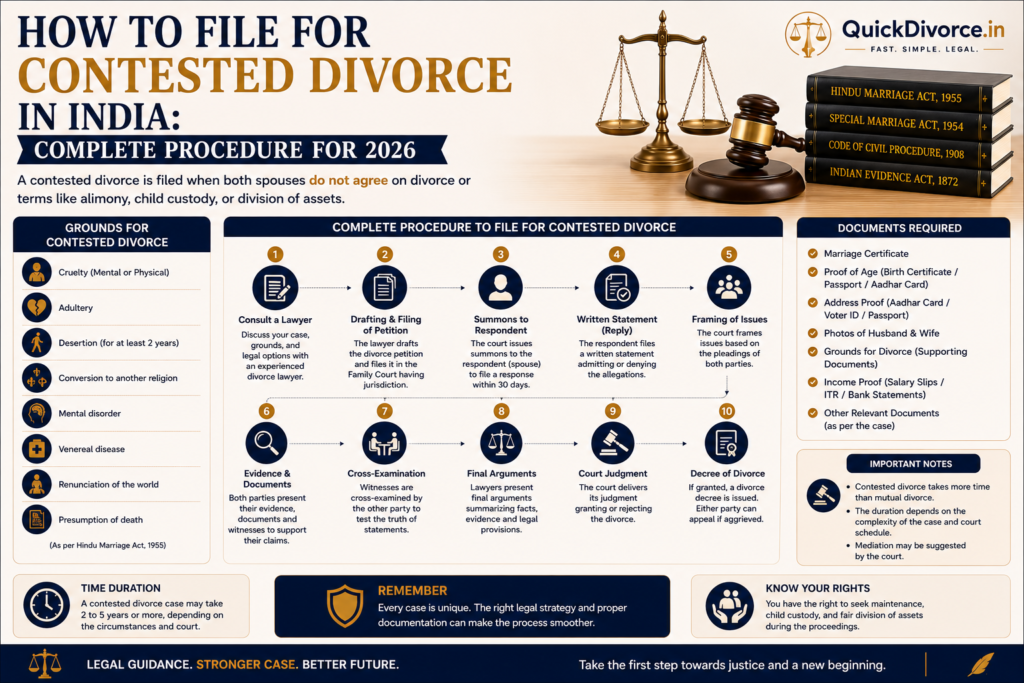
Step-by-Step Procedure for Filing a Contested Divorce
Step 1: Consult a Family Law Advocate
The first and most important step is engaging a qualified family law advocate. A contested divorce involves complex pleadings, court appearances, cross-examination of witnesses, and potentially multiple interim applications. Attempting to navigate this without legal representation significantly reduces the petitioner’s chances of a favourable outcome.
At the initial consultation, the advocate will assess:
- Which ground or grounds are available and strongest on the facts
- Which court has jurisdiction
- What documents and evidence are available to support the petition
- Whether interim reliefs such as maintenance or injunctions should be applied for immediately
- Whether mediation is worth attempting before or during the proceedings
Step 2: Identify the Court with Jurisdiction
The divorce petition must be filed in the Family Court (or District Court where a Family Court has not been established) that has jurisdiction. Jurisdiction is determined by:
- Where the marriage was solemnised, or
- Where the husband and wife last resided together, or
- Where the wife is currently residing, or
- Where the respondent currently resides
The petitioner may choose any one of these courts where jurisdiction exists.
Step 3: Draft and File the Divorce Petition
The advocate drafts the divorce petition, which is a formal legal document containing:
- Full particulars of the petitioner and respondent
- Date, place, and details of the marriage
- Details of children, if any
- The specific ground or grounds on which divorce is sought
- A detailed factual narrative supporting each ground pleaded
- The reliefs sought — divorce, maintenance, child custody, property, etc.
The petition is signed by the petitioner and filed at the Family Court along with the required documents and court fee. The court assigns a case number and schedules the first date of hearing.
Step 4: Service of Summons on the Respondent
After the petition is filed, the court issues summons to the respondent directing them to appear before the court on the scheduled date. Summons are typically served through:
- Registered post with acknowledgement due, or
- Court bailiff or process server, or
- Substituted service (newspaper publication or other means) if the respondent evades service or cannot be located
The respondent must acknowledge receipt of the summons. If the respondent evades service deliberately, the court can proceed ex parte after following the substituted service procedure.
Step 5: Respondent Files Written Statement
Once served, the respondent has the opportunity to file a Written Statement — their formal reply to the petition. The Written Statement may:
- Deny the grounds alleged by the petitioner
- Set up a counter-case or counter-allegations
- Raise preliminary objections on jurisdiction or maintainability
- File a counter-petition for divorce on their own grounds
The petitioner then has the right to file a Replication (reply to the Written Statement) to rebut any new facts raised by the respondent.
Step 6: Mediation (Mandatory Attempt)
Under Section 9 of the Family Courts Act, 1984, and various High Court rules, courts are required to attempt reconciliation or settlement between the parties before proceeding with the trial. The court will typically refer the matter to:
- A court-appointed mediator or counsellor, or
- A mediation centre attached to the court
If mediation succeeds and the parties agree to a settlement, the matter can be converted into a mutual divorce. If mediation fails, a failure report is submitted to the court and the matter proceeds to trial.
Step 7: Framing of Issues
After pleadings are complete, the court frames the Issues — the specific factual and legal questions that the trial must resolve. Issues are framed based on the petition, written statement, and replication. For example:
- Whether the respondent subjected the petitioner to cruelty as alleged?
- Whether the respondent deserted the petitioner for a continuous period of 2 years?
- Whether the petitioner is entitled to a decree of divorce?
- What, if any, maintenance is the petitioner entitled to?
Step 8: Evidence Stage — Examination of Witnesses
The trial proceeds with the recording of evidence. This is the most time-consuming stage of a contested divorce. The process is:
- Petitioner’s evidence: The petitioner files an affidavit of evidence (examination-in-chief) and produces documents. The respondent’s advocate cross-examines the petitioner and their witnesses.
- Respondent’s evidence: The respondent files their affidavit of evidence and produces documents. The petitioner’s advocate cross-examines the respondent and their witnesses.
Evidence may include documentary evidence (messages, emails, medical records, police complaints, photographs) and oral testimony of witnesses (family members, neighbours, doctors, etc.).
Step 9: Final Arguments
After evidence is complete, both advocates present their final arguments — oral submissions and written notes of argument — summarising the evidence and the law in support of their respective positions. The court may also call for written submissions.
Step 10: Judgment and Decree
After hearing final arguments, the court pronounces its Judgment. If the court finds in favour of the petitioner, it passes a Decree of Divorce dissolving the marriage. The decree also addresses ancillary reliefs such as:
- Permanent alimony and maintenance
- Child custody and visitation
- Division of matrimonial property
- Return of Stridhan
If the court finds against the petitioner, the petition is dismissed. Either party may appeal the judgment to the High Court.
Interim Reliefs During Contested Divorce Proceedings
Given that contested divorce proceedings can take years, the law provides for interim (temporary) reliefs that a party can apply for during the pendency of the case:
Interim Maintenance (Section 24, Hindu Marriage Act):
Either spouse who does not have sufficient independent income for their support and for the expenses of the proceedings can apply for interim maintenance. The court can order the other spouse to pay a monthly amount during the pendency of the case.
Interim Custody of Children:
The court can pass interim orders on who the children will live with during the pendency of the divorce proceedings, along with visitation arrangements for the other parent.
Injunction Orders:
The court can pass injunctions restraining either party from disposing of matrimonial assets, from harassing the other party, or from removing children from the jurisdiction.
Protection Orders under Domestic Violence Act:
If the petitioner (typically the wife) has faced domestic violence, she can simultaneously pursue remedies under the Protection of Women from Domestic Violence Act, 2005, including protection orders, residence orders, and monetary relief.
Documents Required for Filing a Contested Divorce Petition
Identity and Basic Documents
- Aadhaar Card of the petitioner — Mandatory
- PAN Card of the petitioner — Mandatory
- Passport / Voter ID / Driving Licence — Mandatory
- Proof of current residence of the petitioner — Mandatory
- Passport-size photographs of the petitioner — 4 to 6 — Mandatory
Marriage Documents
- Original or certified copy of Marriage Certificate — Mandatory
- Wedding photographs — Supporting
- Marriage invitation card — Supporting
Evidence Supporting the Ground for Divorce
- For cruelty: Medical records of injuries, police complaints (FIR or NC), photographs, WhatsApp / SMS messages, emails, recorded conversations (where legally obtained), witness statements
- For desertion: Proof of separate residence, correspondence attempting to resume cohabitation, witness testimony
- For adultery: Any documentary or circumstantial evidence — hotel bills, photographs, messages — establishing the ground (direct evidence is rarely available; courts accept circumstantial evidence)
- For mental illness or addiction: Medical certificates, hospital records, psychiatric reports
Financial Documents (for maintenance and alimony claims)
- Salary slips of both parties — last 3 to 6 months — Mandatory
- Income Tax Returns of both parties — last 2 to 3 years — Mandatory
- Bank account statements of both parties — last 6 months — Mandatory
- Property documents for any assets owned by either party — If applicable
Children’s Documents (If Applicable)
- Birth certificate(s) of the child or children — Mandatory
- School records or enrollment certificate — Supporting
- Medical records of children — If applicable
Court Documents
- Divorce Petition (drafted by advocate) — Mandatory
- Vakalatnama / Power of Attorney to the advocate — Mandatory
- Affidavit verifying the petition — Mandatory
- Court fee payment receipt — Mandatory
Timeline: How Long Does a Contested Divorce Take?
- Filing and service of summons: 1 to 3 months
- Filing of written statement and replication: 2 to 4 months
- Mediation attempt: 1 to 3 months
- Framing of issues: 1 to 2 months
- Evidence stage: 6 months to 2 years (depending on number of witnesses and court scheduling)
- Final arguments: 1 to 3 months
- Judgment: 1 to 6 months after arguments
Total estimated timeline: 2 to 5 years in most Family Courts. Courts in metropolitan cities with heavy dockets tend to take longer. Courts in smaller cities may be faster. Parties who cooperate on procedural matters and avoid unnecessary adjournments can shorten the timeline.
Can a Contested Divorce Be Converted to Mutual Divorce?
Yes — and this is one of the most important strategic options available to parties in a contested divorce. At any stage of the contested divorce proceedings, if both parties reach an agreement on all terms, the matter can be converted into a mutual divorce under Section 13B. This allows the parties to avoid a prolonged trial and obtain the decree much faster.
Many contested divorces in India are ultimately settled through negotiation or mediation and converted to mutual consent proceedings. Early settlement is almost always better for both parties — financially, emotionally, and in terms of time.
What Happens If the Respondent Does Not Appear in Court?
If the respondent is served with summons but fails to appear in court, the court can proceed ex parte — meaning it hears and decides the matter based only on the petitioner’s evidence and arguments. An ex parte decree of divorce can be passed against the absent respondent.
However, the respondent retains the right to apply to set aside the ex parte decree if they can show sufficient cause for their non-appearance. The court will consider such applications on their merits.
Appeal Against a Divorce Decree
Either party — whether the decree was passed in their favour or against them — has the right to appeal the Family Court’s judgment to the High Court. The appeal must generally be filed within 90 days of the date of the decree. The High Court may affirm, modify, or reverse the Family Court’s order. Further appeal to the Supreme Court is also available in appropriate cases.
Common Mistakes to Avoid in Contested Divorce Cases
- Filing on a weak or unsupported ground: The ground pleaded must be supported by evidence. Filing on a ground that cannot be proved leads to dismissal of the petition.
- Not preserving evidence early: Evidence such as messages, emails, photographs, and medical records must be preserved from the very beginning. Evidence deleted or lost before the case is filed cannot be recovered.
- Delaying the filing of interim maintenance application: If you need financial support during the proceedings, apply for interim maintenance at the earliest opportunity — ideally at the time of filing the main petition.
- Agreeing to unnecessary adjournments: Every adjournment adds months to the timeline. Both parties should instruct their advocates to minimise adjournments and keep the case moving.
- Ignoring mediation: Many parties resist mediation out of anger or principle. Mediation that results in a negotiated settlement is almost always better than a contested trial — faster, cheaper, and less traumatic for all involved, especially children.
- Social media activity during proceedings: Posts, photographs, and statements on social media during pending divorce proceedings can be used as evidence against you. Exercise extreme caution with what you post online.
- Making unilateral decisions about children: Do not relocate children, change their school, or restrict the other parent’s access without a court order. Such actions can count against you in custody proceedings.
Frequently Asked Questions
![]()
![]() 1. What is a contested divorce in India?
1. What is a contested divorce in India?
A contested divorce is a legal proceeding where one spouse seeks a divorce but the other spouse does not agree, or where disputes exist regarding alimony, child custody, maintenance, or property division. The court decides the matter after examining evidence and hearing both parties.
2. On what grounds can a contested divorce be filed?
A contested divorce may be filed on grounds such as cruelty, adultery, desertion, mental disorder, conversion of religion, renunciation, or any other ground recognized under the applicable personal law.
3. Can I file for divorce without my spouse’s consent?
Yes. A contested divorce does not require the consent of the other spouse. However, the petitioner must prove a legally valid ground for divorce before the court.
4. Which court has jurisdiction to hear a contested divorce case?
A contested divorce petition is usually filed before the Family Court having jurisdiction over the place where the marriage was solemnized, where the couple last resided together, or where the respondent currently resides.
5. What documents are required for a contested divorce?
Commonly required documents include the marriage certificate, identity and address proofs, photographs, evidence supporting the grounds for divorce, financial records, and documents relating to children, if applicable.
6. How long does a contested divorce take in India?
The duration varies depending on the complexity of the case, court workload, and cooperation of the parties. Most contested divorce cases take anywhere from 2 to 5 years or more.
Conclusion
A contested divorce is one of the most challenging legal proceedings an individual can face — emotionally, financially, and practically. The process is long, the legal standards are demanding, and the personal stakes are extremely high. But with the right legal representation, a clear understanding of the procedure, and a commitment to preserving and presenting your evidence effectively, a contested divorce can be navigated successfully.
Where at all possible, explore settlement and mediation at every stage. A negotiated resolution that converts the contested matter into a mutual divorce is almost always better for both parties — and critically, for any children involved.
Know your legal rights. Preserve your evidence. Get expert legal representation from day one. And approach this process with the resolve and the information you need to protect your future.
Need Help Filing for Contested Divorce? Talk to an Expert Today.
QuickDivorce.in provides complete legal support for contested divorce proceedings — from petition drafting and evidence strategy to interim maintenance applications, child custody, and final decree. Our experienced family law advocates handle your case with speed, expertise, and complete confidentiality.
🟡Visit LegalTax.in for other Legal and Trademark related services as 👉 Money Recovery Cases
👉 Property Disputes 👉 Business & Licence Registrations
🟡Visit Business24hub for IT services
👉 Mutual Consent Divorce at QuickDivorce.in 👉 Contested Divorce Filing 👉 Child Custody and Maintenance 👉 Matrimonial Property Settlement 👉 NRI Divorce Services 👉 Alimony and Maintenance
🟡 Protect Your Rights 👉 Domestic Violence Legal Support at QuickDivorce.in 👉 Stridhan Recovery
📞 Call Now: +91 8595439395 🕐 Free Consultation: Monday to Saturday, 10 AM to 6 PM

Adv. Manish Kashyap is a Family Law & Divorce Lawyer with extensive experience in Mutual & Contested Divorce, NRI Divorce, Child Custody, Alimony, Domestic Violence, Judicial Separation, and Family Court matters, providing professional legal guidance to clients.

